الغرافيتي تواجه الطائرات الأمريكية دون طيار

cnn arabia

الغرافيتي تواجه الطائرات الأمريكية دون طيار

الاثنين، 02 كانون الأول/ديسمبر 2013، آخر تحديث 16:32 (GMT+0400)

دبي، الإمارات العربية المتحدة (CNN) — تحلق طائرة أمريكية دون طيار فوق العاصمة اليمنية، صنعاء، لكنها ليست طائرة آلية حقيقية، بل رسم غرافيتي، أعرب فيه طفل يمني عن استيائه بعبارة “لماذا قتلتم أسرتي؟” في أحدث أساليب الاحتجاج والتذمر في اليمن، بجانب الشعر، من الضربات الجوية التي تلتزم إدارة واشنطن الصمت التام حيالها.

والغرافيتي المرسوم على حائط بصنعاء، بجانب ثلاث رسومات آخرى تستهجن استخدام الولايات المتحدة هذا النوع من الطائرات الآلية لتعقب وتصفية العناصر الإرهابية في اليمن، من أعمال الفنان اليمني “مراد سبيع”، وهي جزء من حملة “12” ساعة التي أطلقها لتسليط الضوء على 12 مشكلة تواجه اليمن منها: انتشار الأسلحة، والطائفية والاختطاف والفقر، وكانت الطائرات الأمريكية دون طيار هي المشكلة الخامسة الأكثر إلحاحاً.”

ونقلت مجلة “التايم” الشقيقة لـCNN، عن السبيع، 26 عاما،  قوله: الغرافيتي أو فن الشوارع في اليمن أداة جديدة للتواصل مع الناس.. خلال ثانية واحدة يمكنك إيصال رسالة.”

والسبيع الذي بدأ رسومات الغرافيتي على ضوء انتفاضة اليمن التي أطاحت بالرئيس السابق، ساهم في تطوير حركة الغرافيتي المناهضة للحكومة.

وتعالت الأصوات المناوئة لاستخدام الطائرات بدون طيار في اليمن، التي تزايد زخمها مع تولي الرئيس الأمريكي، باراك أوباما، السلطة، وهي عمليات نادرا ما يقر المسؤولون الأمريكيون بها ورغم ذلك أثارت جدلا دوليا واسعاً على الصعيد الأخلاقي والقانوني ومدى فعاليتها.

ويقول المؤيدون إن البرنامج وسيلة فاعلة للتصدي لتنظيم القاعدة في شبه الجزيرة العربية، والمتمركز في اليمن، وأقر الرئيس اليمني، عبد ربه منصور هادئ بالتعاون الأمريكي اليمني في مجال مكافحة الإرهاب و”الدقة العالية” للطائرات الآلية.

وبالمقابل، يرى المناهضون ومن بينهم منظمات حقوقية وعائلات ضحايا بأن عمليات الطائرات بدون طيار أوقعت ما بين 21 و 56 مدنيا قتيلا.

كما لجأ اليمنيون إلى “سلاح” آخر بمواجهة الطائرات الأمريكية وهو الشعر، وقال براء شيبان، الناشط اليمني ومنسق حركة “ربيريف” الحقوقية البريطانية، إن المنظمة نظمت مسابقة شعرية مناهضة للطائرات دون طيار، رصدت لها جائزة قدرها 600 دولار، أي واحد في المائة من ثمن صاروخ “هيلفاير” الذي تستخدمه هذا النوع من الطائرات، طبقا للمصدر.

رابط الموضوع..

“Le Maghreb” Journal

جريدة المغرب

ثقافة و فنون

شباب يمنيون يحاربون الطائفية بالغرافيتي في شوارعهم

السبت 01 فيفري 2014 
| بقلم: جريدة المغرب

نفذ فنانون يمنيون شباب حملة مناهضة للحرب المذهبية التي عصفت بالبلاد، وقام الفنانون الشباب برسم لوحات جدارية في أحد أهم شوارع صنعاء لحشد الرأي العام لوقف هذه الحرب، في سياق برنامج

استهدف العديد من الظواهر السلبية التي يعاني منها المجتمع اليمني.

ويقول مراد سبيع فنان تشكيلي رائد في حملة 12 للرسوم الجرافيتية في شوارع المدن اليمنية «نحن نناقش قضية الحروب يعني بنتكلم على يدين بتشارك في نزع زناد قنبلة كما سيظهر في يد جداريتي فقط في عبارة تقول يا أيادينا لا تشاركي في حروبهم ضدنا هي ليست حروبنا».

Continue reading ““Le Maghreb” Journal”

جريدة “السفير” اللبنانية، في عمودها “بألف كلمه” عن حملة “12 ساعة

آخر تحديث الثلاثاء 28 ك2 2014 19:34
ضدّ الحرب الأهلية، الحلقة السابعة من حملة “12 ساعة” في اليمن – حنان الصرمي (تصوير عبدالكريم المؤيد )

الرابط..

جريدة “السفير العربي”، في عمودها “بألف كلمه” عن حملة 12 ساعة

آخر تحديث الثلاثاء 28 ك2 2014 19:34
ضدّ الحرب الأهلية، الحلقة السابعة من حملة “12 ساعة” في اليمن – ذي يزن العلوي (تصوير عبدالكريم المؤيد )
 

الرابط..

جريدة “السفير العربي”، في عمودها “بألف كلمه” عن حملة 12 ساعة

آخر تحديث الثلاثاء 28 ك2 2014 19:34
ضدّ الحرب الأهلية، الحلقة السابعة من حملة “12 ساعة” في اليمن – مراد سبيع

 الرابط..

Yemen: da detenuti politici scomparsi ai droni… murales di denuncia colorano Sana’a

wiiu


Yemen: da detenuti politici scomparsi ai droni… murales di denuncia colorano Sana’a

Aki, 31 ottobre 2013


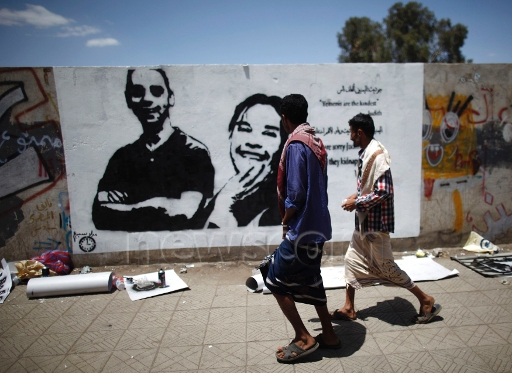
I ritratti dei prigionieri politici scomparsi, con nomi e data della loro ultima apparizione, sono apparsi, uno di fianco all’altro, sui muri dell’università di Sana’a come in altre città dello Yemen. È l’opera dell’artista di strada Murad Sobay, 26 anni, che con la sua campagna “I muri ricordano i loro volti” ha ritratto i detenuti politici di cui si sono perse le tracce, dagli anni Settanta alla rivoluzione contro l’ex presidente Ali Abdullah Saleh nel 2011. “Il significato della parola ‘murò è cambiato. Un muro era una prigione, una barriera. Oggi un muro è un mezzo per esprimersi, un muro ispira. I muri conservano la memoria dei detenuti politici scomparsi meglio di quanto possa fare la gente”, ha spiegato Sobay. Partita da lui, la campagna si è estesa nello Yemen e ha coinvolto altri artisti invitati a “Colorare i muri della vostra strada”. Oltre che dei detenuti politici, i murales denunciano anche azioni settarie, il rapimento di stranieri e i raid condotti con droni americani nel Paese. “Dopo la rivoluzione, ho notato che gli yemeniti erano abbattuti per la guerra, la situazione nel Paese. Ho trovato gli edifici e le strade piene di proiettili, danneggiati. Così sono andato su Facebook e annunciato che sarei andato in strada a dipingere e il giorno dopo l’ho fatto”, ha detto Sobay. “L’arte di strada ha una straordinaria capacità di mettere in luce un problema. Questioni come il settarismo non necessitano di letture di un’ora. Con l’arte di strada si comprendono in un secondo”, ha spiegato.

Link..

YEMEN: Yemeni artists take their work to Sanaa’s streets

ITN Source

YEMEN: Yemeni artists take their work to Sanaa’s streets, spraying graffiti on the city’s walls in a bid to express public outrage over U.S. drone strikes in the country

Yemeni artists have turned a Sanaa wall into a canvas for their artwork, to express their outrage over U.S. missile attacks in their country. Spray-painting drones and war motifs on the wall, the artists said they were speaking out against the killings of innocent civilians. “American aircraft enter Yemen in order to fight terrorism – at least that’s what they say. But in reality, they themselves are the terrorists, killing innocent people inside Yemeni territory,” said artist Hadeel al-Mowaffaq, as she painted a drone flying over a peace dove. U.S. officials say that any drone strikes in Yemen are very carefully targeted and that civilian casualties have been kept to a bare minimum, possibly in the low dozens. But the artists said the killings were unjustified. “Drones have killed dozens of innocent people: children, women and men. They had nothing to do with any terrorism,” said Murad Subai. Last month, human rights groups accused the United States of breaking international law and perhaps committing war crimes by killing civilians in missile and drone strikes that were intended to hit militants. Human Rights Watch said they had found violations of international law when civilians were “indiscriminately” killed in Yemen. In a September 2, 2012, attack, the target – an alleged al Qaeda militant, Abd al-Raouf al-Dahab, – was “nowhere in sight” when the United States hit a passenger van and killed 12 people returning from the market, they said. Similarly, on December 17, 2009, an attack by as many as five U.S. Navy cruise missiles struck a Yemeni hamlet, killing what the Yemeni government initially described as 34 “terrorists” at a training camp. However, Human Rights Watch said a Yemeni government inquiry later established that although 14 fighters for al Qaeda’s Yemeni affiliate were killed in the attack, so were at least 41 civilians, including nine women and 21 children. One man who has first-hand experience of such attacks is Mohammad al-Qawli, whose brother Ali was killed by a drone strike. “Now, we see them (the drones) as horror and murder tools. Every time we hear them buzzing, the children run for shelter, fearing an air strike,” said al-Qawli as he took a photograph of the motifs painted on the wall. Local human rights groups say the attacks are counter-productive, and only serve to fuel a rise in al Qaeda recruits. “On the security side, they (drone strikes) outrage society and leave people wanting revenge against the government and against the U.S. authorities. Also, dozens of young men in fact joined al Qaeda after air strikes in some areas,” said Mohammad al-Ahmadi of the al-Karama rights watchdog. U.S. drone strikes in Pakistan and Yemen increased dramatically after President Barack Obama took office in 2009, and the pilotless aerial vehicles became a key part of the fight against al Qaeda. More recently, the number of strikes has slowed. The United States has also used drones over Afghanistan, Somalia, Libya, and Iraq, and this year received approval to base drones in Niger.

(COPYRIGHT: REUTERS)

SANAA, YEMEN (OCTOBER 31, 2013) (REUTERS) PEOPLE WATCHING AS ARTISTS PAINT WALL ARTIST PAINTING DRONE VARIOUS OF ARTISTS PAINTING ON WALL PEACE DOVE MOTIF (SOUNDBITE) (Arabic) ARTIST, HADEEL AL-MOWAFFAQ, SAYING: “American aircraft enter Yemen in order to fight terrorism – at least that’s what they say. But in reality, they themselves are the terrorists, killing innocent people inside Yemeni territory.” ARTIST SPRAY-PAINTING MOTIF WALL ARTWORK ON WALL SHOWING DRONE IN SKY, CHILD BELOW AND SLOGAN (English and Arabic): ‘WHY DID YOU KILL MY FAMILY?’ DRONE PAINTED ONTO WALL (SOUNDBITE) (Arabic) ARTIST, MURAD SUBAI, SAYING: “Drones have killed dozens of innocent people: children, women and men. They had nothing to do with any terrorism.” PEOPLE GATHERED ROUND AS ARTISTS PAINT WALL VARIOUS OF ARTIST PAINTING CHILD PLAYING PAINTING SHOWING MISSILE HEADING TOWARDS CHILD CROWD WATCHING ARTISTS PAINT WALL SANAA, YEMEN (NOVEMBER 2, 2013) (REUTERS) VARIOUS OF PEOPLE WALKING IN OLD CITY OF SANAA WALL COVERED IN PAINTINGS VARIOUS OF MAN TAKING PHOTO OF DRONE PAINTING DRONE MOTIF PAINTED ON WALL (SOUNDBITE) (Arabic) BROTHER OF MAN KILLED BY DRONE STRIKE, MOHAMMAD AL-QAWLI, SAYING: “Now, we see them (the drones) as horror and murder tools. Every time we hear them buzzing, the children run for shelter, fearing an air strike.” WALL COVERED IN PAINTINGS TRAFFIC ON STREETS (SOUNDBITE) (Arabic) SANAA RESIDENT, AHMAD AL-SHARAFI, SAYING: “Those American drones are interfering in the internal affairs of the country, and we reject this interference, we reject it because they strike civilians.” MEN STANDING IN STREET, TALKING (SOUNDBITE) (Arabic) LEGAL COORDINATOR OF AL-KARAMA RIGHTS WATCHDOG, MOHAMMAD AL-AHMADI, SAYING: “On the security side, they (drone strikes) outrage society and leave people wanting revenge against the government and against the U.S. authorities. Also, dozens of young men in fact joined al Qaeda after air strikes in some areas.” VARIOUS OF PEOPLE WALKING IN OLD CITY OF SANAA

Link..

تشكيليون يطلقون حملة ضد العنف من خلال الرسم على الجدران

300px-Althawra_news_paper_yemen

فنانون تشكيليون يطلقون حملة ضد العنف من خلال الرسم على الجدران

الأربعاء, 22-يناير-2014

يتظم مجموعة من الفنانين التشكيليين حملة احتجاج على أعمال العنف في البلد من خلال لوحات يرسمونها على الجدران في شوارع العاصمة صنعاء. ويسعى الرسامون إلى تسليط الضوء على خطورة الوضع الأمني الذي قد يهدد باندلاع حرب أهلية. ويقود الحملة الرسام اليمني المبدع مراد سبيع الذي سبق وقام بحملات رسوم على الشوارع مثل “المخفيين قسريا” وغيرها في كل المدن وآخرها حملة للمطالبة بإطلاق سراح صحفية هولندية خطفت، وقال سبيع: المجتمع اليمني ليس له دخل بحروب هؤلاء الساسة وأمراء الحروب. نحن نريد أن نوجه رسالة لكل المجتمع اليمني. نحن لا ندخل في حروبهم وهنا سيفقدون الأذرع.. سيفقدون الأيدي التي يحتاجونها لتنفيذ أجندتهم.
وتستوقف الرسوم الجدارية المارة في شوارع صنعاء بينما يؤكد الفنانون المشاركون في الحملة أهمية التعبير عن الاحتجاج بهذا الأسلوب الملفت للأنظار. وقال رسام يدعى ذو يزن العلوي: نحن نقوم بإرسال رسائل للناس بخطورة الحروب الأهلية وما تؤدي إليه من كوارث إنسانية كبيرة، حملة احتجاج من خلال الرسم في الشوارع يشارك فيها عدداً من الفنانات منهن حنان الصرمي التي تحدثت عن أهوال الحرب والصراعات.
وقال: الحرب الأهلية بشكل عام تضيع فيها دماء اليمنيين ضمن مصالح أخرى. والحرب بشكل عام لا تناسب طبيعة البشر لما فيها من ضحايا كثيرة ودمار للمباني والبيوت وضياع في الأموال وما تسببه من اضطرابات وقلق للشعب نفسه.

رابط الموضوع..

The Coward’s War: the artist. By: Victoria Fontan

Picture
Murad Subay, 7th Hour, Twelve Hours Campaign, Sana’a

He is painting graffiti on a wall opposite a westernized shopping mall. All major media networks are there, Reuters, Al-Arabiya, Agence France Presse, they try to capture his attention as they are buzzing around him: “Murad, here please,” “Murad, Murad!,” “Hello Murad, can you explain what you doing;” a fixer approaches him as he tries to concentrate: “Murad, my client would like a bit of time to interview you later, can you make it?”… If twenty-seven year-old Murad Subay is a star, he does not behave like one. He does not see the circus going on around him as a disturbance, he embraces it and makes it part of his work. A self-made artist, he is painting to raise awareness on certain issues, and he channels the attention from his own person to the message he is trying to spread, both locally and globally. It is clear, vivid, uncompromising: two hands hold a hand-grenade circular safety pin, ready to undo it, a sentence is written both in Arabic and English “Our hands… Do not participate in their wars against us.”It all started in 2011, after the civil war that opposed dictator Ali Abdullah Saleh and other tribes, an offset of the “Arab Spring” which could well have transformed Yemen into another Syria. As opposed to Syria, the Yemeni dictatorship was backed by the US, and only a cosmetic change occurred: Saleh’s Prime Minister was elected in office with 99.6% of the vote.(1) Murad explains: “the city bore the scars of the clashes, so I went out and started to paint over them. After one week, people started to come and paint with me. Parents sent me their children, even soldiers put their weapons down and took brushes instead.” The Color the Walls of Your Street campaign was born. After to months, all major cities in Yemen took the initiative, colors appeared in Aden, Ta-az, Ebb, and Hodeidah. The campaign received international coverage, and was very well received by the Yemeni population.As Murad learned stencil art, his second campaign was planned. For some, it took a political turn, yet Murad stresses that it is not his aim: “we are not politicians and we don’t have power to stop what is happening to our country. The only thing we can do is making noise around important issues.” During seven months, every Thursday, faces of people “disappeared” by the government, some since the 1960s, were painted all over Sana’a and other towns. Next to the faces, the date of the disappearance, and the idea that no one can vanish from public view. Walls became a symbol of hope, of unity, not only for the disappeared but also their families, which were brought at the core of public spaces.

The Walls Remember Their Faces campaign had a decisive impact. Maybe the US embassy asked that its puppet “ally” throw a bone to its people… Four months after the campaign started, Mutar Aleriani was released. He had been disappeared since 1981. He was tortured so badly with a drill that he can no longer move his legs. Confined to a wheelchair, he is not being looked after by his daughters. Murad met him in Hodeidah, his words against US ally Abdullah Saleh were understandably very harsh. Murad explains how the campaign has brought humanity onto the whole issue; meeting Mutar had a huge impact on him.

Murad realizes that he cannot design a campaign for all the issues that Yemen is facing right now. He is not financed, and rejects all offers of help from international organizations, including the UN. He says that he needs to remain independent, so that the impact of his campaigns cannot be compromised: “the supplies could be coming from [not so benevolent neighbors] Saudi Arabia or Iran, we just cannot allow that.” Everyone who turns up brings their own supplies, and people who are part of the network also donate items randomly. Murad is his own complex adaptive system.(2)

Paintings speak louder than academic lectures. Murad’s Twelve Hour campaign is now famous around the world for its coverage of the drones issue. A little boy writes right below a drone: “why did you kill my family.” This question is timely: many children in Yemen are asking themselves the question, day in, day out. Chances are that Westerner meeting them will be asked, just like I was.(3) Another painting by Hadel Almowafak represents a Tao symbol, on top the drone, and at the bottom a dove: the vivid imagery of Liberal Peace, the peace that kills innocents, the peace that I teach as pat of the UN.

The drones representations figure in Murad’s Twelve Hours Campaign. Each hour of a clock brings in a new issue that Yemen is facing: weapons, sectarianism, kidnappings, poverty, and internal strife. Will one of the hours focus on Barack Obama’s war secret war against Yemen?(4)  Murad’s stencils ought to reach the streets of Washington, D.C., New York and San Francisco, so that Yemenis would no longer be disappeared from the world’s view.(5) We often ask ourselves what we can in the face of injustice. Murad gives us a plain answer: noise.

(1) See http://www.nytimes.com/2012/02/25/world/middleeast/yemen-to-get-a-new-president-abed-rabu-mansour-hadi.html, accessed on January 20th 2014.

(2) See Decolonizing Peace, chapter 3.

(3) Please circulate: https://www.youtube.com/watch?v=Un0vxahkYFM

(4) See http://dirtywars.org

(5) For more information on Murad Subay and Hadel Almowafak, see: https://muradsubay.wordpress.com andhttp://hadeelalmowafak.wordpress.com

Link..

“12 Hours” graffiti campaign

بجوار صديقتي “الساعه الأولى”

تصوير الصحفيه Lucy Kafanov

Me and my first mural in the “12 Hours” graffiti campaign.

Photo by: Lucy Kafanov

BYGd6BLIIAEuzUa