
لقائي مع قناة “TMNews” الإيطالية، أثناء حملة “لون جدار شارعك” قبل حوالي ثلاثة أعوام.
On “TMNews” Italian Chanal, during “Color your street’s wall”campaign, three years ago.
________
Roma, (TMNews) – L’arte diventa lo strumento ideale per voltare pagina dopo la rivoluzione nello Yemen. Mourad Subai, che prima aveva riempito i muri della capitale Sanaa con scritte e slogan politici, ha ora deciso di sostituirli con murales e opere d’arte. I suoi graffiti, infatti, ora decorano i muri della città. Un modo, secondo il giovane artista 24enne, di far cambiare idea al popolo, che si lascia alle spalle un anno di profonda crisi politica. “Il popolo yemenita è stato profondamente coinvolto nella politica degli ultimi mesi. L’unico tema di discussione era la politica. Allora ho pensato che l’arte poteva essere il solo modo di allontanare gli eventi politici e di far pensare ad altre cose”.I murales di Mourad decorano anche quartieri come questo, dove sostenitori e oppositori dell’ex presidente Saleh si sono spesso scontrati.Nello Yemen non c’è alcuna legge che impedisce l’arte di strada. E Maourad ha tutta l’intenzione di continuare nella sua opera.
Category: News

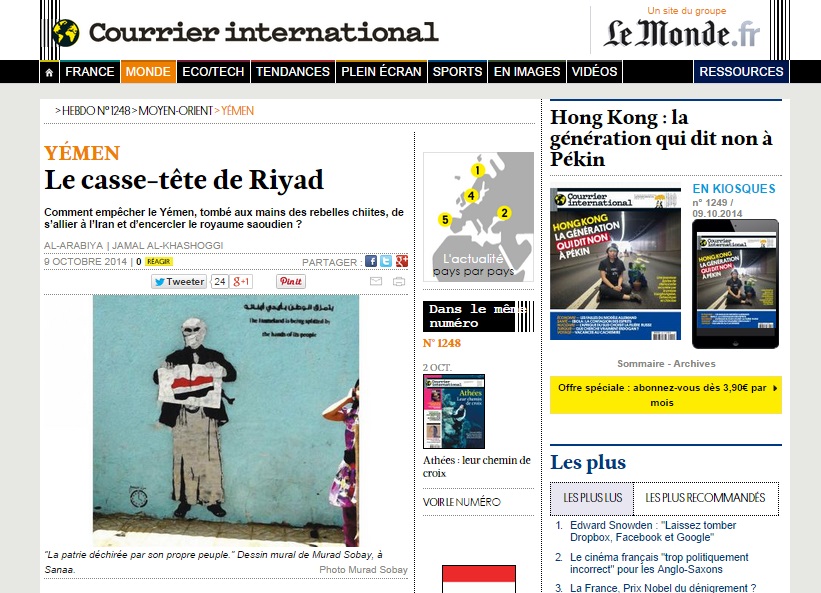
“الوطن يتمزق بأيدي أبنائه” “La patrie déchirée par son propre peuple.”
“الوطن يتمزق بأيدي أبنائه”
“La patrie déchirée par son propre peuple.”
صوره لجدارية “العبث بوطن” على الموقع الفرنسي “الليموند، كورير إنترناشيونال”
Photo of “Tempering with our Homeland” on “Le Monde, Courrier international”
Share this:

Yemen. I graffiti politici che risvegliano le coscienze\By: Anna Toro
Yemen. I graffiti politici che risvegliano le coscienze
Una serie di murales per raccontare le questioni cruciali che affiggono il paese: l’idea è del giovane Murad Subay, artista e attivista che in questi ultimi anni il pubblico ha imparato a conoscere come il “Banksy yemenita”, grazie alle sue campagne politiche e sociali a suon di spray e colori per le piazze e strade della capitale.
L’ultima, le cui immagini hanno fatto il giro del mondo, si chiama “12 hours” (Dodici ore) e mira a evidenziare i “mali” dello Yemen, incentrando ogni ora dell’orologio su un tema diverso: dal settarismo al rapimento degli stranieri, dall’incarcerazione degli oppositori politici agli attacchi dei droni statunitensi nel paese.
“Dopo la rivoluzione – scrive Subay – mi sono reso conto che l’anima del popolo yemenita era frantumata a causa della guerra e della situazione all’interno del paese. Ho visto che gli edifici e le strade erano danneggiati e pieni di proiettili. Così sono andato su Facebook e ho detto che il giorno dopo sarei andato in piazza a dipingere. E così ho fatto”.
Alla chiamata su Facebook è seguita una massiccia risposta da parte dei cittadini, che si sono recati fuori con Subay e l’hanno aiutato a dipingere le pareti con potenti messaggi su governo, politica e ingiustizie sociali.
Lo scopo dell’artista, pienamente riuscito, è infatti coltivare la consapevolezza dei problemi in modo pacifico e partecipativo. E quale mezzo più immediato per arrivare al cuore della gente, se non i colori, l’arte e la strada?
Così, grazie a questa campagna durata un intero anno, dalle pareti hanno preso vita le tante ferite della storia yemenita degli ultimi 30 anni, visibili da tutti, e perciò diventate un atto di resistenza e di protesta. Non a caso, è capitato che diverse opere di Subay fossero state rimosse, rovinate o coperte.
La prima ora della campagna, ad esempio, è dedicata al problema della violenza armata in Yemen, un paese che, secondo i dati 2012 di Aljazeera, ha il secondo più alto tasso di possesso di armi nel mondo.
La seconda ora affronta invece il tema del settarismo, lo scontro tra sciiti e sunniti che da tempo provoca tensioni tra le due sette religiose. La popolazione dello Yemen, infatti, è divisa tra circa il 45% musulmani sciiti e il 55% di musulmani sunniti, il cui divario ha portato negli ultimi tempi a manifestazioni di odio, fanatismo, e rivolte.
La terza ora racconta delle sparizioni forzate, di arresti e carcerazioni di cui il governo continua a negare il suo coinvolgimento. In realtà si tratta di veri e propri rapimenti di stato, un tema che l’artista aveva precedentemente affrontato nella campagna creativa “The walls remember their faces” (I muri ricordano i loro volti) in cui i volti delle persone disperse apparivano sulle strade accanto al luogo e la data della loro scomparsa, scritti in arabo e in inglese.
Anche quella volta il successo di partecipazione da parte del pubblico era stato enorme.
Toccanti ed evocativi i graffiti dedicati al problema dei droni statunitensi nei cieli yemeniti, con le loro vittime civili “collaterali”, fonte di traumi e terrore per la popolazione.
Secondo una ricerca dello psicologo forense inglese Peter Schaapveld, ben il 92 per cento del campione di popolazione da lui esaminata è risultato essere affetto da disturbo da stress post-traumatico, che colpisce soprattutto donne e bambini. Si parla infatti di “un’intera generazione traumatizzata”.
Ma i “mali” dello Yemen non sono finiti: ed ecco che troviamo murales sul terrorismo, sulla povertà, sulla guerra civile, sul reclutamento dei bambini nei conflitti.
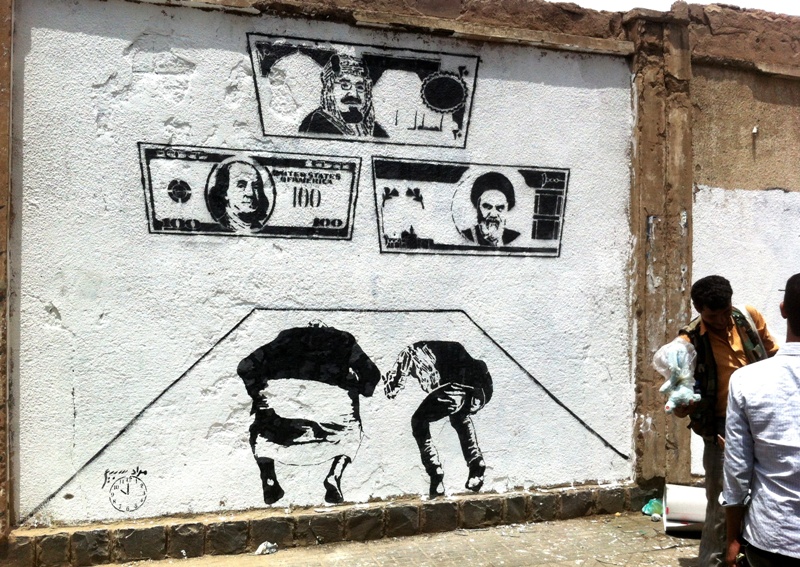
Ricchi di elementi simbolici sono poi quelli dedicati ai torbidi rapporti tra l’Arabia Saudita, l’Iran e gli Stati Uniti, che attraverso il pompaggio di denaro – e non solo – esercitano una forte influenza su tutte le decisioni politiche yemenite (e infatti si chiama la loro “ora” si chiama “Treason”, tradimento).
Infine si parla di corruzione, di stigmatizzazione ed emarginazione, per chiudere con un auspicio positivo, ovvero la “condivisione” della pace, con una strizzata d’occhio al web e ai social network.
Tanto grande è stato l’impatto di questi muri in tutto il mondo, che Murad Subay, nato nel 1987 nella provincia di Thamar, ha ricevuto diversi riconoscimenti, tra cui il premio internazionale “Arte per la pace” della Fondazione Veronesi.
L’artista ci racconta via mail di essere proprio in questi giorni alle prese con le pratiche per il passaporto, pronto per venire in Italia alla premiazione ufficiale che si terrà questo novembre.
Per visitare la gallery sul nostro sito clicca qui.
Si ringrazia Murad Subay per la gentile concessione delle foto.
12 Ottobre 2014
di: Anna Toro
Area Geografica: Yemen
Share this:

Art for Peace Award 2014

PACE COME CONDIZIONE DEL BENESSERE
14 – 15 NOVEMBRE 2014 UNIVERSITÀ BOCCONI, MILANO
Un premio per chi promuove una cultura di pace.
Ogni anno Science for Peace assegna l’Art for Peace Award, un riconoscimento importante riservato agli artisti che si sono distinti nella diffusione di un messaggio di pace.
Quest’anno l’Art for Peace Award verrà assegnato a Murad Subay, giovane artista yemenita che ha dato vita quasi interamente da solo allo sviluppo dell’arte dei graffiti nello Yemen a partire dal 2012, all’indomani della Primavera Araba nel suo paese.
Il premio verrà consegnato a Murad durante la 6° edizione della Conferenza Mondiale, venerdì 14 Novembre 2014.
 “A livello personale, i graffiti sono stati e rappresentano tuttora una fase fondamentale della mia vita, durante la quale ho scoperto me stesso. La street art non è soltanto la mia voce, ma di recente è diventata anche quella di molti yemeniti, poiché affronta i problemi principali che colpiscono gli abitanti del paese. Tutti gli yemeniti desiderano la pace e una vita dignitosa. Ho visto tantissime persone dipingere i loro sogni su muri nella speranza che un giorno diventino realtà. Questo premio ha un enorme significato per me e per le persone che hanno preso parte al progetto e rappresentano l’anima delle mie campagne artistiche, poiché è un riconoscimento del nostro umile lavoro e impegno. Inoltre, il premio è un segnale forte di incoraggiamento per il mio team di artisti e per me stesso. In sostanza, è un riconoscimento che premia tutti gli yemeniti.”Murad Subay
LE EDIZIONI PRECEDENTI
 2013alla cantante Fatoumata Diawara, in arte Fatou
Per il forte impegno che la sua musica rivela a favore dei diritti delle donne del suo paese, il Mali. 2012allo scrittore e saggista israeliano David Grosmann
per la sua continua testimonianza a favore del dialogo e di dissenso nei confronti dell’uso della violenza. 2011al fotoreporter Joao Silva
perchè i suoi scatti hanno sempre denunciato la necessità di un cambiamento e la volontà di raggiungerlo 2010al regista Xavier Beauvois
per il suo mirabile film “Uomini di Dio” tratto dalla storia vera dei monaci di Tibhirine, emblema di tolleranza e umana fraternità, uccisi da terroristi della Gia. 2009al Maestro Daniel Barenboim
per aver creato la West-Eastern Diva Orchestra che riunisce musicisti palestinesi e israeliani.
Share this:

HELEN DAY EXHIBIT SHOWCASES PROTEST ART

Helen Day exhibit showcases protest art

Rachel Moore
Rachel Moore, assistant director of the Helen Day Art Center, with part of the new exhibit she curated: “Unrest: Art, Activism & Revolution.”
Posted: Thursday, September 25, 2014 7:00 am | Updated: 5:07 pm, Fri Sep 26, 2014.
During the daytime, the 10-foot-long, cool blue sign hanging on the Helen Day Art Center blends in under cloudless skies, but as night falls, the words are a piercing electric blue message in Arabic: “We are with you in the night.”
The sentiment is borrowed from graffiti found in Italian cities during the 1970s, showing solidarity with and support for political prisoners.
Whatever the language, whatever the era, though, the message resonates. And the neon sign is an apt way to draw people into the art center’s newest exhibit.
“Unrest: Art, Activism & Revolution” opened during the weekend at the Helen Day, and it’s a melange of artistic media that rewards deep exposure, and a lingering visit.
Rachel Moore, the art center’s assistant director, curated the exhibit; she says “Unrest” looks at the ways art can be used in the 21st century to spark changes in rough parts of the world.
“When you’re right in the middle of protests, to be able to create art is just amazing,” Moore said last week while showing off the exhibit.
She was inspired to put it together after watching the 2011 Arab Spring uprisings in Tunisia, Egypt, Libya, Syria, Yemen, and all through the Arab world. So it’s fitting that “We Are With You in the Night,” by French artist collective Claire Fontaine, has a prominent role in this collection of work by artists who at some point could have used the solace found in the neon sign. (Claire Fontaine is a group of artists who present their work under the name of a fictional artist.)
“They are all trying to pursue their own goals, but taken all together, you get an overarching theme,” Moore said.
So it is with Lara Baladi, an Egyptian-Lebanese artist who was on the ground in Cairo’s Tahrir Square during Egypt’s uprising. Baladi took note of the images and videos of the protests in the square that were being uploaded to the Internet, more and more as the political tension increased. She began to archive them, and expanded her archive to include similar events around the world, and broadcast them to the world in real time. The piece “Alone, Together … In Media Res” is the result of that collecting.
So it is with the people of Culiacan, in western Mexico, as they give up their guns to artist Pedro Reyes, who turns them into shovels. In return for the guns, Reyes gave them coupons for domestic appliances or electronics. He collected more than 1,500 weapons, almost half of them high-powered military-use guns. The piece “Palas por Pistolas” features five gleaming new shovels, hung minimalist-style on a white wall in the gallery, the documentary on repeat nearby.
Proving the power of graffiti art — and not the peurile kind that a Stowe scofflaw recently peppered portions of the area with — is artist Murad Subay, emerging as Yemen’s very own Banksy. The display “12 Hours” takes up one whole wall of the “Unrest” exhibit, an image that turns graffiti on its head by literally stamping out sentiments such as child poverty, drones, sectarianism, kidnapping, poverty.
“Unrest” may have been inspired by the protests in the Middle East, but there’s plenty of room in America for art of the revolution. And prankster-activists The Yes Men’s collaboration with artist Steve Lambert is one worth spending some time with while in the Helen Day gallery. Titled “New York Times Special Edition,” it’s exactly what it sounds like, a copy of the venerable Gray Lady.
Except it’s not. Look closer at the November 2008 paper, printed right after Barack Obama was elected president. The headline screams “Iraq War Ends,” and the front page is dotted with other future utopian articles that are, as it cleverly says “All the News We Hope to Print.” The Yes Men and Lambert circulated 80,000 of these around New York City, their answer to what ought to be making news.
Many of the artists in “Unrest” are famous enough to have been featured in places such as the Museum of Modern Art in New York City. Now, though, they live side by side in Stowe for the next two months. Moore thinks they work well together, which is kind of the point of what these artists are doing for their own causes.
Said Moore, “The artists I picked may be located in one place or another, but this is more holistic, like they’re trying to figure it out for everyone.”
Share this:

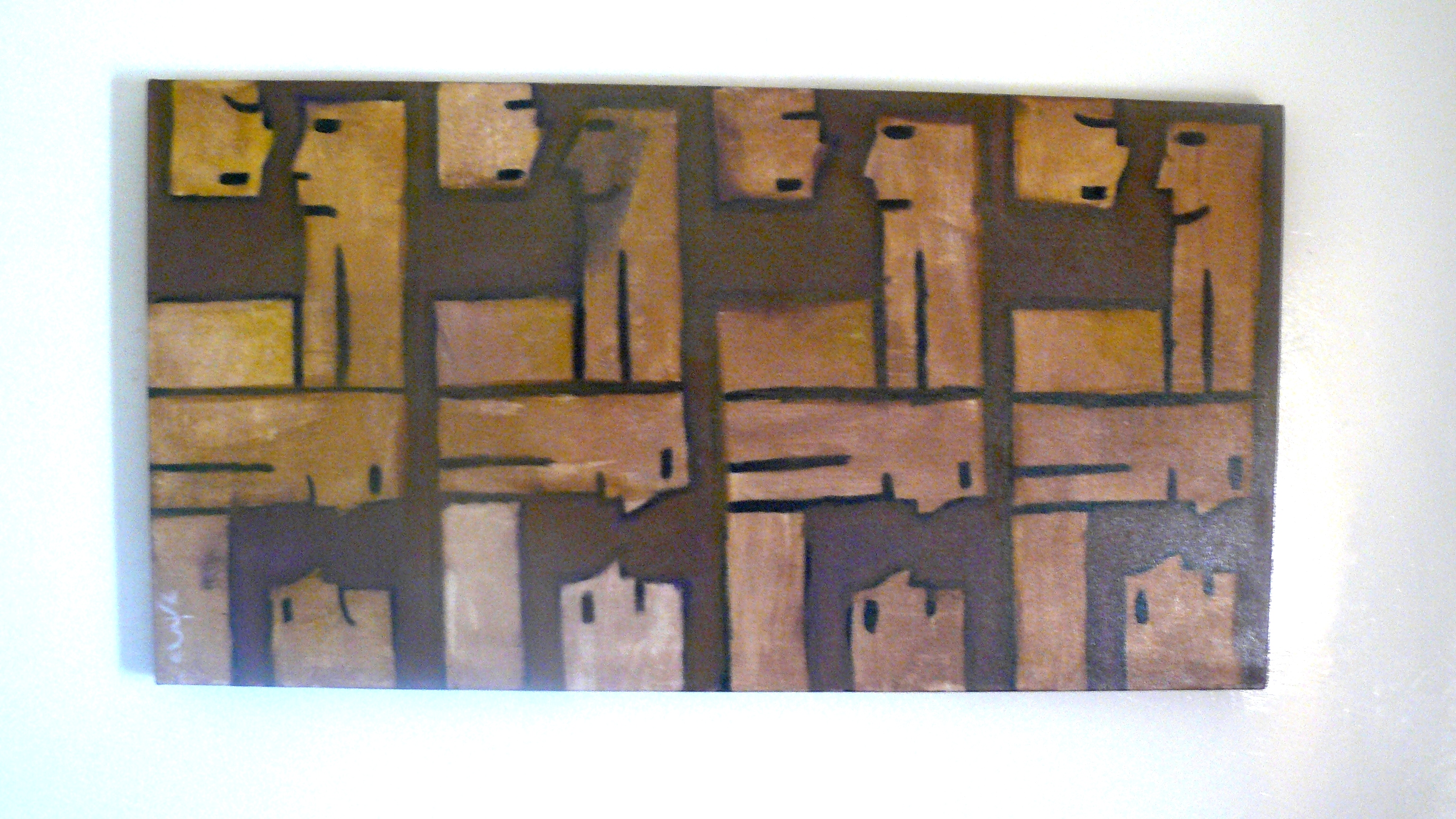
“FOURZ” My artwork Acrylic on Canvas 130×70 Cm

My mural in the 5th Hour “Drones” on the cover of the Dutch magazine “MILITAIRE”. Photo by: Yahya Arhab
My mural in the 5th Hour “Drones” on the cover of the Dutch magazine “MILITAIRE”. Photo by: Yahya Arhab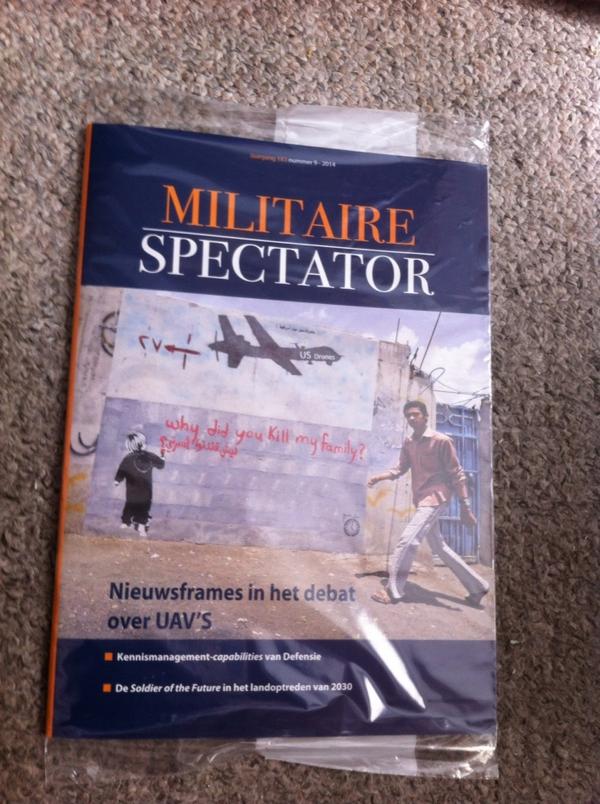
Share this:

Photo for one of three murals I participated by in an exhibition in “Vermont, USA”.
صورة لجدارية من جداريات حملة “12 ساعة” والتي شاركت بثلاث منها، في معرض في الولايات المتحدة الأمريكية، ولاية “فيرمونت”، جداريات: الطائفية، وتجنيد الأطفال وجدارية الساعة الـ12.
ضم المعرض عشرة فنانين من حول العالم التالية أسمائهم:
-ستيفن لامبيرت
-كلير فونتاين
-مراد سبيع
-مايكل راكويتز
-باكارد جينينقس
-شيرين نشئت
-لارا بالادي
-ببلك ستوديو
-يس مان
-بيدروا رياس
Photo for one of three murals I participated by in an exhibition in “Vermont, USA”. The murals Part of the “12 Hours” campaign, about “sectarianism, child recruitment and the 12th hour’s mural”.
10 Artists from around the world participated in this exhibition and they are:
Claire Fontaine
Steve Lambert in Collaboration with The Yes Men
Murad Subay
Public Studio
Packard Jennings
Shirin Neshat
Michael Rakowitz
Lara Baladi
Pedro Reyes
ضم المعرض عشرة فنانين من حول العالم التالية أسمائهم:
-ستيفن لامبيرت
-كلير فونتاين
-مراد سبيع
-مايكل راكويتز
-باكارد جينينقس
-شيرين نشئت
-لارا بالادي
-ببلك ستوديو
-يس مان
-بيدروا رياس
Photo for one of three murals I participated by in an exhibition in “Vermont, USA”. The murals Part of the “12 Hours” campaign, about “sectarianism, child recruitment and the 12th hour’s mural”.
10 Artists from around the world participated in this exhibition and they are:
Claire Fontaine
Steve Lambert in Collaboration with The Yes Men
Murad Subay
Public Studio
Packard Jennings
Shirin Neshat
Michael Rakowitz
Lara Baladi
Pedro Reyes

Share this:

Graffiti gets political in Yemen\ By: Mohammed Al-Absi. ALMONITOR

THE PULSE OF THE MIDDLE EAST


Graffiti gets political in Yemen
Since the youth uprising in 2011, there have been many street graffiti initiatives and campaigns in Yemen. As armed groups and fighting spread, and the regions outside the state’s control grow, graffiti campaigns are increasingly used as ways to resist the violence and address the political conflict through art.
Caricatures: from newspapers and magazines to the street
A few weeks ago, young painter Dhi Yazan al-Alawi launched a drawing campaign in the streets of Sanaa. The “Street Caricatures” campaign is characterized by candor, simplicity and a focus on highlighting local imagery using common clothing and facial features.
In addition to their cynical and sarcastic commentary, the drawings that make up this initiative express the concerns of the public. The first week focused on prices and the lifting of subsidies on petroleum products, while the second week was dedicated to the killing of soldiers and al-Qaeda attacks, which have escalated in the past two years. The third week revolved around art and life. The faces of 22 prominent male and female Yemeni artists were drawn on the streets.
Alawi told Al-Monitor that the initiative “seeks to bring caricatures out of the pages of newspapers and magazines and onto the streets, where all the people can see them, both the educated and the illiterate.”

Open Book: a “mobile bookshop”
Four neighborhoods away from the “Street Caricatures” team, more artists paint excerpts from the books and writings of Che Guevara, Abdullah al-Baradouni, Gandhi and Mahmoud Darwish on the walls of Kuwait Hospital, near Change Square. Young Tammam al-Shaybani and four other painters launched the “Open Book” campaign 10 weeks ago. Every week the campaign chooses a wall and announces a meeting time over social media. The next day, young men and women gather to create murals.
What is new in this initiative is that the words are more important than the image. The campaign is a platform for reading, a “mobile bookshop” to urge people to read and acquire books. Passersby are visually stimulated to read brief excerpts from writers, philosophers and well-known figures as they walk or stop their cars at traffic lights.
“We try very hard to choose the streets that have the most traffic and activity, or where cars and buses constantly stop. For instance, cars stop at traffic lights for three minutes every day at the Baghdad Roundabout. I think about how many people read the murals closely, either sitting in their cars or from behind the bus windows, and then decide to go to the bookstore to purchase the book. It’s a delightful feeling,” Shaybani told Al-Monitor.
Art is an important tool for expression and change
The first graffiti campaign dates back to the 2011 youth uprising, when young painter Murad Subay launched the “Color the Walls of Your Street” initiative. At the time, Sanaa’s streets were covered with political slogans such as “Execute the butcher, he won’t leave,” and other slogans expressing feelings of hatred and verbal violence. Buildings destroyed during the fighting and other eyesores dominated a number of neighborhoods, particularly the Kentucky region (al-Zubayri Street). In 2011, that street was the dividing line between the half of the capital controlled by forces loyal to the former president and the other half controlled by the revolutionary forces. This was the beginning of Sanaa’s transformation into an open-air studio.
The influence of the “Color the Walls of Your Street” initiative spread to several other Yemeni cities, most notably Taiz. Subay, the campaign’s founder, won the 2014 Art for Peace prize. The Italian Veronesi Foundation awards the prize to artists who have shown a commitment to a culture of peace. Subay’s campaign was ranked fifth in a list of campaigns around the world that have sparked change.
Subay’s second campaign, called “The Walls Remember their Faces,” was an initiative to depict the faces of those who had disappeared and whose fates are unknown, as a way of remembering the victims of the successive political regimes. The most notable faces were those of soldiers and politicians who had disappeared, or were perhaps killed, following the assassination of the young President Ibrahim al-Hamdi in 1977. The campaign also featured civilians and soldiers whose relatives claimed they had disappeared following the summer 1994 war, victims of the National Democratic Front rebellion and victims of the failed coup attempt against former President Ali Abdullah Saleh in 1979. The attempt was made by the Nasserist Unionist People’s Organization, whose leaders were executed and their families are still requesting that the state hand over their remains.
Subay’s third initiative, “12 hours,” is the most mature and professional yet. Each week was devoted to a particular issue that he and others would express in drawings. Topics included the abduction of foreigners, raids by US planes, child labor and carrying arms. One week’s artwork depicted the faces of victims of theattack on the Ministry of Defense complex and Ardi Hospital on Dec. 5, 2013, the most hideous al-Qaeda terror attack in Yemen. The attack left 56 dead, including civilians and military personnel of various nationalities. In addition to Yemenis, the victims included two Germans, an Indian nurse and a doctor and two nurses from the Philippines. The project expressed both gratitude and grief for the lives of the victims and their families.
“Art is an important tool for expression and change. The most important part about campaigns to draw on walls is the people’s participation. The wall no longer remains a static or negative concept,” Subay told Al-Monitor.
Collaboration and funds from abroad
In light of the numerous wars waged by the Houthi group Ansar Allah in the north of Yemen and the outskirts of the capital, the clashes between the army and al-Qaeda in the south and the organized attacks on oil pipelines and electricity pylons, the initiatives calling for people to draw on walls and revive musical events have become a form of struggle.
The most important issue raised by the “12 hours” initiative was the collaboration and funds from foreign countries. Some forces linked to Saudi Arabia have even bragged about receiving foreign funds.
At the end of Hael Street (al-Rabat), in the center of the capital, four murals concerning such collaboration with foreign states have been destroyed by vandals. One mural depicted the currencies of Saudi Arabia, Iran and the United States as the most prominent states pumping in political money and influencing Yemeni decision-making. The three coins appear as icons, idols or a holy shrine, and two men are drawn in front of the coins, bowed down as though in worship. Subay painted them with their backs to the viewer and their faces hidden, as if to call to mind Handala, the heroic figure featured in late artist Naji al-Ali’s works.
The artist’s skill shines in the small details and the symbolism of the mural. The first of the two men is wearing traditional clothing (a long gown and a dagger), a reference to the tribal sheikhs and leaders. The other represents an educated civilian in jeans and a shirt. This is a deliberate reference to the fact that foreign funds do not go to tribes and sheikhs alone. The traditional man appears larger than the other, a reference to the disparity in financial allocations between the two. The prominent currency in the mural is that of Saudi Arabia, expressing the historical influence the country has wielded in Yemen. The Iranian and Saudi currencies on the mural are of equal size, a reference to the strong competition between them in Yemen, which has become an arena for regional conflict.
Continue reading “Graffiti gets political in Yemen\ By: Mohammed Al-Absi. ALMONITOR”
Share this:

MAKING STORIES VISIBLE, A YEMENI ART HISTORY\ By: Anahi Alviso-Marino

Making Stories Visible
A Yemeni Art History
9 September 2014
I.
In March 2012, a month after former president of Yemen Ali Abdallah Saleh[1] formally left power following a year of contentious mobilizations demanding his overthrow, the walls of Sana’a started being covered by colourful murals and sprayed with myriad paintings. Located on walls that were bullet-marked by violent clashes between demonstrators and forces loyal to the regime during the period before Saleh’s departure, the first paintings to appear were all dated and signed. They were attributed to Murad Subay, the painter in his twenties who initiated this artistic action.[2] Up until he decided to place a call on his Facebook page to take over the streets with brushes and sprays, he had worked on his canvases – which he recreated in March 2012 onwards on Sana’a’s walls – without exhibiting his work at any of the art spaces that existed in the city[3]. Through this initiative, he triggered an artistic action characterized by the use of public space not only to paint, but also to reflect on issues of political concern through art, involving a participative audience.

The campaigns Murad Subay initiated became Yemen’s largest art exhibition ever undertaken in public space. In Sana’a, kilometres of walls were intervened by a diverse public made up of an eclectic youth mostly under thirty and forty, formed by painters, activists, writers and all sorts of passers-by including, at times, even the military stationed at nearby crossroads. Other cities of the country followed suit, and in places like Taez, the walls showed reproductions of works by Hashem Ali (1945–2009), one of the pioneering figures of Yemeni modern painting.[4] In a country without museums specifically dedicated to modern and contemporary art, street art became a medium to portray pioneering works side by side with those of the youngest generation of painters and photographers. Street art was, for the first time, making it possible for art to reach unknown numbers – an unspecified audience, or public, who not only watched the walls as they were being transformed, but participated in that very change. In all, the interventions in public space portrayed mixed aesthetics, combined artistic expression with social and political commentary, and brought to the street snapshots, sequences of Yemeni art history.
The art campaigns initiated by Subay have radically and symbolically changed public space in urban centres of Yemen, namely Sana’a, turning the walls into memorial sites of struggle and public paintings into political awareness devices, making them, at times, reflect and refract collective action.[5] By referring to this now, my aim is to point out the dynamics affecting Yemeni art worlds[6] so as to explore how arts infrastructures were developed and used in Yemen before artistic practices took over street walls. Certainly, if young painters in their twenties find in public space and – more specifically -– the walls of the streets, possible canvases where they are able to reproduce old and new works, then it is certain that prevalent models of exhibition, valorisation, and recognition are being questioned as relatively obsolete.
However, it is important to note that street art is not the central focus of this essay. The case of Subay’s campaigns serves to point out ongoing questions about the dynamics of Yemen’s art infrastructures. I have written elsewhere about these street art campaigns, explaining more about how and when these practices emerged and how they differ from Arab and European street art, not to mention the ways they are similar (mainly during 2011) to Egyptian, Libyan or Bahraini street art. [7]
Indeed, street art has become rather visible in the international media, which has equally contributed to obscure the clearly different dynamics at play in the Yemeni case. Thus, in what follows, I will focus on describing the larger context from which these street art campaigns emerged. By contextualizing the emergence of artistic practices, my aim is to provide a rough cartography of arts infrastructures in Yemen.[8]
II.
Although historicizing artistic practices in Yemen is limited here by space and scope, it is possible to highlight certain elements pertinent to providing a general image of Yemeni art history. In order to do so, it should be stressed that painting is certainly the most visible and recognized of all disciplines. Practised in the southern city of Aden since the 1930s and 1940s during the British occupation (1839–1967), and later developed in the northern cities of Taez and Sana’a[9] during the late 1960s and mainly the 1970s, painting has since occupied a central place in Yemeni visual arts. Today, sculpture and photography, though also pursued, remain relatively marginal in relation to painting, as also do installation and video art.
Since the first ‘clubs’ (s. nadi) of the 1930s and 1940s in Aden to the artistic associations of the 1950s, and to the establishment of the first spaces dedicated to formalized learning, exhibition and commercialization of art in the late 1970s, very different initiatives structured the domain of the arts in Yemen such as workshops, institutes, artist studios, galleries and art departments at university and at non art-related museums (i.e: military museums). Most but not all of these initiatives participated in a process through which the arts were institutionalized – that is, regulated by the state. With different levels of intensity, the state established, intervened and incorporated art infrastructures at changing levels throughout the years. In this light, the state strongly mediated the art scene between the 1970s and until the 1990 unification, provoking a rich period of political art with trained painters producing posters for political parties or large canvases portraying political figures. From unification onwards and until 2002, followed a period marked by the retreat of the state from the artistic domain. A new phase of strong state intervention continued from 2002 until 2007, again followed by a new retreat. Intermittently, the state has played an important role in the establishment of institutions as well as in the education and professionalization of artists. As I illustrate in what follows, the fluctuating character of this intervention was equally marked by the emergence of independent and non-governmental initiatives, suggesting efforts being made towards a relatively more autonomous art scene.
This complex process started in the 1970s, linking the emergence of spaces where painting could be practised in a more independent manner, like in artist studios, to more or less formalized learning, like the state-run “free workshops”.[10] One example of the first type was the studio opened by Hashem Ali, which did not lead to any type of formal diploma but informally educated painters since the early 1970s.
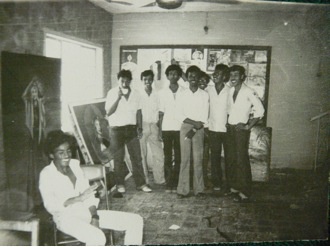
The second type dates back to 1976 and was located in Aden. Known as the ‘Free workshop’ (al marsam al hurr), it was an initiative of the Ministry of Culture and Education of the People’s Democratic Republic of Yemen that became the first space that provided a diploma after three years of study. It started with a group of thirty to forty Yemeni students taught by the Egyptian artist Abdul Aziz Darwish, whom like many other foreigners was employed by the state within an effort to expand education. Organized as an evening workshop, it lasted until 1978, when art classes where also being taught at the state-run Jamil Ghanem Institute of Fine Arts by Egyptian, Palestinian, Iraqi and Russian teachers artists.
During the 1980s the artistic movement located in Aden grew and expanded, in part through the establishment of professional associations for artists. For instance, the Association of Young Plastic [artists] (jama’ia al tashkilin al shabab) included, at that time, eighty members whose works were exhibited in Yemen and outside the country. Also during this decade, a few independent commercial galleries like Gallery N°1, Colours, and Al Ameen Gallery, opened in Sana’a and Aden after the initiative of painters. They reflected on the need to commercialise art works while also signifying an expansion in the art scene in terms of adding independent spaces to the arts infrastructures.
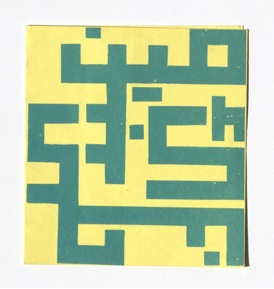
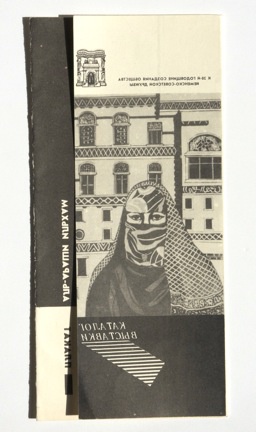
It was also during these years that the largest group of Yemeni students to have studied abroad left the country to pursue Fine Arts-related degrees in the former Soviet Union.[11] Between the 1970s and the 1990s, state scholarships were provided to pursue such studies, both in former North and South Yemen, and students returned to Yemen after having earned qualifications ranging from Bachelor’s to Doctor of Philosophy degrees. The return of these students to Yemen around the time of the unification (1990) nourished a dynamic of nationalization affecting the domain of visual arts. Yemenis took over teaching jobs in Aden, Sana’a and later on, in the coastal city of Hodeidah.[12] Trained artists also worked in the art department of the military and national museums established during the 1960s in Aden and Taez and the 1980s in Sana’a,[13]which before and after unification made use of painting for political purposes.
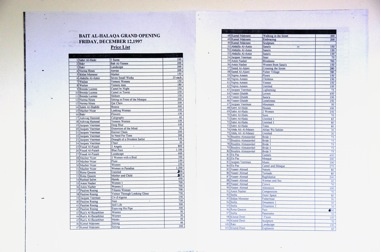
Throughout the 1990s, ‘groups’ formed with large numbers of participants, generally more than ten and up to forty. These groups announced a feature in a period marked by a search, through collective efforts that were more or less independent from governmental resources, for better conditions that might alleviate reduced opportunities to exhibit and commercialise art works. Certain examples include the Group of Modern Art (jama’a al fann al hadith, 1990s) and the Cultural Circle al-Halaqa (jama’a al halaqa, 1996–2001). Other individual and collective initiatives emerged, taking the form of informal workshops to teach painting, such as the opening of Mohammed al-Yamani’s studio in Sana’a (1997–) and the establishment of non-governmental art spaces that combined exhibitions with art-related events and publications. Such was the case of Bayt al-Halaqa (1997–2001), an art space found by Dutch expatriates living in Sana’a, which was simultaneously a space for workshops and exhibitions linked to the group ‘Cultural Circle al-Halaqa’ with artists based in Sana’a, Aden and Taez, and a cultural publication, The Halaqa Journal (last issued in 2001). These types of initiatives reflected both, the diversification of spaces dedicated to visual arts as well as the search for independent networks, all triggered by a period marked by the retreat of the state.
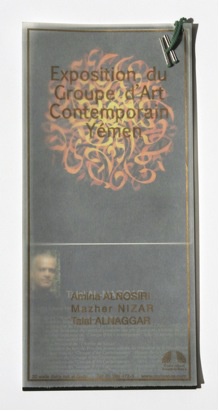
In the 2000s, another type of group of artists emerged. Among the main features these new groups introduced, they differed from the groups of the 1990s by their reduced membership (usually less than six), which contrasted also with the large memberships characteristic of associations, syndicates and federations that previously grouped artists. Some of them also differed from previous groups, in the fact that they were female-only groups like Halat Lawniafrom Hodeidah (2005–) and a group yet without a name based in Aden (2010–). Some of these groups were also linked to the establishment of art spaces dedicated not only to exhibit and possibly sell their works, but also to entertain debates through the organization of weekly meetings, as was the case with Group of Contemporary Art, which established Atelier, an artist-run space locatedin the old city of Sana’a (2001–2009). These initiatives were a variation from similar ones attempted in the 1980s in the fact that they not only served to commercialize art works, like galleries do, but they reflected the need to tackle different purposes, like promote debate among artists and their public, create networks, showcase works, and propose informal learning to artists without a formal training in fine arts.
During the years 2000s, these groups of artists participate to the expansion of artistic networks, reflecting independent efforts that notwithstanding aim to better integrate and attain institutionally run spaces and opportunities. Such are the cases of the only-female groups from Hodeidah and Aden above mentioned, but also mixed ones like the Sanaani Group of Contemporary Art or only-male groups such as jama’a ruh al-fann (Art’s Spirit Group, 2005–2007) based in Aden.
From 2002 to 2007, another phase of institutionalization took place, this time through mainly fostering the establishment of art spaces dedicated to the exhibition and commercialization of art. Relatively decentralizing the artistic movement, which had until then been centred in the capital Sana’a, the Ministry of Culture established Houses of Art in different governorates[14] where permanent exhibitions and training workshops were organized, and where art works could be bought. Such efforts were successful at incorporating some of the young and emerging artists (below their thirties during these years) to state-run institutions and networks (i.e newly opened Houses of Art and exhibitions organized at the Houses of Culture). From 2008 onwards, the Ministry of Culture launched yearly international forums for plastic arts, which together with a state-run gallery opened in 2011 demonstrated an interest for the internationalization and commercialization of Yemeni art. These efforts apart, certain artists still describe the years that followed and led to the 2011 mobilizations and until 2014 by an again fluctuating retreat of the state. This perception is possibly due to the saturation of the state-run networks with always the same artists. Consequently, opportunities for independent experiences were again triggered and favoured by the experimental environment of revolutionary times. For instance, non-governmental multi-disciplinary spaces such as ‘The basement’ and the ‘Gallery Rauffa Hassan’ opened respectively in 2011 and 2013, mixing exhibitions with music concerts or poetry performances. Such spaces attracted young artists, among which those not included or not participant to state-run networks found different possibilities for visibility and recognition. It is during this relatively more independent and experimental phase that Murad Subay took over the streets to put his paintings on the walls and outside the market and the state-run spaces.
III.
As is evident in the case of the street art campaigns undertaken by Murad Subay, the period that followed the contentious mobilizations that spread throughout the country in 2011 have also affected the domain of visual arts. In the same way that the mobilizations unleashed political creativity, they also created a safe environment where different kinds of social experiments could be tried. Subay’s street art campaigns are one of such experiments.
As I have briefly explained, arts infrastructures have developed in Yemen not only through a process defined and directed by the state. Individual and collective non-governmental initiatives have also structured Yemeni art worlds. Nevertheless, both these realms were disrupted with Subay’s campaigns. This is because, although organized independently from governmental infrastructures, independent initiatives have seldom aimed at proposing an alternative to institutional artistic networks. In other words, art spaces or groups created with a will to obtain more autonomy from the state have rarely been established in order to counter governmental initiatives. On the contrary, they have produced ways to better compete, integrate and participate in those institutional networks of exhibitions, commercialisation, and in general, opportunities of visibility and recognition.
What Murad Subay’s campaigns introduced was a sort of break from these dynamics: by placing art expression on the street and by provoking participation from artists but not limited to them, he has disrupted modes of exhibition-making, not to mention art’s interaction with audiences. Most importantly, he has placed art works outside the market. These ruptures from the ways in which art has been displayed and recognized until 2011, has introduced a type of art that is extremely public, given the work is being shown on the streets and is thus accessible by anyone, free of any entry fee, and thus open to anyone. Audiences have turned into possible participants, and streets into open museums and galleries.
Given how different art initiatives such as multidisciplinary exhibition spaces and installations on the streets have been undertaken by different actors after 2011 and mostly also in their twenties, Subay’s campaigns have been successful at attaining a visibility unprecedented for any art initiative taking place in Yemen. Inscribing this painter’s campaign into a historicized context allows the opportunity to think about what kind of histories – understood both as narratives and as historical accounts – are put forward in a global context, where artistic practices of peripheral countries such as Yemen unfortunately remain invisible.
[1] He formally retained power since 1978, when he became president of the former Yemen Arab Republic (YAR). Upon the unification of 1990, he became president of the current Republic of Yemen (ROY) until 2012.
[2] Murad Subay developed three collective campaigns (s. hamla, pl. hamlat) in Sana’a between March 2012 and May 2014: « Color the walls of your street », « The walls remember their faces », and « 12 hours ». Besides these campaigns, he has also wheat-pasted photographs realized by one of his brothers. Refer to Murad Subay’s blog for short documentaries, articles, interviews and photographs of these campaigns:http://www.muradsubay.wordpress.com.
[3] There are several spaces dedicated to visual arts in the capital, Sana’a, both state-run and independent. Among the state-run: the House of Culture hosts temporary exhibitions while permanent ones can be viewed at the House of Art where paintings can also be bought; the National Museum in collaboration with European cultural institutions has hosted a number of art exhibitions and installations, and the Sana’a Gallery located whithin the main building of the Ministry of Culture besides exhibiting also comercializes art works. Whithin the framework of cultural cooperation, European cultural centers also organize temporary exhibitions. Some of the independent initiatives that opened in the last five years include Kawn Foundation, the Basement, Gallery Rauffa Hassan and Reemart Gallery.
[4] Called “Colors of life”, this artistic action took started possibly in May or July 2012 in Taez. For a brief explanation and images refer to http://www.youtube.com/watch?v=UR2qx14GO0Y&feature=youtu.be andhttp://www.al-monitor.com/pulse/contents/articles/galleries/yemen-graffiti-vandalism-or-high-art.html, last accessed on June 3, 2014. In Taez, certain images were vandalized with black painting.
[5] Mainly in a chapter under publication and presented at the symposium “The Revolutionary Public Sphere: Aesthetics, Poetics & Politics”, organized by the Project for Advanced Research in Global Communication (PARGC) at the Annenberg School for Communication, University of Pennsylvania, Philadelphia, April 2014. For shorter analysis refer to my chapter « Les murs prennent la parole. Street art révolutionnaire au Yémen», inJeunesses arabes. Loisirs, cultures et politique, Laurent Bonnefoy and Myriam Catusse (dir.), La Découverte, Paris, 2013, “Mobiliser et sensibiliser à travers le street art au Yémen”, in 34 Short Stories, Bétonsalon-Centre d’art et de recherche et les Editions de Beaux-Arts de Paris, Paris, forthcoming in 2014, and http://universes-in-universe.org/eng/nafas/articles/2013/street_art_yemen.
[6] Contrary to an individualistic conception of the artist and the art works, sociologist Howard S. Becker proposes a collective approach: “art worlds consist of all the people whose activities are necessary to the production of the characteristic works which that world, and perhaps others as well, define as art […] We can think of an art world as an established network of cooperative links among participants […] Works of art, from this point of view, are not the products of individual makers, ‘artists’ who possess a rare and special gift. They are, rather, joint products of all the people who cooperate via an art world’s characteristic conventions to bring works like that into existence”. H. S. Becker, Art Worlds, University of California Press, Berkeley, 1982 (2008), pp. 34-35.
[7] Mainly in a chapter under publication and presented at the symposium “The Revolutionary Public Sphere: Aesthetics, Poetics & Politics”, organized by the Project for Advanced Research in Global Communication (PARGC) at the Annenberg School for Communication, University of Pennsylvania, Philadelphia, April 2014. For shorter analysis refer to my chapter « Les murs prennent la parole. Street art révolutionnaire au Yémen», inJeunesses arabes. Loisirs, cultures et politique, Laurent Bonnefoy and Myriam Catusse (dir.), La Découverte, Paris, 2013, “Mobiliser et sensibiliser à travers le street art au Yémen”, in 34 Short Stories, Bétonsalon-Centre d’art et de recherche et les Editions de Beaux-Arts de Paris, Paris, forthcoming in 2014, and http://universes-in-universe.org/eng/nafas/articles/2013/street_art_yemen.
[8] I conducted my doctoral research in Yemen from May 2008 until March 2011.
[9] Until the unification of 1990, Yemen was divided into two separate states. The Yemen Arab Republic, in the northern part of the country, was established in 1962 and marked the end of the Zaydi Imamate, which also coincided between 1839-1918 with the Ottoman occupation. The south, divided in 25 sultanates and sheykhasthat during 128 years were grouped into two protectorates, was occupied by the British until 1967. Until unification, the People’s Democratic Republic of Yemen represented the only Arab regime of the region explicitly Marxist.
[10] Translated as “the Free Atelier” or “the Open Studio”, such workshops also emerged during the 1960s in other parts of the Arabian Peninsula, for instance in Kuwait or Qatar, and were also state-run initiatives. On Kuwait see for instance Fatima al Qadiri and Kaelen Wilson-Goldie, “Farida Al Sultan”, Bidoun, Spring 2010, pp. 42-45. The catalogue Swalif. Qatari art between memory and modernity published by the Mathaf museum in 2011 also mentions them on the glossary in p. 24.
[11] For a detailed analysis of this group, refer to my article « Impact of transnational experiences: the case of Yemeni artists in the Soviet Union », Chroniques Yéménites, N° 17, 2013.
[12] The University of Hodeidah, located in the Red Sea coast, is the only public university in the entire country to offer the possibility to study visual arts since the late 1990s.
[13] Museums from the former South were looted during the short war of 1994 (May 5 to July 7), where the armies of the former nothern and southern states confronted each other. For a study of museums in Yemen refer to Gregoire Nicolet’s master thesis Les musées du Yémen. Développement et enjeux de l’institution, Mémoire de DESS : Mondes arabes, mondes musulmans contemporains, Geneva, 2007.
[14] Sanaa, Dhamar, Ibb, Yarîm, Hodeidah and Aden among them.
Continue reading “MAKING STORIES VISIBLE, A YEMENI ART HISTORY\ By: Anahi Alviso-Marino”

 Murad Subay
