An activist paints graffiti on a wall in Sanaa June 7, 2012. Since last month, a group of young artists took to the streets of Sanaa using graffiti as a medium to promote peace in neighbourhoods. REUTERS/Mohamed al-Sayaghi (YEMEN – Tags: CIVIL UNREST SOCIETY)
Yemeni Artist Murad Subay has spent the last seven years in decorating Sanaa’s streets with murals and colorful paintings.
Since the Arab Spring kicked off in 2011, Subay has drawn hundreds of paintings on the walls of Sanna’a, which have been damaged by the war, aiming to highlight the oppression and sufferance of millions of Yemenis caused by the war, poverty, and revolution in their country.
Till this day, Subay launched five artistic campaigns, and each focused on a different aspect of the conflict, including the incidents of kidnap, disappearance, corruption, poverty, killing of civilians, drones’ use, and the huge devastation of his country’s infrastructure.
While drawing one of his paintings near the Yemeni Central Bank, Murad Subay said: “Today we are near the Yemeni Central Bank, and we want to say that economy shall find real solutions, stop the corruption and the collapse of the national economy”.
The deterioration of the Yemeni economy has increased with the launch of the civil war in March 2015, when the Saudi-led Arab coalition kicked off an air attack to overthrow the Houthis, and to return the government of President Abd Rabbo Mansour Hadi. The conflict led to the death of more than six thousand Yemeni to date, displaced more than two million people, and involved the poor country in one of the worst world humanitarian crises ever.
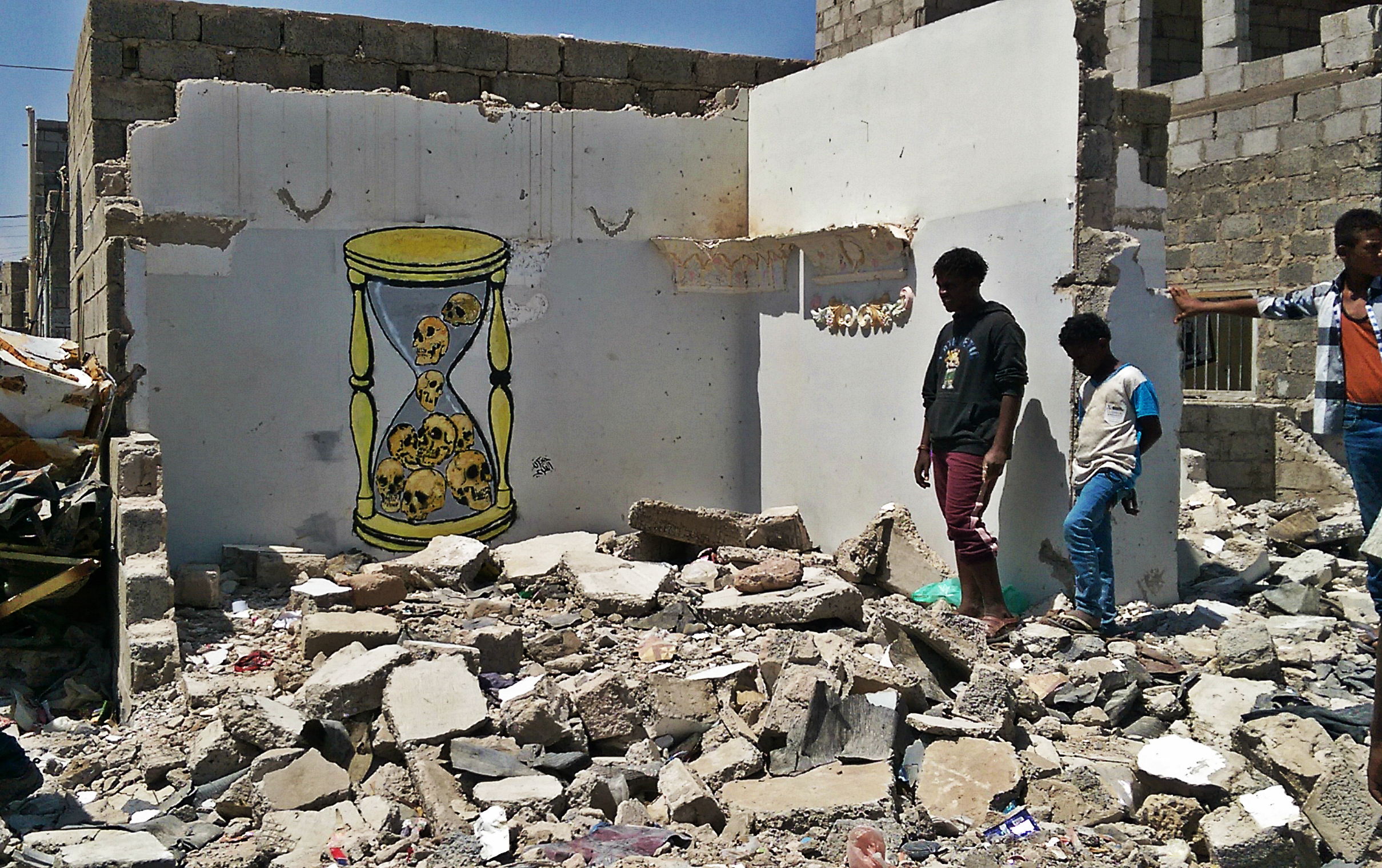
Subay has called his recent campaign “Ruins”, and drew paintings on the walls of the buildings damaged during the war, to commemorate thousands of people who lost their lives in the conflict.
Subay does not work alone. Over the years, he has called the youth who live in the neighborhoods near the city to join him, and hundreds have responded. The artist stresses that art is the best peaceful and influential mean to refuse oppression and to emphasize sufferance. Subay said that colors and paintings are a decent and peaceful call for Yemenis to refuse hatred and conflicts, and to move toward the construction of their country and to stop its destruction.
Subay received many global awards for the political expressions he use in his works. Yet, he sees that he earned these awards due to the support of his friends, family, and the Yemeni people, saying teamwork can make a significant difference in Yemen.
“في صنعاء كذلك، رسمٌ متواصل على ما تبقى من المدينة. رسم مراد سبيع سابقاً على ركام المدينة مشروعه “حُطام”. صارت المباني المدمرة جزئياً دفتراً مفتوحاً له، وحوّلها إلى رسائل مضادة للحرب، نال بعدها جائزة “الفن من أجل السلام”. عاد سبيع في 16 آذار/ مارس الحالي ليحتل الشارع، ودعا معه ناس المدينة للمشاركة في الرسم على جدران شارع الرباط في صنعاء، فَقَدِم منهم رجال ونساء وأطفال وكبار. لا يعود مهماً هنا “جودة” العمل الفني بالمعنى التقني، لكن أن يستعيد سكان المدينة سيطرتهم على جزء من الحيز المعماري الذي يشغلونه، أن يكون لهم حق ترك أثر ما عليه، وأن ينقل هذا الأثر أملهم بيمن بلا حرب.
هذه الفنون التي تجاهلت الوسائط الكلاسيكية، يصنعها شباب يعتبرون المدينة مساحة ضرورية للعمل وعرض الأفكار، يرونها ستوديو كبيرا. أهمية الفن المديني تكمن أولاً في كونه (غالباً) غارقا في الهم الاجتماعي والسياسي. وفي كونه ثانياً يقدّم رؤية مختلفة لدور الفنون واستعمال الحيّز. عليك أن تركّب أفكارك مع المدينة أولاً، ثمّ أن تعيد تركيب العمل (ربما مع فنان جديد) فوق العمل الأول الزائل أو المتغيّر، وربما بتقنيات أخرى، ودائماً بنظرة مختلفة. تتراكم طبقات المدينة ويغمر بعضها البعض.
لا يكترث من يرسم على حائط بإمكانية أن يأتي أحدهم ليخرب عمله أو يعدله لاحقاً. الفن هنا سريع الزوال نسبياً، يعبر المدينة عبوراً سريعاً كما نفعل نحن حين نمر من مكان العمل إلى مكان السكن.. فن المدن يخترع أساليب لتطويع الأسطح المدينية العامة في خدمة الفكرة البصرية، صار مع الوقت جزءاً من الهوية البصرية لمدن عالمية كبرى وحركة فنية معترف بها، ويزداد تقبّلها في العالم العربي، خصوصاً بعد أعوام الثورات المتنقلة التي احتاجت الجدران لتقول قولها.”
People pass by Murad Subay’s mural “Flowers Bouquet” in Sanaa in May 2015. The Yemeni street artist has spent five years making the case for peace through street art projects.
On the first day of Saudi Arabia’s intervention into Yemen’s civil war in March of last year, warplanes bombed a residential compound on the outskirts of the capital Sanaa, killing dozens of people inside.
A Yemeni human rights organization said a coalition led by Saudi Arabia killed 27 civilians, including 15 children, in the strikes on the Bani Hawat neighborhood on March 26, 2015.
Yemeni artist Murad Subay headed to the compound with a group of friends a few weeks later, and together with local kids painted 27 flowers on its walls, 15 of them with just one leaf to symbolize the children whose lives were lost.
It was the beginning of the 28-year-old’s latest street art campaign, “Ruins.”
SHARF ALHUTHY
Murad Subay is a 28-year-old artist who grew up in the Yemeni capital Sanaa.
At least 6,200 people have been killed since last march in the latest round of conflict, in which Saudi Arabia’s military coalition and its Yemeni ally President Abd-Rabbu Mansour Hadi are battling Yemen’s Houthi rebels and supporters of ex-president Ali Abdullah Saleh.
“They have destroyed everything,” Subay told The WorldPost of the warring parties. “So, what can we do? Just this: Not remain silent, commemorate the innocent people who have been killed, and highlight the cost of this war.”
Over the past year, Subay and fellow artist Thi Yazen have gone to areas where the war has destroyed homes or killed civilians, and covered them in murals.
What can we do? Just this: Not remain silent, commemorate the innocent people who have been killed, and highlight the cost of this war.”
U.N.-sponsored peace talks between the government and rebels began on Thursday, 10 days into a shaky truce. Government representatives said their expectations of the talks were low, while Yemenis on social media urged the leaders: “Don’t come back without peace.”
“I hope this is an opportunity, and it’s not just me,” Subay said. “There are millions of Yemenis who want peace… who need peace.”
MOHAMMED HAMOUD /ANADOLU AGENCY/GETTY IMAGES
Subay tries to get the community involved in his street art projects. “Art humanizes us,” he says.
Subay has been making his case for peace in Yemen through street art projects for the past five years.
The Arab Spring uprisings of 2011 were a rude political awakening for the young artist. He joined thousands of Yemenis protesting then-president Saleh’s three-decade grip on power. He and his friends helped form a security cordon around Sanaa’s “Change Square” to prevent people bringing in weapons into peaceful sit-in.
But in the end, Yemeni activists weren’t able to stop the pro-democracy uprising from being hijacked by the political forces tussling over power in Yemen. The protests became street battles, and Saleh cut a deal to leave office in exchange for legal immunity, allowing him lurk around Sanaa trying to undermine the new government led by Hadi.
Subay was disgusted by the way politicians exploited the revolution. “It turned out that there was a game inside the revolution,” he said. “I was so frustrated by what happened, and that the country was heading into turmoil, and all I wanted to do was paint.”
MOHAMED AL-SAYAGHI / REUTERS
Last month, he and his friends held a three-day public street art campaign in the capital, where they invited passers-by to help paint.
In March 2012, he launched his first street art campaign, “Color the walls of your street.” He and his friends headed into battle-scarred neighborhoods where different factions were fighting for control, and covered them in colorful murals.
On social media, Subay invited people to come help them paint, and after a week, dozens of people started to show up, bringing their kids and their own paints. Similar murals began to appear on the walls of other cities.
“It’s like protesting by colors,” Subay said. “We painted to paint on the ugliness of war, and say there are options instead of going to war and using weapons.”
“To use colors — it is better than to use bullets.”
MOHAMED AL-SAYAGHI / REUTERS
His first campaign was “Color the walls of your street” in March 2012. “We painted to paint on the ugliness of war,” he says.
One of Subay’s next street art campaigns brought him into more direct confrontation with authorities. Inspired by the investigations of his friend, Yemeni journalist Sami Ghalib, into enforced disappearances in Yemen, Subay launched “The walls remember their faces” in September 2012. Over the next seven months, he and his collaborators painted portraits of over 100 Yemenis thought to have been secretly kidnapped or killed by authorities since the 1960s.
“It was very simple — just faces and names — but they are not remembered,” Subay said. “The people responsible for these crimes have silenced every voice who wanted to say something about this.”
HANI MOHAMMED/ASSOCIATED PRESS
His street art campaign, “The walls remember their faces,” commemorated over 100 Yemenis who were forcibly disappeared since the 1960s.
Subay found his murals kept getting erased, but his team would just go back and repaint them, and add more portraits of the disappeared.
They also took the campaign right to the heart of the regime — painting faces of the disappeared on the walls of the intelligence agency, and outside the offices of powerful general Ali Mohsen al-Ahmar and ex-president Saleh. This drew the ire of Yemeni security forces, but Subay says the families of the disappeared and media who accompanied the painters prevented their arrest.
KHALED ABDULLAH ALI AL MAHDI / REUTERS
The campaign drew the attention of the authorities. Above, a soldier tries to stop Subay painting a portrait of one of the disappeared in September 2012.
Saleh eventually allied with the Houthi rebel movement (which as president, he had repeatedly tried to crush), enabling their takeover of the Yemeni capital in September 2014.
As the Houthis continued to advance through the country, and Hadi fled for his life, Saudi Arabia formed a military coalition to oust the rebels, citing concerns that they were supported by the kingdom’s regional rival Iran.
The impact of the ensuing war has been devastating to Yemen, already the poorest country in the region. Some 35,000 people have been wounded, over 2.5 million people displaced, and 14 million people don’t have enough food. The United Nations and human rights groups say the coalition has bombed weddings, markets, schools, hospitals and homes around Yemen.
“Things people built over decades, they lost in one moment,” Subay said.
The war has made him constantly anxious — about making ends meet or getting hold of basic supplies — but he emphasizes that his family in Sanaa has had it much better than the millions who don’t have food, water or shelter because of the war. His older brother, a poet and journalist, was shot by unknown gunmen in the capital earlier this year, but he is recovering overseas.
MOHAMED AL-SAYAGHI / REUTERS
Subay’s latest campaign, titled “Ruins,” places murals in the areas damaged or destroyed by war, and highlights its terrible toll on the people of Yemen.
Subay went to the U.K. last week to collect a “Freedom of Expression” award from the campaign group Index on Censorship. He dedicated his award to all “the unknown people who struggle to survive” in Yemen, while berating the “the world’s presidents, kings and leaders who misused their power,” and the international community and media for turning a blind eye.
While in London, he collaborated with British street artists to paint his first mural outside Yemen, slamming international involvement in the war and indifference to the civilian toll.
“Sometimes it feels like nobody knows what’s happening in Yemen,” Subay said.
He warned of the dangers of neglecting the fallout of Yemen’s war, which is exacerbating divisions and grievances in a country with weak institutions and awash with weapons. “You see what happened in Libya with nobody in government … some even say it could be worse than Syria because there is so much anger in Yemen,” he said.
MURAD SUBAY
Subay collected a freedom of expression award in London last week, and took the opportunity to paint his first mural outside of Yemen, which he called “Dirty Legacy.”
Yet Subay is a determined optimist. He is encouraged that some Yemenis have replicated his street art campaigns and others have begged him for art classes.
In a country where people are fighting for survival and art galleries are a distant luxury for many, he stresses the importance of bringing art to people where they already are — “in front of their houses, the places they pass by on the way to work.”
Last month, he organized a three-day public art event in the capital, inviting passers-by, including some members of the security forces, to help cover the walls of the university in murals.
MURAD SUBAY
In a country where many are struggling to survive, Subay says it’s important to bring art to the places where people already are.
He hopes Yemenis will get both joy and insights out of participating in his art projects.
“War is not an option. There is a lot of beauty to see in this world,” he said. “If they take just this idea from the art, it would be enough.”
“Art humanizes us,” he said.
More images of the “Ruins” campaign with descriptions from Subay:
MURAD SUBAY
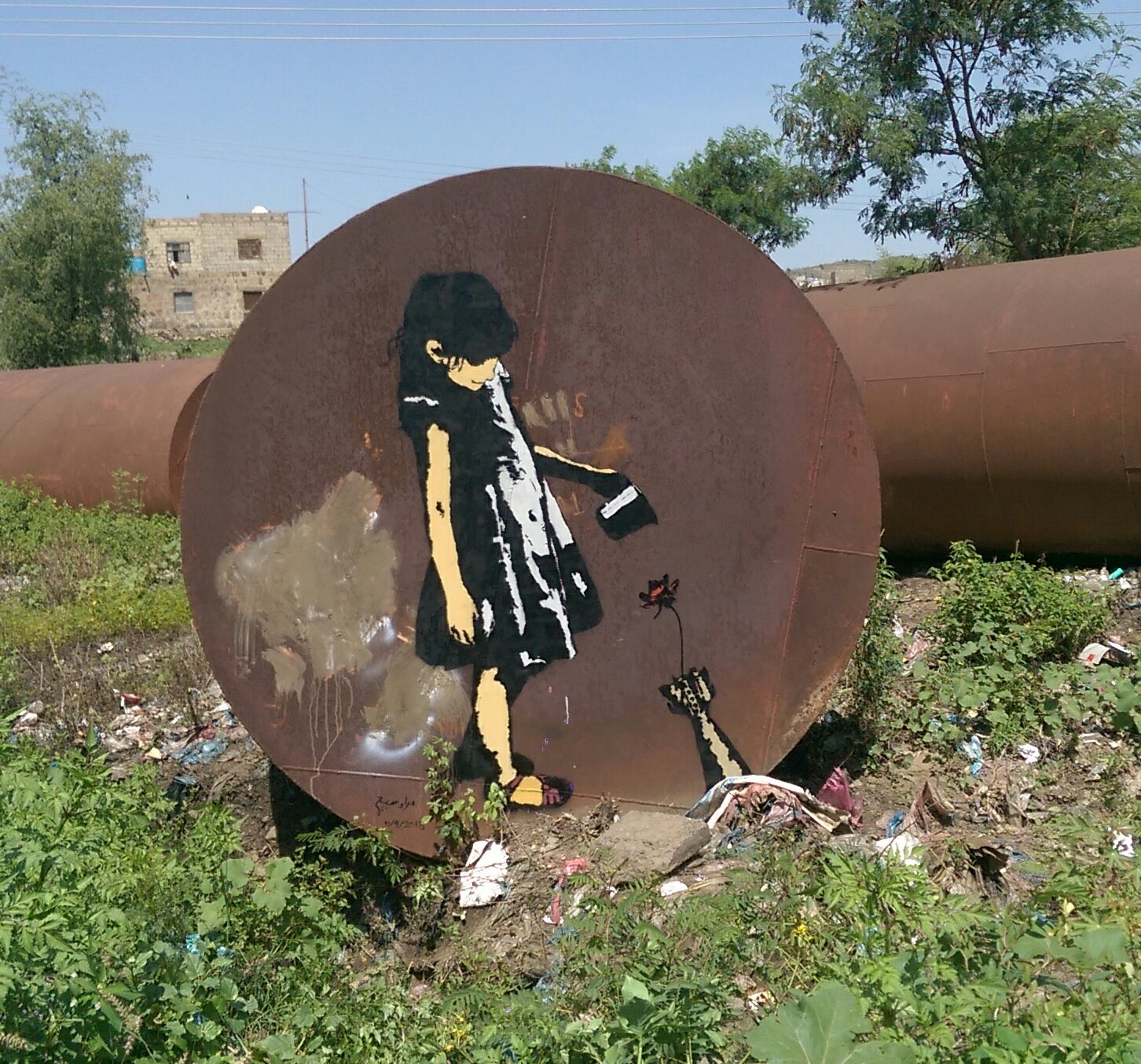
“We painted this on a big container in Taiz. The most common weapon used in that area at the time was mortars, and they were destroying many areas. I took a photo of a friend’s daughter holding a watering can, and painted her watering a flower that is growing out of a mortar. We have to believe and we have to hope… our life will not stop with this war. It will not prevent us from dreaming.”
MURAD SUBAY
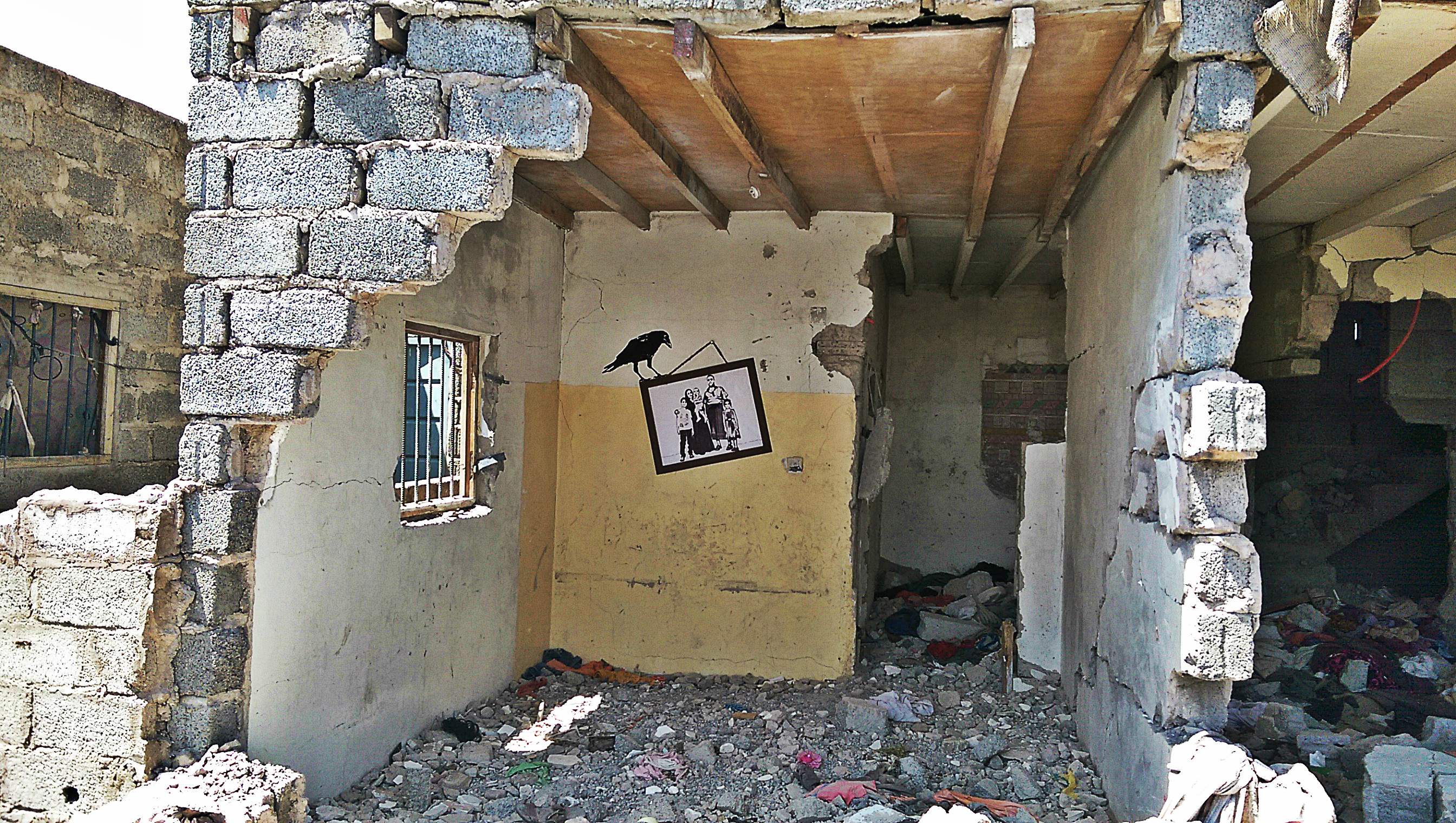
“We left Taiz after we were stopped and questioned by gunmen. It was also for our safety as there was shelling in the area. So we painted this in north Sanaa. It’s very simple. The black crow has kicked the family photo out of balance. It’s like our country has lost its balance because of this war. A family was living in this house, and the only survivors were the father and the 1-year-old daughter.”
MURAD SUBAY
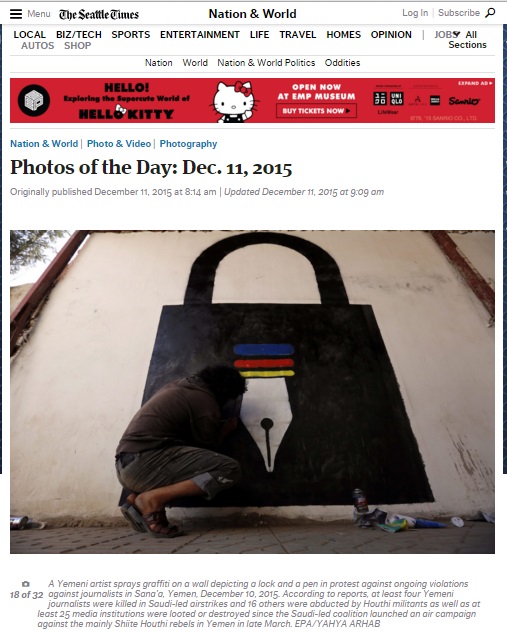
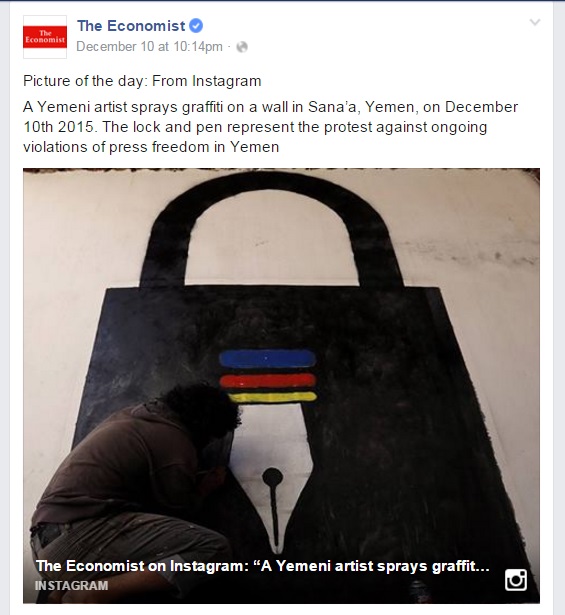
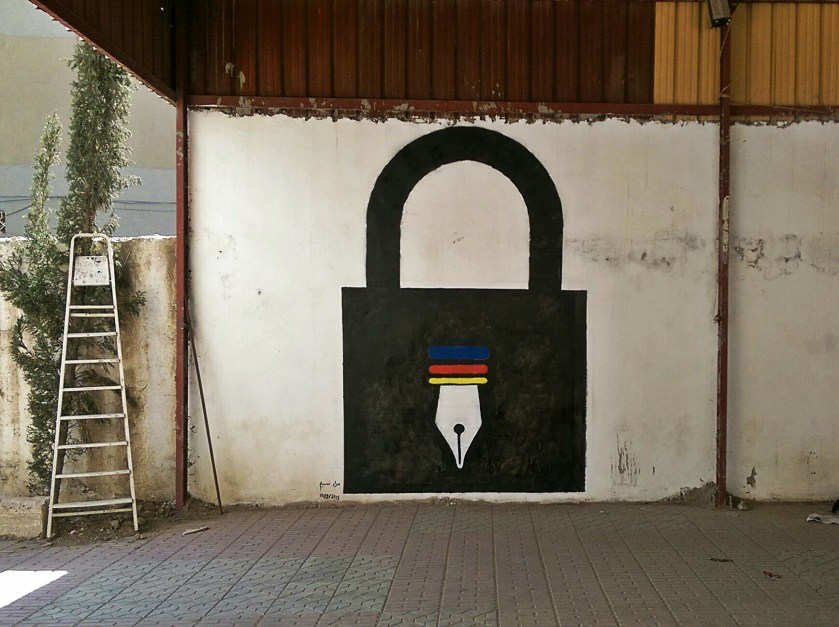
“Before the war there was 26 weekly or daily newspapers published in Yemen. Now, there are maybe only five and they all have one voice. The parties to this war have closed their websites. So I painted this mural on the Yemeni journalists’ syndicate to protest that there is no freedom anymore.”
MOHAMMED HUWAIS VIA GETTY IMAGES
“I painted this in the middle of the city of Sanaa, to say the whole of Yemen is under blockade — both from internal and external parties. The blockade is turning the whole country to ruins. I used barbed wire to convey the reality of how hard life is here.”
“I am honored to be here with all of you today and for that, I would like to thank Index on Censorship for giving me this award, for believing in me and for acknowledging our work back home.
I want to thank my friends who join me every time I paint the walls of the streets and who share with me the same concerns over the issues that are really important. I also want to thank the good people of Yemen who have always supported us and who were the spirit of every campaign I launched to paint in the streets.
I would like to take this opportunity tonight to shed light on one of the biggest concerns for me and for many Yemenis. As many of you know, Yemen is going through one of the hardest times in its history, with the outbreak of internal and regional armed conflicts. Yemenis suffered greatly even before these conflicts broke out, and they’re going through this alone, but it seems that the heavy losses that Yemenis endure every day isn’t enough yet to capture the interest of the international community and media.
I dedicate this award today to the unknown people who struggle to survive, and I do not talk about those who are fighting the war with their weapons. Rather, I talk about every person who suffers a serious injury, who lost a family member or a loved one, who lost their home, school and job and who struggles to keep their family alive when they were starved to death. Those women, men and children are the real heroes that we should all bow to in respect for moving on and holding on to life.
Therefore, for the world’s presidents, kings and leaders who misused their power, it is true that you might never be tried, but you should know that you are leaving behind a dirty legacy in the time when you should concentrate on the real issues that face humanity, rather than throwing mindless wars and engaging the world in killing one another.
Again, I thank Index on Censorship and all its team for this award, and I thank you all for listening to me sharing my concern with you. Let’s hope for peace to prevail in Yemen as soon as it can be.
My mural about “Treason” in “12 Hours” campaign is republished by “FOREIGN AFFAIRS” Magazine along with other artistic murals from countries sinking in conflicts entitled “War Painting”.
“In Sana’a, Artist and activist Murad Subai puts final touches on his graffiti depicting Saudi, U.S., and Iranian currency banknotes on a wall. His work is part of a graffiti campaign against foreign interference in the internal affairs of Yemen, May 15, 2014.”
ما أشبه اليوم بالأمس حيث تزدهر الخيانة الوطنية أكثر ويتباهى الخونة بخيانتهم، كالطواويس.جداريتي عن “الخيانه الوطنيه” في حملة “12 ساعه” اعادت نشرها مجلة “FOREIGN AFFAIRS” الأمريكيه مع مجموعة من الجداريات الفنيه من بلدان تلتهما الصراعات تحت عنوان “جداريات الحرب”
On the American website “The Seattle Times”: Photos of the day.
During painting my fifth mural in “Ruins” campaign, on the wall of the Yemeni journalist Syndicate, Dec.10, 2015
من “صور اليوم من حول العالم” على الموقع الأمريكي “The Seattle Times”
الصوره أثناء عملي على جداريتي الخامسه ضمن حملة “حُطام” التي عنت بالحريات، على جدار نقابة الصحفيين اليمنيين، 10 ديسمبر 2015.
تصوير: Yahya Arhab “EPA”
Posted: 12/08/2015 3:28 pm EST Updated: 12/08/2015 3:59 pm EST
For many, Yemen war is a forgotten one. Nonetheless, aspects of Yemen war are meant not to be forgotten for Yemeni graffiti artist, 28, Murad Subay who believes walls shall represent accounts of warfare. In the wake of Yemen’s 2011 uprising, as he utilized his art to reflect the political and social concerns of that phase, Murad has been regarded as a revolutionary artist-perhaps the first Yemeni political graffiti artist of his kind in Yemen’s contemporary history. Today, determined to continue his artwork, and in light of Yemen war, Murad Subay continues to shed light on the human cost of the war, which could make him to be regarded as a war artist.
As of 16 October, health facilities in Yemen had reported 32,307 casualties (including 5,604 deaths) – an average of 153 injuries or deaths every day, according to a UN report.
Murad was compelled to create a visual account of that destruction of human lives. ‘Ruins’ is the title of his latest art work intended to depict the impact of the war by commemorating war victims across Yemen. ‘Ruins’ was initiated in May, 2015 in Sana’a, aiming to leave graffiti paintings on what’s left of the destroyed houses by the bombings. One of his outstanding graffiti art is when Murad beautifully commemorated 15 children killed in Bani Hawwat area, in Sana’a, where air strikes destroyed more than seven houses. Murad painted 15 children faces on the wall of what’s left of the destroyed house. Another 27 civilians were killed as well in that attack.
In our email correspondence, Murad told me that he doesn’t want to focus only on his town of residence, Sana’a. He tried to visit the war-torn Taiz city and paint. He managed to paint at Hoban area, then when he tried to paint in further areas in Taiz, he was denied to enter to the heart of the city by one of the warring parties. When I asked who exactly denied him, he prefered not to disclose further information. I expect that is so for his own security. Murad did not let that stop him; he went back to Sana’a and continued painting.
The painting process usually takes place with the help of a number of Murad’s friends and even with the help with strange people who happen to pass by and feel interested in what’s been done. Even though Murad has been occasionally harassed by different officials in power for the work he does, he praises greatly the support he has been getting from the Yemeni society – ‘that’s the main thing that keeps me going since 2012,’ he tells me. Murad believes that the significance of graffiti art lies in its power in reflecting a society’s concerns better than words.
Murad’s experience with graffiti has began since 2011 with his consecutive art campaigns which include; ‘The Walls Remember Their Faces‘, ‘Colour the Walls of Your Street’ and today’s ‘the Ruins’. Nonetheless, Murad is thirsty to dig more into graffiti art and seeks to improve his knowledge about art academically. He hopes to study it further in the near future.
Murad is not just another graffiti artist; who’s being dubbed as ‘The Banksy of Yemen.’ Murad is a rare humanist voice in an extreme polarized political scene in Yemen. It’s been remarkable the audacity his art has in depicting Yemen’s critical political and social issues following Yemen’s 2011 uprising till the ongoing conflict. Given the growing political division among the nation influenced by the multi-layered conflict in Yemen, it’s been hard to find a voice that can reflect the humanism of the situation; speaking about the killing and bloodshed of all sides, regardless of who fired the bullets first. Murad’s art doesn’t only express Yemeni people’s pain but it also revives a sense of humanity that’s suffocated by massive injustices.







 Murad Subay