This was how Peter Maurer, the president of the International Committee of the Red Cross, saw the country in August 2014:“Yemen after five months looks like Syria after five years.” As ever, civilians are bearing the brunt of the violence. In fact, Yemen has been in turmoil for far longer, with a split between the north and south areas, and between Shia and Sunni. Internal conflict became even more serious war with the intervention in 2015 of Sunni Saudi-backed coalition forces.
Artists have come to the fore, using a variety of media to contemplate and bring the Yemenis’ situation to the world’s notice. It strikes me that Yemeni art and culture is inherently poetic, how else could they make films such as The Melody of our Alienation?
Video ‘The Melody of our Alienation’ by Abdurahman Hussain, a filmmaker of #SupportYemen
Video ‘The Color of Injustice’ by Abdurahman Hussain, a filmmaker of #SupportYemen
However, here I am concentrating on the activities of Murad Subay, an artist outraged at the ravages wrought in Yemen, who started a series of Campaigns in March, 2012. He made street art, and encouraged other artists and the ordinary Yemenis to join in, which they have done with enthusiasm. This is despite the obvious dangers of pointing to the corruption, gun violence, enforced disappearances or state kidnappings, the effect of US drones, to mention but a few of the ills that beset the Yemenis.
His Campaigns are carefully orchestrated and I have, where possible, obtained images that relate to each of them. Each Campaign or activity within a Campaign produced many images, I have only room for an example from each. His first Campaign was called Color the Walls of your Streets, in March 2015. It started in Sana’a and later was launched in other cities.
From Murad Subay’s 1st Campaign ‘Color the Walls of your Streets’, Sana’a, Yemen, 2012
The second Campaign, called The Walls Remember their Faces, in September 2012, referred to the oppression that Yemenis were suffering, particularly the enforced disappearances, or state kidnappings, of numerous individuals. Subay and his friends painted the pictures of 102 forcibly disappeared victims in many areas in the cities Sana’a, Taiz, Alhudayda and Ibb.
From Murad Subay’s 2nd Campaign ‘The Walls Remember their Faces’. Yemen, 2012
On July 4, 2013, Subay launched his third and most forceful and ambitious Campaign, 12 Hours. For a whole year, Subay and fellow artists painted murals about a certain subject each month in the streets of Sana’a city. Each subject was a pressing political or social issue affecting Yemeni society. The twelve months equated to twelve hours and a clock face normally appeared on the murals, indicating their place in the sequence.
The first topic was the spread of weapons leading to gun violence. “The war-torn Arab country [Yemen] is second only to the U.S. in gun ownership — and second to none in weapons culture.”
From Murad Subay’s 3rd. Campaign, ‘Gun violence’. Sana’a, Yemen, 2013
Fellow artists started to join him during the second activity of the campaign which was about sectarianism.
From Murad Subay’s 3rd. Campaign, ‘Sectarianism’. The Yemeni flag being painted over the word for sectarianism. Sana’a, Yemen, 2013
From Murad Subay’s 3rd Campaign, ‘State kidnapping’. Sana’a, Yemen, 2013
The fourth hour dealt with the splits within Yemen. North and South Yemen had been warring for some time, but had been united, supposedly, in 1990. Conflicts have repeatedly broken out since.
From Murad Subay’s 3rd. Campaign, ‘Self-destruction of the homeland’. Sana’a, Yemen, 2013
The dreaded US drones, stealthily backing up the regime’s forces, and killing civilians, are the subject of the fifth Hour.
From Murad Subay’s 3rd Campaign, ‘US drones bombing Yemen’. Sana’a, Yemen, 2013
Yemen is one of the driest, poorest and least developed countries in the world. Its conflicts have brought even worse conditions for ordinary Yemenis. Poverty is Subay’s subject for the sixth Hour.
From Murad Subay’s 3rd Campaign, ‘Poverty’. Sana’a, Yemen, 2013
For the seventh Hour, Subay reverted to the key problem for Yemenis—the civil war. Subay sees Yemen’s self-inflicted wounds, and exhorts the country and its people to unite against the real enemies.
From Murad Subay’s 3rd. Campaign, ‘Civil war’. “Do not participate in their wars against us”. Sana’a, Yemen, 2013
I could not find an image from the eighth Hour, terrorism. Of course, not everybody liked or approved of Subay’s Camapigns. As might be expected, activists on both, or all, sides have attempted to obliterate the various images that have appeared on the streets. Perhaps that has happened to the terrorist ones.
The ninth Hour was devoted to the tragic cases of child recruitmentinto the fighting factions.
From Murad Subay’s 3rd. Campaign, ‘Child recruitment to the fighting’. Sana’a, Yemen, 2013
The tenth Campaign deals with ‘treason’.
From Murad Subay’s 3rd. Campaign, ‘Treason’. Sana’a, Yemen, 2013
Unsurprisingly, many of the tenth and eleventh hour images were vandalised or covered with white paint. Fortunately some were recorded before this happened.
From Murad Subay’s 3rd. Campaign,’Corruption’. Sana’a, Yemen, 2013
“Corruption is the root cause of Yemen’s stagnant growth, which threatens the country’s future and wastes vital resources, time, and human capabilities on a national level. ” We see corrpt antagonistic parties tearing the Yemeni flag to pieces as they are manipulated by third parties.
The final, twelfth Hour, was open to all to add their images.
From Murad Subay’s 3rd. Campaign, open to all. “We won’t be silenced”. Sana’a, Yemen, 2013
Wonderfully, they declare, “We won’t be silenced”. They resist still.
Subay’s fourth Campaign was to consist of sculptures, hence its title Dawn Sculptures. However, power outages and lack of funding forced him to postpone the activity. Only one sculpture was made, the Elmuqah, an ancient Yemeni symbol. Its importance for Subay is that it represents the unity of Yemenis and their state 3000 years ago, that he yearns to re-establish.
Murad Subay’s 4th. Campaign ‘Dawn Sculptures’. ‘Elmuqah’ ancient Yemeni symbol of unity. Sana’a, Yemen, 2015
Recent interpretations of the symbol of the god Elmuqah, or Almaqah, are that it depicts bull’s horns cradling a solar disc. The writing on the first line of the tablet is in the ancient Sabatean script.
Subay’s fifth Campaign, in 2015, was carried out during the actual war in Yemen, once the Saudis and their allies started bombing and destroying the country physically. Hence the campaign’s title, Ruins, to commemorate the victims of the conflicts and to highlight the catastrophic situation of the country. He often paints in the destroyed areas.
From Murad Subay’s 5th. Campaign ‘Ruins’, Bani Hawat district, Sana’a, Yemen, 2015
Inside a destroyed house
From Murad Subay’s 5th. Campaign ‘Ruins’. Bani Hawat area, Sana’a, Yemen, 2015
Throughout, other artists have joined in, and this is a particularly striking, bitter and clever image by Thi Yazan Al-Alawai, for the Ruins campaign. Yemen’s heartbeat is failing.
From Murad Subay’s 5th. Campaign ‘Ruins’.’ ‘The Last Impulse’. Mural by Thi Yazan Al-Alawai. Bani Hawat area, Sana’a, Yemen, 2015
There were many more images produced during the Ruins campaign, not included here.
A sort of respite was granted to Subay, when in April 2016 he went to London, to receive the Freedom of Expression Award 2016 from the campaign group Index on Censorship. This did not, of course stop him from expressing his passionate concerns about his country on a wall in London, in collaboration with other artists, as part of the Ruins campaign.
Mural by Murad Subay for his 5th. Campaign ‘Ruins’. ‘Dirty Legacy’, London, 2016
His acceptance speech is powerful and moving. He dedicates his award to the suffering and struggling people of Yemen, and says to “the world’s presidents, kings and leaders who misused their power… you should know that you are leaving behind a dirty legacy…” You can see from the mural that he includes the UN in this, as well he might.
הקשר נוצר לפני מספר שנים, כשהיא עדיין גרה בצנעה. אז היא סיפרה לי על החיים בתימן המסורתית של מי שלמדה במערב, דיברנו על מצב הנשים ועל אמנות. היום היא מבקשת עזרה.
17/04/2016
הקשר נוצר לפני מספר שנים, כשהיא עדיין גרה בצנעה. אז היא סיפרה לי על החיים בתימן המסורתית של מי שלמדה במערב, דיברנו על מצב הנשים ועל אמנות.
כיום היא חיה מחוץ לתימן ובספטמבר האחרון חודש הקשר. מה שהתחיל בהתכתבות עבר לשיחת טלפון, שיחה עצובה, היא אפילו בכתה מיאוש תוך כדי שיחתינו, ביקשה עזרה, הסבירה לי על ההרס, המוות התסכול והיאוש, על הנסיונות הנואשים להעלות את המשבר עצום המיימדים לסדר היום העולמי ועל התחושה שהם נעזבו ונשכחו, שמתיהם אינם נספרים. במערב אין כל חדש ולמתים של המזרח יש תעריף זול.
אנחנו, שלא נטעה, אנחנו במזרח.
Murad Sobay Street art
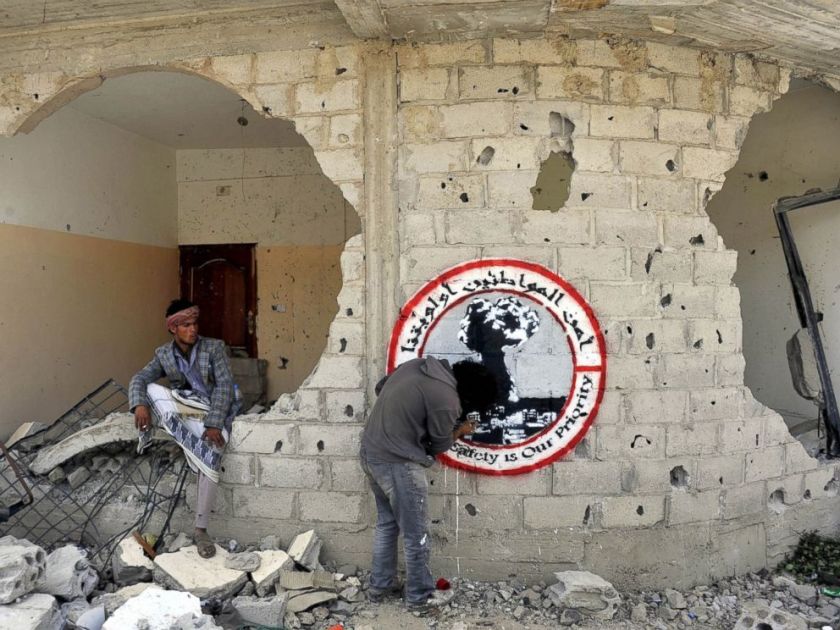
מוראד סובאי מצייר על קירות מבנים שנהרסו בהפצצות. כל פרח מייצג אדם שנהרג בהפגזה הזו. שני עלים – מבוגר, עלה אחד – ילד.
המשכתי לקרוא ולעקוב אחרי המצב בתימן, שהתדרדר מאז שיחתינו הקודמת. תימן, שהיתה עניה גם קודם לכן, מדממת. הארץ הפכה למזרח הפרוע: ארץ שבה אין שלטון מרכזי דה פקטו, כוחות שונים נלחמים זה בזה באכזריות. כבר שנה שהפצצות אוויר סעודיות יומיומיות פוגעות גם במטרות אזרחיות. שיטת הפעולה הסעודית דומה להפליא למבצעים שלנו בעזה, אך ללא הביקורת האינטנסיבית מבחוץ. הסעודים (הסונים) נהנים מתמיכה מלווה בעצימת עיניים (ואספקת נשק) מצד המערב. המטרה הרשמית הם המורדים החות’ים (השיעים, נתמכים ע”י איראן) אבל הפצצות מהאויר זורעות הרס לתשתיות ופוגעות באזרחים מדי יום.
המלחמה בחות’ים מאפשרת לאל קאעידה לשפר עמדות ומקלה את כניסתו של שחקן נוסף: דע”ש, אבל לפיגוע דע”ש בצנעה אין הד כמו לפיגוע דומה בבריסל. מצור מהים והיבשה שנאכף על ידי הסעודים מונע סחורות וסיוע הומניטרי. יותר ממליון וחצי תימנים איבדו את ביתם, חצי מהאוכלוסיה אינה יודעת מהיכן תגיע הארוחה הבאה (רוב המזון בתימן תלוי ביבוא), התשתיות הרוסות.
Murad Sobay Street Art
הכיתוב: Citizens Safety is our priority
כיצד נשאר סבל כזה כל כך רחוק מהעין בעידן הגלובלי, מעבר לאינטרסים הברורים של מי שאמור לייצג ליברליזם? בהעדר רשות מרכזית שאחראית על הביטחון, התקשורת נמנעת מלהגיע (נוכחות מצומצמת לעומת מקומות עימות אחרים). כמו כן, בשל המיקום הגיאוגרפי פליטים תימנים אינם מציפים את אירופה, כך שהם לא ״בעיה״ ולא יוצרים אי נוחות במערב – סבלם רחוק מהעין ורחוק מהלב.
התימניה שלי מנסה בכל דרך להגיע למודעות ציבורית. היא מעורבת בדף פייס ״I love Yemen“, שמטרתו להדגיש את הצד היפה של תימן ומשתדלים לסנן פוליטיקה. לא פעם משתפים שם סירטונים מישראל: מעופרה חזה, A-WA, וקליפים מריקודים תימנים בחתונות. הם אוהבים וגאים מאוד ביהודים התימנים השומרים על קשר עם התרבות התימנית.
היא בכתה, וביקשה שאעזור, ואמרתי, אבל מה אני יכולה לעשות? את יודעת מאיפה אני. היא ענתה שהיא מנסה בכל כיוון, אפילו עזרה מהשטן היא תבקש … (האמפ), ואנחנו היהודים, יש לנו קשרים.
לא ידעתי איך לעזור ואולי היא התיאשה ממני. לא המשכנו לדבר.
לפני שבוע הוכרזה הפסקת אש לקראת שיחות שלום שיתקיימו השבוע (החל ב-18 באפריל) בכווית בחסות האו”ם. האופטימיות אינה בשיאה: הפסקת האש נשמרת באופן חלקי ונסיונות להגיע להסכמה בבעבר, בשיחות דומות בג’נבה שהתקיימו בדצמבר – נכשלו. ארגוני זכויות אדם קוראים לספקי הנשק להפסיק לחמש את הצדדים.
Graffiti Artist Portrays the Horrors of War in Yemen
By Lena Masri
LONDON — Oct 28, 2016, 2:13 PM ET
Yahya Arhab/EPA
WATCH Footage of Starving Teen in Yemen Shows the Horrors of War
When Murad Subay takes a walk in his city of Sana’a in Yemen, he witnesses scenes that he didn’t see two years ago:
There’s trash everywhere. The roads, even the main streets, are full of holes, some completely without asphalt. Passersby look sad and cautious.
Many don’t have access to clean water or enough to eat. Some beg for food, while others are too proud to ask. Instead, they go out at the end of the night, looking for leftovers in the trash.
“Before the war, people would go to gardens, recreational parks and take walks,” Subay, 29, told ABC News. “Now, they mostly stay in their homes and try to live.”
Courtesy Sharaf Alhoth
Artist Murad Subay of Yemen is pictured in an undated handout photo. more +
Subay, an artist originally from Dhamar, Yemen, moved to the capital Sana’a with his family in 1993. He now uses the walls of the city to paint about the 18-month-old war there.
Yemen is one of the world’s poorest countries and the war has made conditions much worse: The United Nations estimates that half the population — more than 12 million people — are in need of humanitarian assistance.
In June 2014, armed conflict between the government and militias spread across the country. Later that year, Houthi fighters, supported by former President Ali Abdullah Saleh forces, drove their way into Sana’a and, little by little, took over government institutions during the early months of 2015.
Hani Mohammed/AP Photo
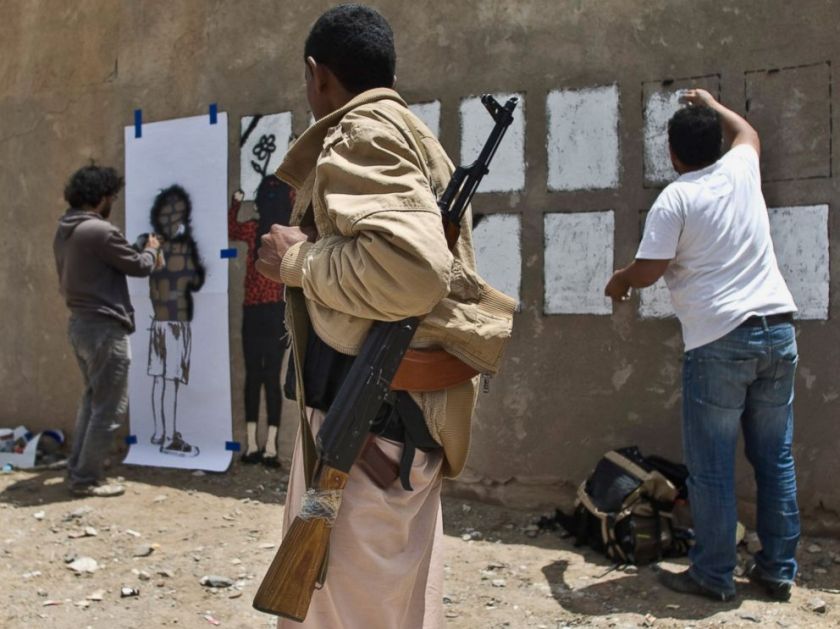
An armed man looks at Murad Subay and a collaborator spraying graffiti on a wall to commemorate the victims who were killed in Saudi-led coalition airstrikes in Sanaa, Yemen, May 18, 2015.more +
Interim President Abdrabbuh Mansour Hadi and his government fled the country. An Arab coalition of nine countries led by Saudi Arabia then initiated a military campaign to restore Hadi’s government to power.
Even before this conflict, Yemen had one of the highest rates of malnutrition in the world. The Rome-based World Food Programme is increasingly concerned about the lack of food and the growing rates of child malnutrition in Yemen.
In some areas like Hodeidah governorate, Global Acute Malnutrition rates have been recorded as high as 31 percent among children younger than 5, more than double the emergency threshold of 15 percent.
Almost half the children countrywide are irreversibly stunted, the World Food Programme says. Basic services across the country are on the verge of collapse. Chronic drug shortages, unpaid salaries and overall destruction restrict around 14 million Yemenis, including 8.3 million children, from accessing health care services, according to the World Bank.
Mohammed Hamoud/Anadolu Agency/Getty Images
Yemeni graffiti artist Murad Subay creates a piece on a wall to commemorate the victims who were killed in Saudi-led coalition airstrikes in Sanaa, Yemen on June 13, 2015.more +
In his art campaign, “Ruins,” started in May 2015, Subay paints about some of the country’s problems. He painted on walls last week with his friends under the theme “death by hunger and disease.” An emancipated child in a casket was among the motives.
“There’s hunger, so much hunger,” Subay said. “People wait in line for water. Cholera was a disease of the 19th century but now we have people suffering from cholera in Yemen in the 21st century.”
When he was younger, Subay used to paint and draw at home. But that changed with the Arab Spring in 2011.
“We chanted for civil rights and for justice in the squares. People from every region of Yemen were there,” Subay said.
He decided to move his art out in the public and started painting with others on walls. During the first campaign in 2012, he and fellow artists painted portraits of more than 100 people who’ve disappeared.
Since then, he has painted about civilian deaths, destroyed homes, life under siege and restrictions on freedom of speech. Subay says there are only a few newspapers left in Yemen and that they all represent the same voice.
Subay’s brother Nabil, a journalist, was shot in both legs by unknown perpetrators after he wrote critically about the war. He is now being treated in Cairo.
The parties of the conflict have also occasionally interrogated Subay and prevented him from painting in certain places. But that has never stopped him from initiating new campaigns.
Mohammed Huwais/AFP/Getty Images
Yemenis look at a piece of art by Murad Subay depicting the blockade in Yemen and the prevention of the entry of food and medicine due to the military campaign against Iran-backed rebels, in Sana’a, Yemen, Dec. 31, 2015.more +
“When you are doing the right thing, you should not fear anybody,” Subay, whose wife studies at Stanford University in California, said.
Financial struggles, however, prevent him from painting as often as he would prefer. Like many other Yemenis in the Arabic-speaking country, Subay doesn’t have a salary.
“I can’t paint like before,” he said. “Materials are expensive, so I only paint every two months. Before, I would paint something every two weeks. There’s almost no work because of the war.”
He started painting and drawing in a serious way when he was in the eighth-grade in 2001. He did a sketch of a boy on an A4-sized paper sheet and showed it to his parents.
“They said, ‘You are an artist, go on. They started supporting me by buying me materials and then it started,” Subay said, adding that he wants friends, passersby and anyone elseo who wants to join to take part in his street art.
Courtesy Murad Subay
Yemeni artist Murad Subay drew this picture of a boy when he was in 8th grade in 2001.
“Art gives hope and expresses the situation people are living,” he said. “It is the voice of people. In war, all voices are voices of hatred and destruction. What we do is show that there are other voices people can listen to. In times of war, even the smallest voices may save lives. Yemenis are in need of every voice in the world to push for stopping the war. The worst thing in war is when hope is lost. I personally also paint to protect myself from becoming hopeless.”
Saida Ahmad Baghili, 18, who is affected by severe acute malnutrition, sits on a bed at the al-Thawra hospital in the Red Sea port city of Houdieda, Yemen REUTERS/Abduljabbar Zeyad TPX IMAGES OF THE DAY
SANAA, Oct 25 – Yemeni street artists are daubing the capital’s walls with haunting images of war and starving children in an effort to highlight the impact conflict is having on the country’s population.
The graffiti, including a malnourished child locked in a blood-red coffin, is turning heads in a country where more than two thirds of the population are in need of some form of humanitarian aid, according to the United Nations.
“We came up with this campaign because of the internal and external wars in Yemen, the economic crisis, all of these factors led to famine and poverty in Yemen,” said participating artist, Thou Yazan Al Alawi.
More than 10,000 people have been killed, thousands more wounded and the healthcare and education systems have crumbled in Yemen‘s 19-month civil war.
A Saudi-led coalition launched an offensive last March aimed at restoring exiled Yemeni president Abd-Rabbu Mansour Hadi to power and ousting the Iran-allied Houthi movement from their strongholds.
“The war has made this country sick, people are dying of hunger,” said one passer-by, Yousef Abdelqawi.
“Can you imagine? These are the soldiers of the wars to come,” Subay told Index. “Without education, these children could become tomorrow’s fighters and tools in the hands of extremists.”
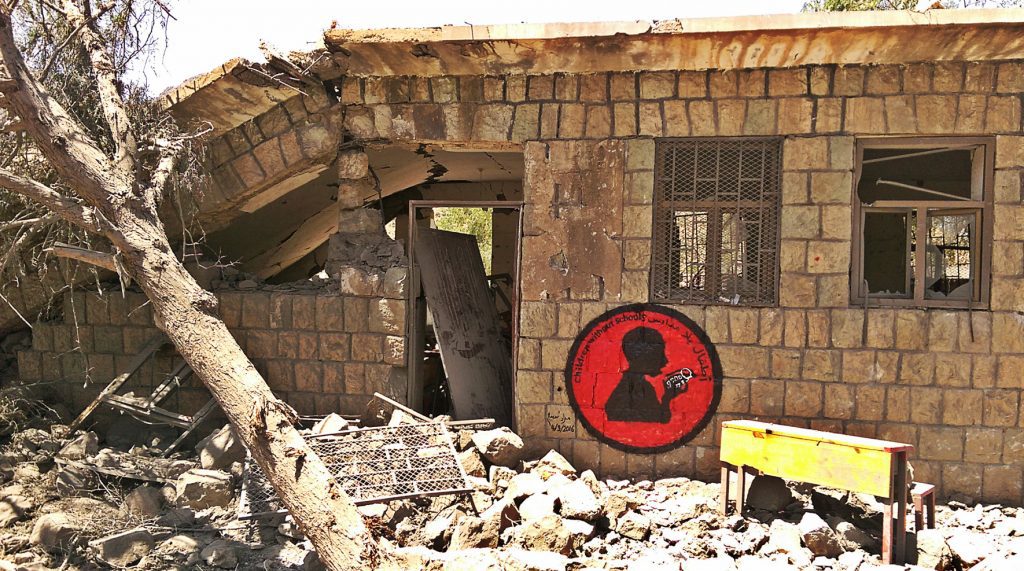
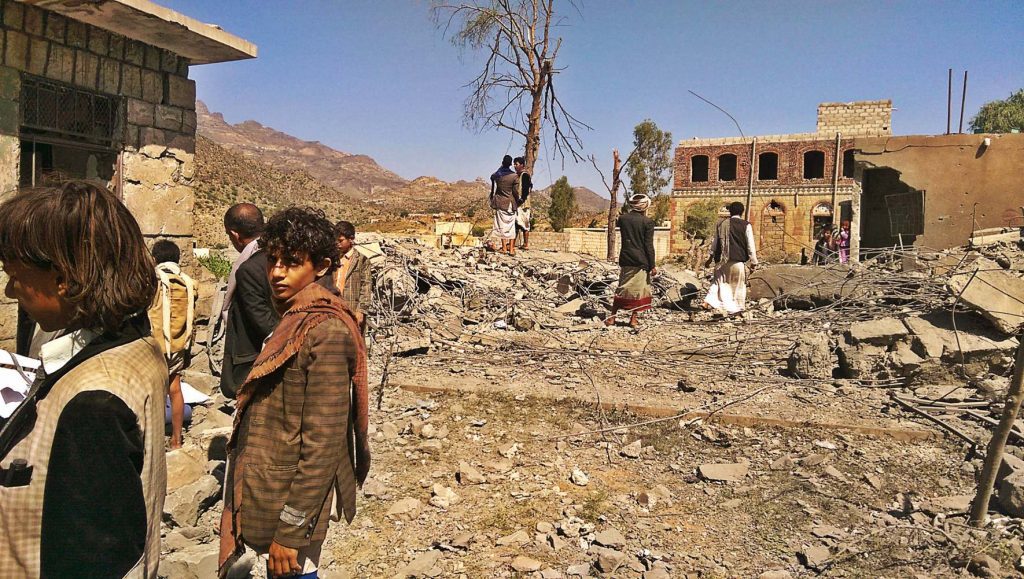
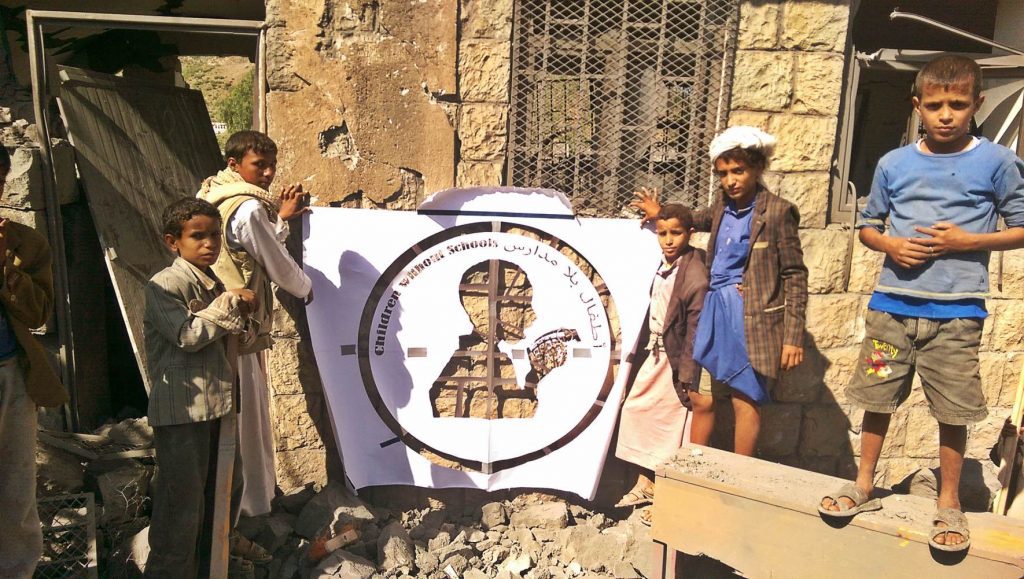
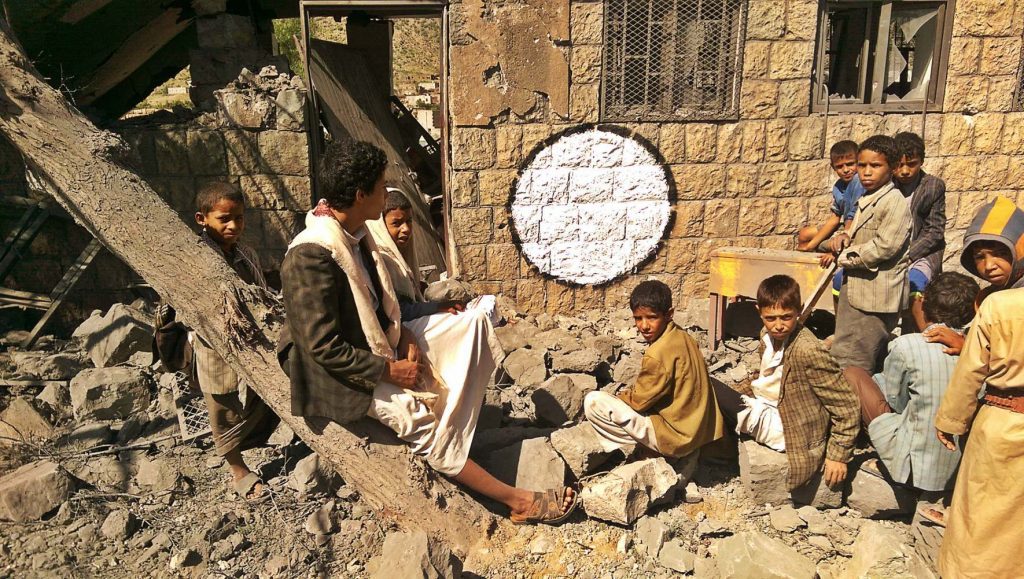
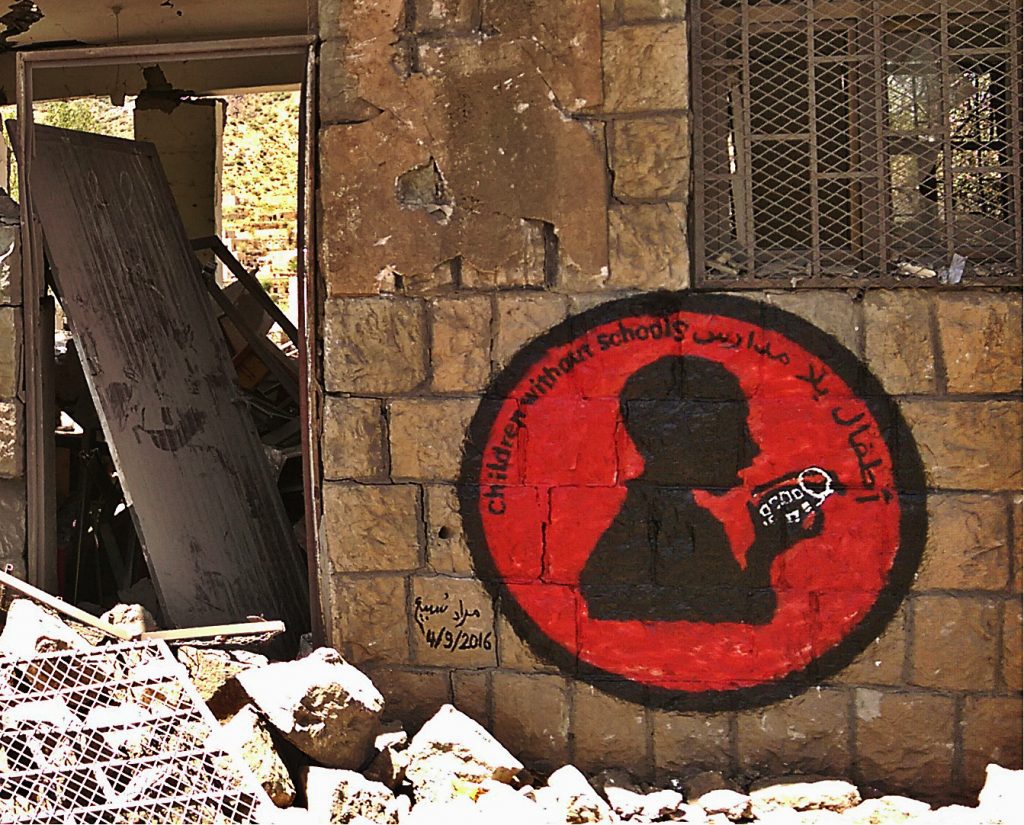
At dawn on 4 September Subay travelled to Bani Waleed to create a mural on what remained of al-Najah.
Credit: Ruins campaign. Bani Waleed, September 2016
“When we got there I asked some of the students what they were going to do now that their school was destroyed and some told me they will go to Sanaa while others said they will travel to surrounding villages,” Subay said. “But it will be much more difficult for the 400 girls who attended the school because traditions in Yemen mean they will not be able to travel alone, making it impossible for them to go to other villages to study.”
Murad Subay is the 2016 Index on Censorship Freedom of Expression Arts Award-winner and fellow. His practice involves Yemenis in creating murals that protest the country’s civil war. Read more about Subay’s work.
Destroying schools isn’t a big deal for the warring parties, the artist added. “Some of the children of those leaders who shout ‘death to America’ are studying at the best universities in the world, including in the USA, while each bombed school in Yemen – especially big ones like al-Haima – will take years to rebuild.”
The situation is made even more difficult in a time of war when resources and building materials are almost impossible to come by. “Even if the West stopped supplying weapons to Saudi Arabia today and patted themselves on the back saying ‘we are doing good’, Saudi Arabia already has enough to wage wars for another 150 years if it wants.”
If there is any hope for peace to prevail and schools, hospitals and other buildings belonging to the people are to be rebuilt, countries like Britain and America should take a step further and tell Saudi Arabia “to show restraint”, Subay said.
“While Saudi Arabia is doing the majority of the destruction, all sides of the war in Yemen must take responsibility.”
Credit: Ruins campaign. Bani Waleed, September 2016
Credit: Ruins campaign. Bani Waleed, September 2016
Credit: Ruins campaign. Bani Waleed, September 2016
The mural completed on 4 September depicts a child holding a hand grenade in place of a book, with the words “Children without schools” painted in English and Arabic.
When painting with fellow artists from the Ruins campaign – set up in May 2015 in collaboration with fellow artist Thi Yazen to paint on the walls of buildings damaged by the war – on 25 August, the group were arrested and interrogated by a local militia.
“They asked us to sign a letter with our fingerprints promising that we would not return again without permission,” Subay explains. “I actually did have permission from a local tribal leader but they wouldn’t listen.”
The artists were told if they returned they would be punished.
“My friends were very afraid and some of them said even with permission they would not return,” Subay said. “It was a strange situation for them.”
Subway himself isn’t put off and is already looking forward the next Ruins campaign, wherever that may be.
Assessing the situation in Yemen and the many different sides of the conflict, Subay said: “It is very difficult. Every night we hear airstrikes here and there, but we go on with our lives.”
“But any day when I can paint is a good one.”
Nominations are now open for 2017 Index on Censorship Freedom of Expression Awards and will remain openuntil 3 October. You can make yours here.
In Yemen’s restive capital of Sana’a, colorful signs of hope emerge amid scenes of wreckage from the country’s ongoing civil war. Vivid murals on the walls of damaged buildings memorialize the many thousands of lives lost since 2011. Artist Murad Subay’s mural campaign, called “Ruins,” calls for peace.
Yəmənin ilk inqilabçı küçə sənətçisi Murad Subay.
Murad inqilabdan sonra divarlara müharibənin izlərini həkk edir
Rəssam həlak olan insanların üzlərini, onların həyat hekayəsini divarlara köçürür.
O, yanlış verilmiş siyasi qərarlara fırçasıyla etiraz edir.
“Yəmənli Banksi” ləqəbi ilə məşhurlaşan Murad məqsədinin insanların qorxularını, ümidlərini və düşüncələrini divarda əks etdirmək olduğunu deyir.
Murad tək deyil. Rəssamın müharibəyə, təcavüzə etirazına dostları da dəstək verir.

















 Murad Subay