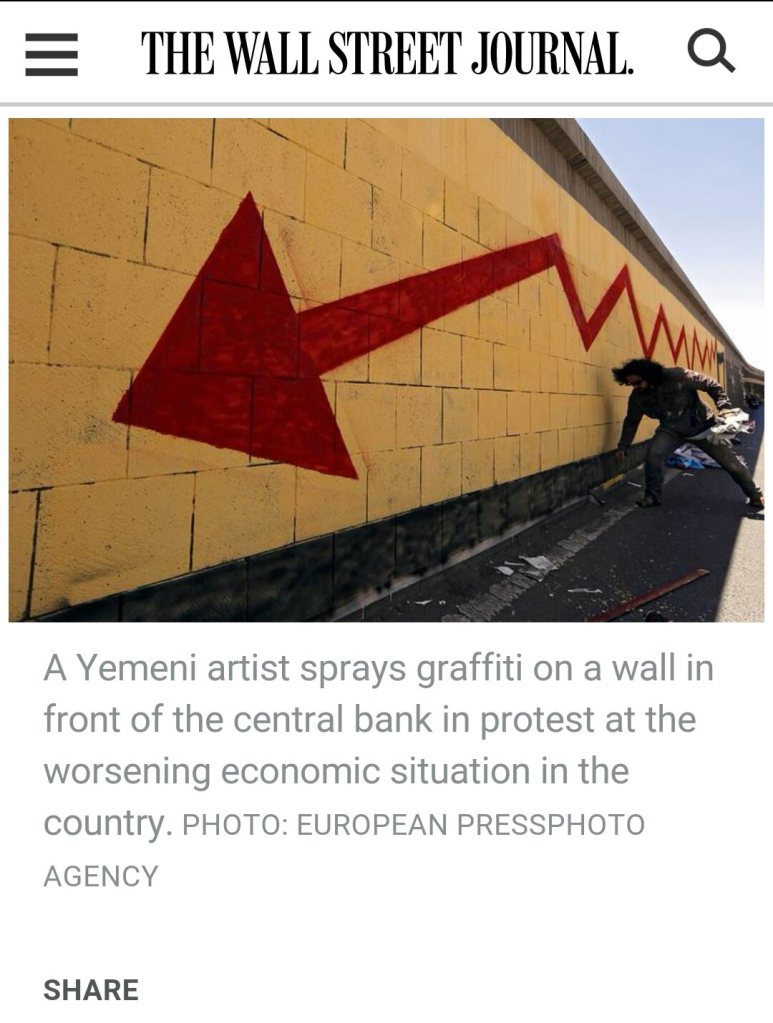
A Yemeni artist sprays graffiti on a wall in front of the central bank in protest at the worsening economic situation in the country.PHOTO: EUROPEAN PRESSPHOTO AGENCY

A Yemeni artist sprays graffiti on a wall in front of the central bank in protest at the worsening economic situation in the country.PHOTO: EUROPEAN PRESSPHOTO AGENCY


An interview with me on BBC Radio in their based in London on “The Cultural Frontline” program, titled by “Identity and Adversity”. I talked in six minutes (20-26), about the street art campaigns and the situation in Yemen. April 2016.


Something peculiar is afoot in Yemen: the usually arcane topics of monetary policy and central banking have become part of everyday chatter, even street art.
Since a Saudi Arabian-led coalition began airstrikes in March 2015 in a bid to oust Houthi rebels from power, some 6,500 people have been killed, and those official numbers are likely far too low.
But what is less reported is how the war has also devastated Yemen’s economy. Most of the country’s exports came from oil and gas, and those industries are simply not functioning.
Last month, a mural appeared on a wall in front of the country’s central bank – seen as a rare neutral and stable institution in Yemen’s fractious conflict. The jagged red line reflected the wild fluctuations of the faltering Yemeni rial.
The artist, Murad Subay, called his work “The Saw”, a reflection of how the economic situation is sawing his country apart. He was inspired to take out his brushes by headlines that the central bank is the last hope for his country’s faltering economy.
“People are devastated because of the currency fluctuation,” Subay told IRIN by email. Prices have shot up while wages have stagnated, he said, and “many people can’t afford to live under this economic situation; they can’t afford to purchase food and basic services”.
For the past few months, commentators have been warning that Yemen’s central bank is in serious trouble.
It is perhaps surprising it has survived this long – after all the country has been ravaged by a war that has become too complex to fit into two sides: it includes multiple local conflicts and allegiances that are tough to untangle.
Related: Why does no one care about Yemen?
The central bank sets official exchange rates for imports of flour and grain. It had also, until recently anyway, managed to keep paying government employees like soldiers, teachers, and doctors – no matter their loyalty or location.
But how long it can prop up a country on the brink of complete economic meltdown is unclear.
Marwa al-Nasaa, resident representative for the International Monetary Fund in Yemen, told IRIN that “the Yemeni economy and rial are obviously in dire straits”.
“After 15 months of intense conflict, the central bank’s reserves, understandably, are running low,” she explained in an email. If foreign reserves become more depleted and the bank can’t prevent the rial from falling further, “it would hit the average Yemeni hard, and the very poor would likely suffer most”.
While there are unconfirmed reports that the Houthis have raided the bank’s reserves, under the hand of respected governor Mohammed Bin Humam, it has done it’s best to keep the currency stable, altering the official exchange rate to combat black market trading.
“Over the last 15 months, by all indications, the central bank tried to deal as neutrally as possible with a very difficult economic, social, and security situation in Yemen,” said al-Nasaa.
“But its ability to maintain foreign exchange support for the most basic imports, service sovereign debt obligations, and pay public sector wages is becoming more and more circumscribed.”
While all this sounds rather academic, it’s not.
Hisham al-Omeisy, an analyst based in Sana’a, pointed out out that what the bank does – or doesn’t do – has a direct impact on everyday life and everyone knows it.
“It affects us directly with pricing, with getting gas… A lot of people don’t have money to begin with,” he explained to IRIN, so any shift in prices can feel drastic.
One impact of the crisis in the banking system has meant that traders seeking to import goods into Yemen – including food – have been unable to acquire credit.
That means food imports are down, and prices are up. In the capital, a 50-kg sack of flour goes for 7,500 rial, compared to 5000 rial a few months ago. In areas like Taiz, prices are significantly higher still.
And it’s hard to buy pricey food without a regular salary.
As of September 2015, the General Union for Yemeni Workers’ Syndicates estimated that three million people had lost their jobs due to the war.Those who still have employment, like the always-in-demand taxi drivers of Sana’a, find it hard to keep going when fuel is in short supply and expensive.
“It’s really hard to make money for your children to survive while you [also] need to feed your car with fuel to keep working,” said cab driver Ahmed Shamsan, a father of three.
The situation is deteriorating fast. Earlier this month, the bank reportedly stopped paying some government salaries, at least for the time being.
And it could yet get worse.
“If basic imports such as grains, fuels, medicines, and fuel are constrained further, this would quickly spill over into the daily lives of people that are on the edge already,” warned al-Nasaa.
Among the sectors hit hardest by the economic crisis is health, an area that was already in a bad way.
Recently returned from Yemen, Karine Kleijer of the medical charity Médecins Sans Frontières has witnessed the country’s healthcare system come grinding to a worrying halt.
“You see that – slowly – programmes like vaccinations and things that should work are no longer functioning because [clinics and hospitals] are just running out of supplies,” she told IRIN.
If public doctors and nurses are unpaid it would represent a really dangerous situation, Kleijer said, as the majority of private clinics have already shuttered and locals are depending solely on publicly-funded healthcare.
“Our biggest concern is the health system is going backwards rapidly. We are at the end of our [tether],” Kleijer added.
Back in 2012, Saudi Arabia stepped in to help Yemen’s economy with a $1 billion deposit in the bank.
“No economic situation improves during wartime… the war needs to stop first”
But as a belligerent in the conflict, further financial support now seems an unlikely prospect, although there are reports that they have demanded the bank move to Riyadh or Aden, which had been a stronghold for Saudi-aligned forces.
Al-Nasaa said the IMF can’t “simply intervene to defend the rial”.
Instead, she said, “it could support a programme designed by the Yemeni authorities, where the authorities would be able to assume and implement programme commitments”.
The IMF does offer concessional lending to low-income countries with urgent needs.
“The IMF has closely engaged with Yemen in the past,” she said, “and it certainly stands ready to help again once conditions would allow [it] to do so”.
Everyone, and that includes al-Nasaa, says the best way to shore up Yemen’s economy is peace.
“The best that could happen is that the conflict parties find a way to a durable peace agreement, and all stakeholders could work together to stabilise and reconstruct Yemen,” she said.
But talks in Kuwait appear to be headed nowhere quickly.
Subay, the muralist, is concerned for his country, even if the bank gets help.
“I don’t think that this crisis can be solved by some kind of resolution on paper. No economic situation improves during wartime… the war needs to stop first.”
(TOP PHOTO: Murad Subay’s “The Saw” in Sana’a. Murad Subay/IRIN)


Artiste de 29 ans né au Yemen, Murad Subay est le Banksy local. Mais contrairement au street artist britannique qui dissimule son identité, Murad Subay expose son visage et ses oeuvres à la vue de tous. C’est en 2001 qu’il commence à peindre sur les murs de Sanaa, la capitale du Yemen et c’est presque seul qu’il lance, dans un pays divisé et en guerre le street art yéménite. Et dans une dictature, pas évident de faire des graffitis politiques sans être inquiéter.

Cependant, Murad Subay n’a pas toujours été un artiste pacifiste. En 2011, il est un des leaders du printemps arabe au Yemen, durement réprimé par le régime. Mais au moment où ces camarades prennent les armes, il choisit le pinceau et les bombe de peintures. Aujourd’hui pacifiste , Murad Subay dénoncent sur les murs de son pays les atrocités de la guerre civile opposant les miliciens chiites au régime sunnite soutenu par l’Arabie Saoudite et les États-Unis. L’artiste combat aussi l’intégrisme religieux caractérisé par la forte présence d’Al Qaida dans la région mais aussi la politique interventionniste des États-Unis, symbolisé par les attaques quotidiennes de drones.

Sa première campagne « colore les murs de ta ville » a été lancé en 2012 juste après les affrontements qui avait secoué la capitale. La campagne visait à effacer les traces du conflit dans les zones les plus touchées. Il encourageait ainsi les passants et les habitants sur les réseaux sociaux à venir peindre des messages de paix sur les ruines des immeubles détruits par les obus et les balles. Cette campagne a duré trois mois et s’est étendue à d’autres villes du pays comme Aden, Taizz.

En 2012, il lance sa deuxième campagne, « les murs se souviennent de leurs visages ». Elle présentait les visages de policiers, civils et opposants politiques disparus. Dans un pays où toute contestation est sévèrement réprimée, sa démarche a pourtant fait le tour du pays et ces visages oubliés ont pu atteindre des provinces reculées. Souvent ironique et irrévérencieux, Murad Subay n’a pas encore été censuré ou intimidé par le gouvernement à l’inverse des extrémistes religieux qui l’ont menacé de mort.


« 12 Hours », sa campagne la plus récente mettait en avant les 12 plus gros problèmes rencontrés par la société yéménite. Vaste programme pour un pays déchiré par la guerre civile. On peut citer au delà du terrorisme et de la dictature le trafic d’armes, les enlèvements, le trafic d’organes et d’êtres humains ou encore les frappes de drones. Avec sa démarche positive, l’artiste a reçu des récompenses liés à l’art ou encore le soutien de l’ONU qu’il a préféré rejeter pour maintenir son autonomie.


En l’espace de deux ans, Murad Subay a peint sur plus de 2000 murs dans tous le pays, invitant quiconque le souhaite à venir participer. « Mes campagnes ne seraient rien sans les gens, même des soldats baissent leurs armes pour donner des coups de pinceaux » dit l’artiste. Et entre la guerre civile, le sectarisme religieux et l’ingérence étrangère, les modestes peintures politiques de Murad Subay ne peuvent être que positives et saines dans une société dictatoriale ravagée par la violence.

In Yemen’s restive capital of Sana’a, colorful signs of hope emerge amid scenes of wreckage from the country’s ongoing civil war. Vivid murals on the walls of damaged buildings memorialize the many thousands of lives lost since 2011. Artist Murad Subay’s mural campaign, called “Ruins,” calls for peace.

“Do you think art can increase global awareness of Yemen’s humanitarian crisis?
Art is often used to send powerful messages, especially when it discusses the issues that concern people. Art can be understood globally; it is a universal an peaceful language. For this reason, I believe that using this medium to highlght the ‘forgotten’ Yemeni crisis and conflict might help in getting some of the attention that we need.”


Yemeni Artist Murad Subay has spent the last seven years in decorating Sanaa’s streets with murals and colorful paintings.
Since the Arab Spring kicked off in 2011, Subay has drawn hundreds of paintings on the walls of Sanna’a, which have been damaged by the war, aiming to highlight the oppression and sufferance of millions of Yemenis caused by the war, poverty, and revolution in their country.
Till this day, Subay launched five artistic campaigns, and each focused on a different aspect of the conflict, including the incidents of kidnap, disappearance, corruption, poverty, killing of civilians, drones’ use, and the huge devastation of his country’s infrastructure.
While drawing one of his paintings near the Yemeni Central Bank, Murad Subay said: “Today we are near the Yemeni Central Bank, and we want to say that economy shall find real solutions, stop the corruption and the collapse of the national economy”.
The deterioration of the Yemeni economy has increased with the launch of the civil war in March 2015, when the Saudi-led Arab coalition kicked off an air attack to overthrow the Houthis, and to return the government of President Abd Rabbo Mansour Hadi. The conflict led to the death of more than six thousand Yemeni to date, displaced more than two million people, and involved the poor country in one of the worst world humanitarian crises ever.
Subay has called his recent campaign “Ruins”, and drew paintings on the walls of the buildings damaged during the war, to commemorate thousands of people who lost their lives in the conflict.
Subay does not work alone. Over the years, he has called the youth who live in the neighborhoods near the city to join him, and hundreds have responded. The artist stresses that art is the best peaceful and influential mean to refuse oppression and to emphasize sufferance. Subay said that colors and paintings are a decent and peaceful call for Yemenis to refuse hatred and conflicts, and to move toward the construction of their country and to stop its destruction.
Subay received many global awards for the political expressions he use in his works. Yet, he sees that he earned these awards due to the support of his friends, family, and the Yemeni people, saying teamwork can make a significant difference in Yemen.
“Defaced Murals”
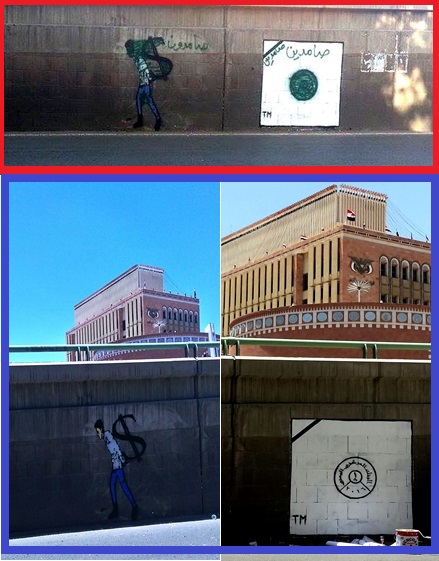
In the picture appears the murals of the two artists, Thi Yazan Al- Alawy and Tammam Mohammed, after being defaced. Whoever defaced the murals wrote the word “Steadfast” on both of them.
The two artists painted those murals within “Ruins” campaign in its eighth activity around “Economy Collapse”, in front of Yemen Central Bank, on June 9, 2016.
The murals were painted merely to reflect the disastrous economic situation of the country and the situation of the Yemeni citizens during these hard times, and no warring party was subjected by any of them.
I find myself wondering, has it become undesirable to express the sufferings endured by the Yemeni people during these conflicts?!
“جداريات مطموسة”
في الصورة تظهر جدارياتا الفنانان “ذي يزن العلوي” و “تمام الشيباني” والتي نفذاها ضمن حملة “حُطام” الخميس 9 يوينو 2016، حول موضوع “تدهور الإقتصاد” في اليمن. في المربع الأحمر تظهر الجداريتان بعد طمسهما وكتب عليهما “صامدون”.
رسمنا جداريات تعبر عن الوضع الإقتصادي الكارثي الذي وصل له الشعب اليمني والبلد، جداريات لا تنتمي أو تتعرض لأي طرف من أطراف الحرب، وإنما حاولت التعبير عن معاناة الإنسان اليمني في هذا الوقت الكارثي.
هل أصبح حتى التعبير عن المعاناة التي يعيشها الشعب اليمني في ظل الحرب وويلاتها أمرا غير مرغوب به؟!

English Text Follows:
عانى اليمنيون الأمرين خلال هذه الحرب، الدمار والقهر والجوع والعطش، وفوق ذلك، يعانون الآن من دمار شبه كلي لإقتصادهم.
جداريتي الثامنة “المنشار”، ضمن حملة “حُطام” في النشاط الثامن بعنوان “تدهور الإقتصاد”، على جدار جسر الصداقة، شارع التحرير، صنعاء بتاريخ 9 يونيو 2016. يظهر في الصورة “البنك المركزي اليمني”.
Yemenis have suffered both, destruction, oppression, hunger and thirst, and above it all, they are now going through even harder times with the almost economy collapse.
My mural “The Saw”, in the eighth activity of “Ruins” campaign around “The Economy Collapse”. It was painted on Al-sadaqah bridge, Tahrir street, Sana’a, on June 9, 2016. The “Central Bank of Yemen” appears in the picture.