انتقلت الثورة من الشوارع والمظاهرات والمسيرات، ومن الفن الحركي من الأفلام والأغاني الثورية والمسرحيات السياسية إلى فن جديد ومن نوع آخر، وهو فن الرسم على الجدران، فن الجرافيتي والطريقة المبتكرة في الثورة على الأنظمة والحكومات بسلمية من خلال الفن الصامت، الذي يصور قضايا مجتمعية من خلال رسوامت ملونة أو بالأبيض والأسود على الجدران.
اشتهر فن الجرافيتي بالتزامن مع أحداث الربيع العربي في مصر وفلسطين و اليمن بالذات، وذلك عن طريق رسم صور للشهداء على جدران الشوارع، لتذكير الشعب بالجرائم الدموية التي ارتكبتها الأنظمة تجاه شعوبها، كما يتم كتابة الشعارات التي استخدمها الثوار في بداية الربيع العربي حتى لا ينسى الشعب مطالبه التي لم تحقهها الأنظمة بعد.
اليمن
الفنان مراد سبيع، المُلقب في اليمن بفنان الشارع، الذي حوّل بقايا الدمار الذي أحدثته غارات التحالف السعودي على اليمن إلى جدران ملونة ورسومات تعبر عن الوضع الحالي في اليمن، استمر مراد في ملاحقة الأماكن التي تخلفها قوات التحالف مدمرة، ويعيد أحيائها بألوانه، الصورة السابقة هي لمجمع سكني تم قصفه من قبل قوات التحالف وقُتل فيه 15 طفلًا، قبل أن يذهب مراد إلى نفس المكان ليرسم على الجدران 15 وردة وبجانبها شريط أسود للحداد على أرواح الأطفال ضحايا القصف.
يقول مراد في حوار على على موقع هافينجتون بوست بأن هذا ما استطاع القيام به تجاه الحرب القائمة في بلده، وبأنه يجب عليه أن يلقي الضوء على ما تفعله تلك الحرب بأهله، وأن يُخلد تلك الصور على جدران المدن، لكي لا ينساها الناس أبدًا، ولكي يعرف العالم ما تكلفه الحرب، وما يخسره الناس بعدها.
قام مراد سبيع بحملة فنية في شوارع صنعاء سُميت باسم خراب، جمع فيها غيره من الفنانين لمدة ثلاثة أيام، للتظاهر عن طريق الرسم على الجدران، كما شجع فيها المارة العاديين في مساعدتهم في تصوير مطالبهم الثورية ومشاكلهم الاجتماعية في صورة رسومات على الجدران، تم منع مراد أكثر من مرة من قِبل الجيش في الشوارع من الاستمرار في الرسم وإلا سيتم اعتقاله.
قام مراد برسم لوحات معبرة عن حالة المدن اليمينة بعض الحرب، والتي وقع بعضها تحت حصار داخلي وخارجي ولم تتلقى المعونات الغذائية أو العلاجية لشهور كاملة، فرسم جرافيتي تعبيري لها في مركز مدينة صنعاء.
فلسطين
الجرافيتي فنٌ هادف، يسعى الفنان من خلاله إلى إيصال رسالة قد تكون متعلّقة بقضايا اجتماعية أو سياسية، أو أزمة معيّنة داخل البلاد، وتعدّ فلسطين أوّل دولة عربية ظهر فيها هذا النوع من الفنون مع اندلاع “انتفاضة الحجارة”؛ فكان أحد أساليب المُقاومة التي جرّمها الاحتلال وفرض على كل من يمارسه عقوبة السجن.
وكان عام 2000 وهو العام الذي قرّرت فيها سلطات الاحتلال أن تعزل الضفة الغربية عن القدس والأراضي المحتلة عام 1948، هو العام الذي تجلّى فيه فن الجرافيتي بشكل كبير، حيث وجد الفنانون الفلسطينيون والعالميون في جدار الفصل العنصري مساحة واسعة للتعبير عن رفضهم للجدار ذاته وللاحتلال.
حاجز قلنديا، الضفة الغربية
تعد الضفة الغربية من الأماكن التي تحتوي على فن للجرافيتي متجدد ومستمر، جعل للقضية الفلسطينية مكانًا بارزًا بين الفنون العالمية، وجذب الفنانين العالميين لإلقاء الضوء على القضية الفلسطينية، بل والذهاب إلى الضفة الغربية والمشاركة في رسم قطع فنية لهم من فن الجرافيتي على الجدار العازل.
مصر
يعد الجرافيتي أحد منتجات الحضارة الفرعونية والاغريقية، تجسد في الرسومات الموجودة على جدران المعابد والكهوف، استخدمه الزنوج مع موسيقى الراب في الولايات المتحدة الأميركية، للتعبير عن ما يجدونه من عنصرية وفقر، وتطور ليصبح فيما بعد وسيلة من وسائل الاحتجاج، تستخدمها الحركات السياسية للتعبير عن آرائها وأفكارها.
ولكن بعد عام 2005، وبعد ظهور روابط الأولتراس الرياضية، وفناني الهيب هوب، اتخذ فن الجرافيتي شكلاً جديداً أكثر احترافية، لأن شباب الأولتراس وفناني الهيب هوب يعتبرون فن الجرافيتي جزءاً من ثقافتهم، ووسيلة للتعبير عن أفكارهم، ونتيجة لتطور وسائل الاتصال، استطاع هؤلاء الشباب تعلم الجرافيتي عبر الانترنت.
اليوم يعد الجرافيتي في مصر هو بمثابة صرخة احتجاج على الجدران، وذلك لتوثيق أحداث الثورة عبر نقشها على جدران ميدان التحرير لينتشر في أكثر من مكان بالقاهرة والمحافظات، ورسم فنانون جداريات للشهداء تجسد بطولاتهم وأخرى تسخر من الرموز الذين قامت ضدهم الثورة.
وغالبًا ما يكون فنّان الجرافيتي مجهولًا حيث يوقّع فنّانو الكتابة على الجدران باسم مستعار يكون غالباً مزيجا من الحروف والأرقام، ويصرّ معظمهم على البقاء مجهولين، حتّى لو وصلت أعمالهم إلى المتاحف، أو حتّى بيعت حيث يعتبرها البعض مشاركة ضد اسقاط نظام بعينه أو ربما تساهم في تغير هيكلة الدولة التي تجرم قانون المظاهرات.
ورغم اختفاء بعض من رسومات الجرافيتي الاحتجاجية، لا يزال هذا الفن موجوداً بقوة، كوسيلة للتواصل، وصرخة مكبوتة تجعل الجدران والأرصفة تنطق بما لا تستطيع أن تنطق به الألسنة.
السبت – 27 شهر رمضان 1437 هـ – 02 يوليو 2016 مـ – رقم العدد13731
فنان يمني يشجع الشباب على تجميل الشوارع بجداريات ولوحات ملونة
لنبذ الكراهية والصراعات والتوجه إلى بناء بلادهم
الثلاثاء – 16 شهر رمضان 1437 هـ – 21 يونيو 2016 مـ رقم العدد [13720]
لوحة كتب عليها العيش بسلام
تعز: «الشرق الأوسط»
في محاولة لنشر السلام والفن، أمضى الفنان اليمني مراد سبيع السنوات الست الأخيرة يزين شوارع صنعاء بجداريات ولوحات ملونة، لكي يناقش المجتمع قضايا سياسية حساسة وأخرى اجتماعية.
فمنذ تفجر انتفاضات الربيع العربي عام 2011، رسم سبيع مئات اللوحات والجداريات على الجدران المتداعية في صنعاء التي تمزقها الحرب، وذلك من أجل لفت الأنظار للمعاناة والظلم الذي يعانيهما ملايين اليمنيين في وقت تطوق فيه الحرب والفقر والثورة بلدهم.
وأطلق سبيع حتى الآن خمس حملات فنية تركز كل منها على أبعاد مختلفة للصراع، منها عمليات الخطف والاختفاء القسري ليمنيين منذ تفجر أحدث انتفاضة، إضافة إلى الفساد والفقر وقتل المدنيين واستخدام الطائرات بلا طيار والدمار واسع النطاق للبنى التحتية في البلاد.
وقال مراد سبيع بينما يرسم أحدث جدارياته قرب البنك المركزي اليمني: «اليوم نحن في المنطقة التي يوجد فيها خلفنا البنك المركزي اليمني، نريد أن نوصل رسالة أنه في الاقتصاد يجب أن يكون هناك حلول حقيقية وإيقاف للفساد وتدهور الاقتصاد اليمني».
وتفاقم تدهور الاقتصاد اليمني في أعقاب تفجر الحرب الأهلية التي بدأت في مارس (آذار) عام 2015، عندما شن تحالف تقوده السعودية هجوما جويا للإطاحة بالحوثيين، وإعادة حكومة الرئيس عبد ربه منصور هادي بعد أن طردها المقاتلون الحوثيون من العاصمة صنعاء ومدن وبلدات كبرى في أنحاء البلاد.
وتسبب القتال حتى الآن في مقتل أكثر من ستة آلاف يمني، وتشريد ما يزيد على مليوني شخص، وإدخال البلاد التي تعاني من الفقر أصلا في واحدة من أسوأ الأزمات الإنسانية في العالم.
وسمى سبيع أحدث حملاته «حطام»، ويرسم فيها لوحات على جدران المباني التي تضررت في الحرب، وذلك كنصب تذكاري لألوف الأشخاص الذين فقدوا حياتهم في الصراع.
وقال الفنان اليمني: «أنا والأصدقاء رسمنا كثيرا من الجداريات، كانت هناك قضايا كثيرة حول الاختطاف، حول الدرونز – الطائرات بلا طيار – وقضايا شاملة أيضا. ثم في آخر جدارية ما تبقى منها هي في آخر حملة حطام في هذه الحرب حول الحصار».
ولا يرسم سبيع لوحاته بمفرده، وإن كان هو الفنان الرئيسي. فعلى مر السنين، كان يدعو الشباب الذين يقطنون الأحياء القريبة من المنطقة التي يرسم فيها للانضمام له، وقد استجاب المئات لدعوته. ويؤكد سبيع أن الفن هو أفضل وسيلة سلمية ومؤثرة للتنديد بالقمع، وتسليط الضوء على المعاناة، مضيفا: «الأعمال الفنية والألوان والرسم وما إلى ذلك هي دعوة خالصة ونظيفة ومسالمة لليمنيين بشكل عام لنبذ الكراهية والصراعات، والتوجه إلى بناء بلادهم والتوقف عن تدميرها. سئمنا ما وصلنا إليه اليوم، سئم اليمنيون كثيرا هذه الحروب والصراعات».
وحصل سبيع على جوائز عالمية أكثر من مرة على التعبير السياسي الذي يقوله في أعماله الفنية.
فقد نال جائزة من منظمة المؤتمر الإسلامي الأميركي على عمله الخاص باليمنيين المختفين قسرا، الذين خطفوا على مدى سنوات بسبب انتماءاتهم وتصريحاتهم السياسية. كما نال جائزة الفن من أجل السلام التي تمنحها مؤسسة فيرونيزي الإيطالية. وفاز هذا العام بجائزة حرية التعبير عن فئة الفنون التي تمنحها منظمة «إندكس أون» البريطانية سنويًا.
وعلى الرغم من الجوائز التي حصل عليها، يؤكد سبيع أن ما ناله جاء بفضل دعم أصدقائه وعائلته والشعب اليمني، مشددا على أن العمل الجماعي هو الذي سيحدث فارقا هائلا في اليمن
Yəmənin ilk inqilabçı küçə sənətçisi Murad Subay.
Murad inqilabdan sonra divarlara müharibənin izlərini həkk edir
Rəssam həlak olan insanların üzlərini, onların həyat hekayəsini divarlara köçürür.
O, yanlış verilmiş siyasi qərarlara fırçasıyla etiraz edir.
“Yəmənli Banksi” ləqəbi ilə məşhurlaşan Murad məqsədinin insanların qorxularını, ümidlərini və düşüncələrini divarda əks etdirmək olduğunu deyir.
Murad tək deyil. Rəssamın müharibəyə, təcavüzə etirazına dostları da dəstək verir.
مراد سبيع يشجع الشباب على تجميل الشوارع بجداريات ولوحات مزينة مؤكدا أن الفن هو أفضل وسيلة سلمية ومؤثرة للتنديد بالقمع وتسليط الضوء على المعاناة.
العرب [نشر في 2016\06\21]
صنعاء – أمضى الفنان اليمني مراد سبيع السنوات الست الأخيرة يزين شوارع صنعاء بجداريات ولوحات ملونة في محاولة لنشر السلام والفن ولكي يناقش المجتمع قضايا سياسية حساسة وأخرى اجتماعية.
فمنذ تفجر انتفاضات الربيع العربي في 2011 رسم سبيع المئات من اللوحات والجداريات على الجدران المتداعية في صنعاء التي تمزقها الحرب، وذلك من أجل لفت الأنظار إلى المعاناة التي يمر بها الملايين من اليمنيين في وقت تطوق فيه الحرب بلدهم.
وأطلق سبيع حتى الآن خمس حملات فنية تركز كل منها على أبعاد مختلفة للصراع، منها عمليات الخطف والاختفاء القسري ليمنيين، إضافة إلى الفساد والفقر في البلاد.
وقال مراد سبيع، بينما يرسم أحدث جدارياته قرب البنك المركزي اليمني، “اليوم نحن في المنطقة التي يتواجد خلفها البنك المركزي اليمني. نريد أن نوصل رسالة مفادها أنه لا بد من حلول حقيقية لإيقاف الفساد الذي ينخر الاقتصاد اليمني وتدهوره”.
وسمى سبيع أحدث حملاته “حطام” ويرسم فيها لوحات على جدران المباني التي تضررت في الحرب، وذلك كنصب تذكاري لألوف الأشخاص الذين فقدوا حياتهم في الصراع.
ولا يرسم سبيع لوحاته بمفرده وإن كان هو الفنان الرئيسي، فعلى مر السنين كان يدعو الشباب الذين يقطنون الأحياء القريبة من المنطقة التي يرسم فيها إلى الانضمام إليه، واستجاب المئات لدعوته.
ويؤكد سبيع أن الفن هو أفضل وسيلة سلمية ومؤثرة للتنديد بالقمع وتسليط الضوء على المعاناة.
وقال “الأعمال الفنية والألوان والرسم وما إلى ذلك هي دعوة خالصة ونظيفة ومسالمة لليمنيين بشكل عام إلى نبذ الكراهية والصراعات والتوجه إلى بناء بلادهم والتوقف عن تدميرها”.
وحصل سبيع على جوائز عالمية أكثر من مرة على التعبير السياسي الذي يقوله في أعماله الفنية. فقد نال جائزة من منظمة المؤتمر الإسلامي الأميركي على عمله الخاص باليمنيين المختفين قسرا والذين خطفوا على مدى سنوات بسبب انتماءاتهم وتصريحاتهم السياسية. كما نال جائزة الفن من أجل السلام التي تمنحها مؤسسة فيرونيزي الإيطالية، وفاز هذا العام بجائزة حرية التعبير عن فئة الفنون التي تمنحها منظمة إندكس أون البريطانية سنويا.
An activist paints graffiti on a wall in Sanaa June 7, 2012. Since last month, a group of young artists took to the streets of Sanaa using graffiti as a medium to promote peace in neighbourhoods. REUTERS/Mohamed al-Sayaghi (YEMEN – Tags: CIVIL UNREST SOCIETY)
Yemeni Artist Murad Subay has spent the last seven years in decorating Sanaa’s streets with murals and colorful paintings.
Since the Arab Spring kicked off in 2011, Subay has drawn hundreds of paintings on the walls of Sanna’a, which have been damaged by the war, aiming to highlight the oppression and sufferance of millions of Yemenis caused by the war, poverty, and revolution in their country.
Till this day, Subay launched five artistic campaigns, and each focused on a different aspect of the conflict, including the incidents of kidnap, disappearance, corruption, poverty, killing of civilians, drones’ use, and the huge devastation of his country’s infrastructure.
While drawing one of his paintings near the Yemeni Central Bank, Murad Subay said: “Today we are near the Yemeni Central Bank, and we want to say that economy shall find real solutions, stop the corruption and the collapse of the national economy”.
The deterioration of the Yemeni economy has increased with the launch of the civil war in March 2015, when the Saudi-led Arab coalition kicked off an air attack to overthrow the Houthis, and to return the government of President Abd Rabbo Mansour Hadi. The conflict led to the death of more than six thousand Yemeni to date, displaced more than two million people, and involved the poor country in one of the worst world humanitarian crises ever.
Subay has called his recent campaign “Ruins”, and drew paintings on the walls of the buildings damaged during the war, to commemorate thousands of people who lost their lives in the conflict.
Subay does not work alone. Over the years, he has called the youth who live in the neighborhoods near the city to join him, and hundreds have responded. The artist stresses that art is the best peaceful and influential mean to refuse oppression and to emphasize sufferance. Subay said that colors and paintings are a decent and peaceful call for Yemenis to refuse hatred and conflicts, and to move toward the construction of their country and to stop its destruction.
Subay received many global awards for the political expressions he use in his works. Yet, he sees that he earned these awards due to the support of his friends, family, and the Yemeni people, saying teamwork can make a significant difference in Yemen.
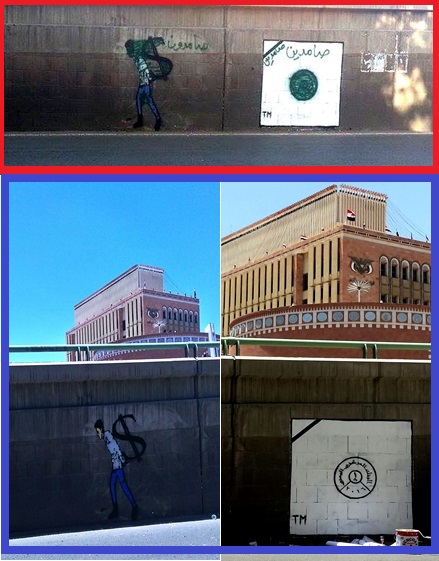
In the picture appears the murals of the two artists, Thi Yazan Al- Alawy and Tammam Mohammed, after being defaced. Whoever defaced the murals wrote the word “Steadfast” on both of them.
The two artists painted those murals within “Ruins” campaign in its eighth activity around “Economy Collapse”, in front of Yemen Central Bank, on June 9, 2016.
The murals were painted merely to reflect the disastrous economic situation of the country and the situation of the Yemeni citizens during these hard times, and no warring party was subjected by any of them.
I find myself wondering, has it become undesirable to express the sufferings endured by the Yemeni people during these conflicts?!
“جداريات مطموسة”
في الصورة تظهر جدارياتا الفنانان “ذي يزن العلوي” و “تمام الشيباني” والتي نفذاها ضمن حملة “حُطام” الخميس 9 يوينو 2016، حول موضوع “تدهور الإقتصاد” في اليمن. في المربع الأحمر تظهر الجداريتان بعد طمسهما وكتب عليهما “صامدون”.
رسمنا جداريات تعبر عن الوضع الإقتصادي الكارثي الذي وصل له الشعب اليمني والبلد، جداريات لا تنتمي أو تتعرض لأي طرف من أطراف الحرب، وإنما حاولت التعبير عن معاناة الإنسان اليمني في هذا الوقت الكارثي.
هل أصبح حتى التعبير عن المعاناة التي يعيشها الشعب اليمني في ظل الحرب وويلاتها أمرا غير مرغوب به؟!
“في صنعاء كذلك، رسمٌ متواصل على ما تبقى من المدينة. رسم مراد سبيع سابقاً على ركام المدينة مشروعه “حُطام”. صارت المباني المدمرة جزئياً دفتراً مفتوحاً له، وحوّلها إلى رسائل مضادة للحرب، نال بعدها جائزة “الفن من أجل السلام”. عاد سبيع في 16 آذار/ مارس الحالي ليحتل الشارع، ودعا معه ناس المدينة للمشاركة في الرسم على جدران شارع الرباط في صنعاء، فَقَدِم منهم رجال ونساء وأطفال وكبار. لا يعود مهماً هنا “جودة” العمل الفني بالمعنى التقني، لكن أن يستعيد سكان المدينة سيطرتهم على جزء من الحيز المعماري الذي يشغلونه، أن يكون لهم حق ترك أثر ما عليه، وأن ينقل هذا الأثر أملهم بيمن بلا حرب.
هذه الفنون التي تجاهلت الوسائط الكلاسيكية، يصنعها شباب يعتبرون المدينة مساحة ضرورية للعمل وعرض الأفكار، يرونها ستوديو كبيرا. أهمية الفن المديني تكمن أولاً في كونه (غالباً) غارقا في الهم الاجتماعي والسياسي. وفي كونه ثانياً يقدّم رؤية مختلفة لدور الفنون واستعمال الحيّز. عليك أن تركّب أفكارك مع المدينة أولاً، ثمّ أن تعيد تركيب العمل (ربما مع فنان جديد) فوق العمل الأول الزائل أو المتغيّر، وربما بتقنيات أخرى، ودائماً بنظرة مختلفة. تتراكم طبقات المدينة ويغمر بعضها البعض.
لا يكترث من يرسم على حائط بإمكانية أن يأتي أحدهم ليخرب عمله أو يعدله لاحقاً. الفن هنا سريع الزوال نسبياً، يعبر المدينة عبوراً سريعاً كما نفعل نحن حين نمر من مكان العمل إلى مكان السكن.. فن المدن يخترع أساليب لتطويع الأسطح المدينية العامة في خدمة الفكرة البصرية، صار مع الوقت جزءاً من الهوية البصرية لمدن عالمية كبرى وحركة فنية معترف بها، ويزداد تقبّلها في العالم العربي، خصوصاً بعد أعوام الثورات المتنقلة التي احتاجت الجدران لتقول قولها.”
People pass by Murad Subay’s mural “Flowers Bouquet” in Sanaa in May 2015. The Yemeni street artist has spent five years making the case for peace through street art projects.
On the first day of Saudi Arabia’s intervention into Yemen’s civil war in March of last year, warplanes bombed a residential compound on the outskirts of the capital Sanaa, killing dozens of people inside.
A Yemeni human rights organization said a coalition led by Saudi Arabia killed 27 civilians, including 15 children, in the strikes on the Bani Hawat neighborhood on March 26, 2015.
Yemeni artist Murad Subay headed to the compound with a group of friends a few weeks later, and together with local kids painted 27 flowers on its walls, 15 of them with just one leaf to symbolize the children whose lives were lost.
It was the beginning of the 28-year-old’s latest street art campaign, “Ruins.”
SHARF ALHUTHY
Murad Subay is a 28-year-old artist who grew up in the Yemeni capital Sanaa.
At least 6,200 people have been killed since last march in the latest round of conflict, in which Saudi Arabia’s military coalition and its Yemeni ally President Abd-Rabbu Mansour Hadi are battling Yemen’s Houthi rebels and supporters of ex-president Ali Abdullah Saleh.
“They have destroyed everything,” Subay told The WorldPost of the warring parties. “So, what can we do? Just this: Not remain silent, commemorate the innocent people who have been killed, and highlight the cost of this war.”
Over the past year, Subay and fellow artist Thi Yazen have gone to areas where the war has destroyed homes or killed civilians, and covered them in murals.
What can we do? Just this: Not remain silent, commemorate the innocent people who have been killed, and highlight the cost of this war.”
U.N.-sponsored peace talks between the government and rebels began on Thursday, 10 days into a shaky truce. Government representatives said their expectations of the talks were low, while Yemenis on social media urged the leaders: “Don’t come back without peace.”
“I hope this is an opportunity, and it’s not just me,” Subay said. “There are millions of Yemenis who want peace… who need peace.”
MOHAMMED HAMOUD /ANADOLU AGENCY/GETTY IMAGES
Subay tries to get the community involved in his street art projects. “Art humanizes us,” he says.
Subay has been making his case for peace in Yemen through street art projects for the past five years.
The Arab Spring uprisings of 2011 were a rude political awakening for the young artist. He joined thousands of Yemenis protesting then-president Saleh’s three-decade grip on power. He and his friends helped form a security cordon around Sanaa’s “Change Square” to prevent people bringing in weapons into peaceful sit-in.
But in the end, Yemeni activists weren’t able to stop the pro-democracy uprising from being hijacked by the political forces tussling over power in Yemen. The protests became street battles, and Saleh cut a deal to leave office in exchange for legal immunity, allowing him lurk around Sanaa trying to undermine the new government led by Hadi.
Subay was disgusted by the way politicians exploited the revolution. “It turned out that there was a game inside the revolution,” he said. “I was so frustrated by what happened, and that the country was heading into turmoil, and all I wanted to do was paint.”
MOHAMED AL-SAYAGHI / REUTERS
Last month, he and his friends held a three-day public street art campaign in the capital, where they invited passers-by to help paint.
In March 2012, he launched his first street art campaign, “Color the walls of your street.” He and his friends headed into battle-scarred neighborhoods where different factions were fighting for control, and covered them in colorful murals.
On social media, Subay invited people to come help them paint, and after a week, dozens of people started to show up, bringing their kids and their own paints. Similar murals began to appear on the walls of other cities.
“It’s like protesting by colors,” Subay said. “We painted to paint on the ugliness of war, and say there are options instead of going to war and using weapons.”
“To use colors — it is better than to use bullets.”
MOHAMED AL-SAYAGHI / REUTERS
His first campaign was “Color the walls of your street” in March 2012. “We painted to paint on the ugliness of war,” he says.
One of Subay’s next street art campaigns brought him into more direct confrontation with authorities. Inspired by the investigations of his friend, Yemeni journalist Sami Ghalib, into enforced disappearances in Yemen, Subay launched “The walls remember their faces” in September 2012. Over the next seven months, he and his collaborators painted portraits of over 100 Yemenis thought to have been secretly kidnapped or killed by authorities since the 1960s.
“It was very simple — just faces and names — but they are not remembered,” Subay said. “The people responsible for these crimes have silenced every voice who wanted to say something about this.”
HANI MOHAMMED/ASSOCIATED PRESS
His street art campaign, “The walls remember their faces,” commemorated over 100 Yemenis who were forcibly disappeared since the 1960s.
Subay found his murals kept getting erased, but his team would just go back and repaint them, and add more portraits of the disappeared.
They also took the campaign right to the heart of the regime — painting faces of the disappeared on the walls of the intelligence agency, and outside the offices of powerful general Ali Mohsen al-Ahmar and ex-president Saleh. This drew the ire of Yemeni security forces, but Subay says the families of the disappeared and media who accompanied the painters prevented their arrest.
KHALED ABDULLAH ALI AL MAHDI / REUTERS
The campaign drew the attention of the authorities. Above, a soldier tries to stop Subay painting a portrait of one of the disappeared in September 2012.
Saleh eventually allied with the Houthi rebel movement (which as president, he had repeatedly tried to crush), enabling their takeover of the Yemeni capital in September 2014.
As the Houthis continued to advance through the country, and Hadi fled for his life, Saudi Arabia formed a military coalition to oust the rebels, citing concerns that they were supported by the kingdom’s regional rival Iran.
The impact of the ensuing war has been devastating to Yemen, already the poorest country in the region. Some 35,000 people have been wounded, over 2.5 million people displaced, and 14 million people don’t have enough food. The United Nations and human rights groups say the coalition has bombed weddings, markets, schools, hospitals and homes around Yemen.
“Things people built over decades, they lost in one moment,” Subay said.
The war has made him constantly anxious — about making ends meet or getting hold of basic supplies — but he emphasizes that his family in Sanaa has had it much better than the millions who don’t have food, water or shelter because of the war. His older brother, a poet and journalist, was shot by unknown gunmen in the capital earlier this year, but he is recovering overseas.
MOHAMED AL-SAYAGHI / REUTERS
Subay’s latest campaign, titled “Ruins,” places murals in the areas damaged or destroyed by war, and highlights its terrible toll on the people of Yemen.
Subay went to the U.K. last week to collect a “Freedom of Expression” award from the campaign group Index on Censorship. He dedicated his award to all “the unknown people who struggle to survive” in Yemen, while berating the “the world’s presidents, kings and leaders who misused their power,” and the international community and media for turning a blind eye.
While in London, he collaborated with British street artists to paint his first mural outside Yemen, slamming international involvement in the war and indifference to the civilian toll.
“Sometimes it feels like nobody knows what’s happening in Yemen,” Subay said.
He warned of the dangers of neglecting the fallout of Yemen’s war, which is exacerbating divisions and grievances in a country with weak institutions and awash with weapons. “You see what happened in Libya with nobody in government … some even say it could be worse than Syria because there is so much anger in Yemen,” he said.
MURAD SUBAY
Subay collected a freedom of expression award in London last week, and took the opportunity to paint his first mural outside of Yemen, which he called “Dirty Legacy.”
Yet Subay is a determined optimist. He is encouraged that some Yemenis have replicated his street art campaigns and others have begged him for art classes.
In a country where people are fighting for survival and art galleries are a distant luxury for many, he stresses the importance of bringing art to people where they already are — “in front of their houses, the places they pass by on the way to work.”
Last month, he organized a three-day public art event in the capital, inviting passers-by, including some members of the security forces, to help cover the walls of the university in murals.
MURAD SUBAY
In a country where many are struggling to survive, Subay says it’s important to bring art to the places where people already are.
He hopes Yemenis will get both joy and insights out of participating in his art projects.
“War is not an option. There is a lot of beauty to see in this world,” he said. “If they take just this idea from the art, it would be enough.”
“Art humanizes us,” he said.
More images of the “Ruins” campaign with descriptions from Subay:
MURAD SUBAY
“We painted this on a big container in Taiz. The most common weapon used in that area at the time was mortars, and they were destroying many areas. I took a photo of a friend’s daughter holding a watering can, and painted her watering a flower that is growing out of a mortar. We have to believe and we have to hope… our life will not stop with this war. It will not prevent us from dreaming.”
MURAD SUBAY
“We left Taiz after we were stopped and questioned by gunmen. It was also for our safety as there was shelling in the area. So we painted this in north Sanaa. It’s very simple. The black crow has kicked the family photo out of balance. It’s like our country has lost its balance because of this war. A family was living in this house, and the only survivors were the father and the 1-year-old daughter.”
MURAD SUBAY
“Before the war there was 26 weekly or daily newspapers published in Yemen. Now, there are maybe only five and they all have one voice. The parties to this war have closed their websites. So I painted this mural on the Yemeni journalists’ syndicate to protest that there is no freedom anymore.”
MOHAMMED HUWAIS VIA GETTY IMAGES
“I painted this in the middle of the city of Sanaa, to say the whole of Yemen is under blockade — both from internal and external parties. The blockade is turning the whole country to ruins. I used barbed wire to convey the reality of how hard life is here.”
“I am honored to be here with all of you today and for that, I would like to thank Index on Censorship for giving me this award, for believing in me and for acknowledging our work back home.
I want to thank my friends who join me every time I paint the walls of the streets and who share with me the same concerns over the issues that are really important. I also want to thank the good people of Yemen who have always supported us and who were the spirit of every campaign I launched to paint in the streets.
I would like to take this opportunity tonight to shed light on one of the biggest concerns for me and for many Yemenis. As many of you know, Yemen is going through one of the hardest times in its history, with the outbreak of internal and regional armed conflicts. Yemenis suffered greatly even before these conflicts broke out, and they’re going through this alone, but it seems that the heavy losses that Yemenis endure every day isn’t enough yet to capture the interest of the international community and media.
I dedicate this award today to the unknown people who struggle to survive, and I do not talk about those who are fighting the war with their weapons. Rather, I talk about every person who suffers a serious injury, who lost a family member or a loved one, who lost their home, school and job and who struggles to keep their family alive when they were starved to death. Those women, men and children are the real heroes that we should all bow to in respect for moving on and holding on to life.
Therefore, for the world’s presidents, kings and leaders who misused their power, it is true that you might never be tried, but you should know that you are leaving behind a dirty legacy in the time when you should concentrate on the real issues that face humanity, rather than throwing mindless wars and engaging the world in killing one another.
Again, I thank Index on Censorship and all its team for this award, and I thank you all for listening to me sharing my concern with you. Let’s hope for peace to prevail in Yemen as soon as it can be.
يعيش اليمنيون كافة أوضاع كارثيه في ظل الحرب وصراعات الداخل والخارج. الشعب اليمني اليوم يتضور جوعا وعطشا ويفتقد لأبسط الأدويه بسبب الحرب وحصارها. بحسب الإحصائات فإن 21 مليون يمني يحتاجوا إلى المساعدة اليوم، منهم أكثر من 7 مليون يمني بحاجة للمساعدات الإنسانية الأساسيه الطارئه.
جدارية “النبض الأخير”
للفنان/ ذي يزن العلوي، ضمن حملة “حُطام” في نشاطها السادس حول “الحصار”، على الجدار المقابل لوزارة الشباب والرياضه، شارع الزبيري، في اليوم الأخير للعام 2015.
Due to the internal and external conflicts in Yemen, Yemenis live under catastrophic conditions. Today, Yemeni people struggle with the lack of food, water and medications because of war and its siege. According to recent statistics, 21 million Yemeni need assistance, of whom more than 7 million Yemenis need urgent and basic humanitarian assistance.
“The Last Impulse” mural
By the artist Thi Yazan Al-Alawai, under “Ruins” campaign in its sixth activity around “Blockade”, on the opposite walls of the Youth & Sports Ministry, Alzubairi Street, in the last day of the year 2015, December 31.


 [نشر في 2016\06\21]




 Murad Subay