




When Murad Subay takes a walk in his city of Sana’a in Yemen, he witnesses scenes that he didn’t see two years ago:
There’s trash everywhere. The roads, even the main streets, are full of holes, some completely without asphalt. Passersby look sad and cautious.
Many don’t have access to clean water or enough to eat. Some beg for food, while others are too proud to ask. Instead, they go out at the end of the night, looking for leftovers in the trash.
“Before the war, people would go to gardens, recreational parks and take walks,” Subay, 29, told ABC News. “Now, they mostly stay in their homes and try to live.”

Subay, an artist originally from Dhamar, Yemen, moved to the capital Sana’a with his family in 1993. He now uses the walls of the city to paint about the 18-month-old war there.
Yemen is one of the world’s poorest countries and the war has made conditions much worse: The United Nations estimates that half the population — more than 12 million people — are in need of humanitarian assistance.
In June 2014, armed conflict between the government and militias spread across the country. Later that year, Houthi fighters, supported by former President Ali Abdullah Saleh forces, drove their way into Sana’a and, little by little, took over government institutions during the early months of 2015.
Interim President Abdrabbuh Mansour Hadi and his government fled the country. An Arab coalition of nine countries led by Saudi Arabia then initiated a military campaign to restore Hadi’s government to power.
Even before this conflict, Yemen had one of the highest rates of malnutrition in the world. The Rome-based World Food Programme is increasingly concerned about the lack of food and the growing rates of child malnutrition in Yemen.
In some areas like Hodeidah governorate, Global Acute Malnutrition rates have been recorded as high as 31 percent among children younger than 5, more than double the emergency threshold of 15 percent.
Almost half the children countrywide are irreversibly stunted, the World Food Programme says. Basic services across the country are on the verge of collapse. Chronic drug shortages, unpaid salaries and overall destruction restrict around 14 million Yemenis, including 8.3 million children, from accessing health care services, according to the World Bank.
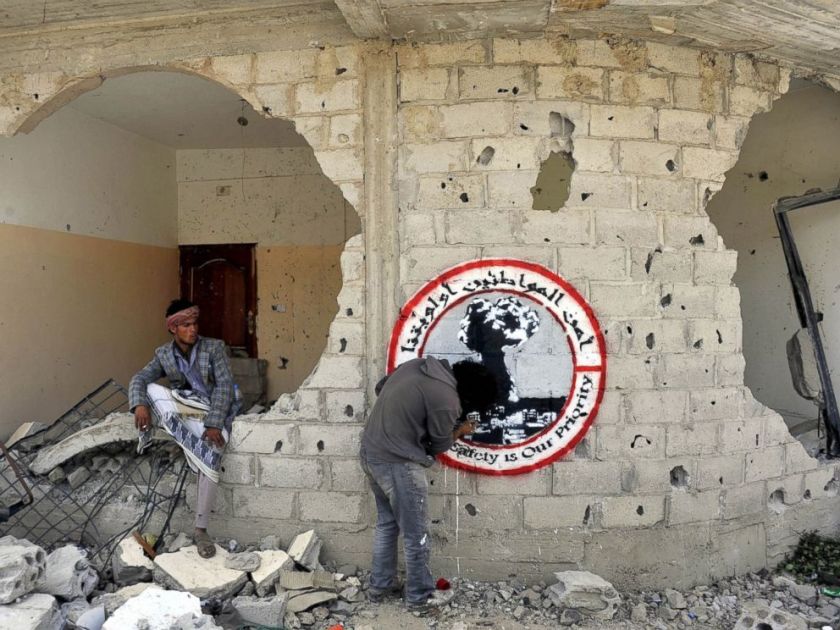
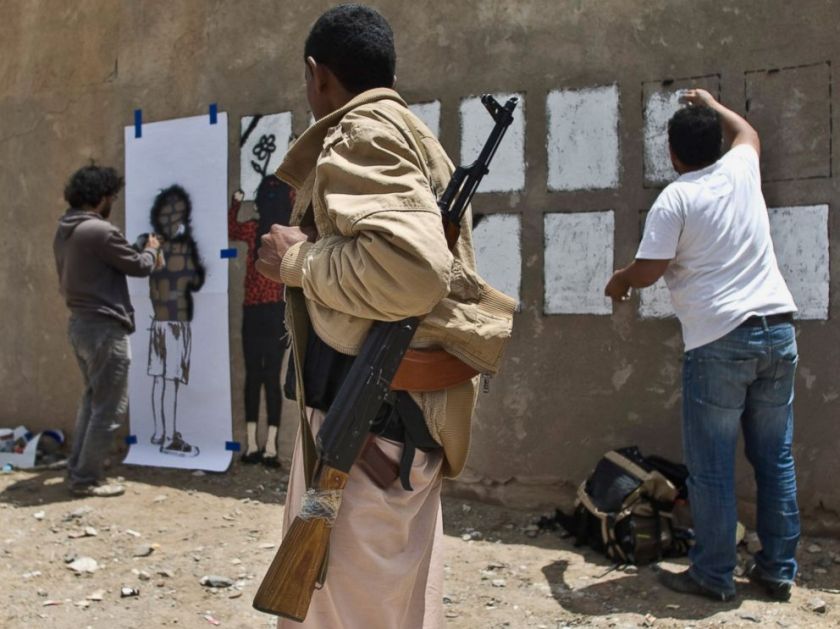
In his art campaign, “Ruins,” started in May 2015, Subay paints about some of the country’s problems. He painted on walls last week with his friends under the theme “death by hunger and disease.” An emancipated child in a casket was among the motives.
“There’s hunger, so much hunger,” Subay said. “People wait in line for water. Cholera was a disease of the 19th century but now we have people suffering from cholera in Yemen in the 21st century.”
When he was younger, Subay used to paint and draw at home. But that changed with the Arab Spring in 2011.
“We chanted for civil rights and for justice in the squares. People from every region of Yemen were there,” Subay said.
He decided to move his art out in the public and started painting with others on walls. During the first campaign in 2012, he and fellow artists painted portraits of more than 100 people who’ve disappeared.
Since then, he has painted about civilian deaths, destroyed homes, life under siege and restrictions on freedom of speech. Subay says there are only a few newspapers left in Yemen and that they all represent the same voice.
Subay’s brother Nabil, a journalist, was shot in both legs by unknown perpetrators after he wrote critically about the war. He is now being treated in Cairo.
The parties of the conflict have also occasionally interrogated Subay and prevented him from painting in certain places. But that has never stopped him from initiating new campaigns.

“When you are doing the right thing, you should not fear anybody,” Subay, whose wife studies at Stanford University in California, said.
Financial struggles, however, prevent him from painting as often as he would prefer. Like many other Yemenis in the Arabic-speaking country, Subay doesn’t have a salary.
“I can’t paint like before,” he said. “Materials are expensive, so I only paint every two months. Before, I would paint something every two weeks. There’s almost no work because of the war.”
He started painting and drawing in a serious way when he was in the eighth-grade in 2001. He did a sketch of a boy on an A4-sized paper sheet and showed it to his parents.
“They said, ‘You are an artist, go on. They started supporting me by buying me materials and then it started,” Subay said, adding that he wants friends, passersby and anyone elseo who wants to join to take part in his street art.

“Art gives hope and expresses the situation people are living,” he said. “It is the voice of people. In war, all voices are voices of hatred and destruction. What we do is show that there are other voices people can listen to. In times of war, even the smallest voices may save lives. Yemenis are in need of every voice in the world to push for stopping the war. The worst thing in war is when hope is lost. I personally also paint to protect myself from becoming hopeless.”



Saida Ahmad Baghili, 18, who is affected by severe acute malnutrition, sits on a bed at the al-Thawra hospital in the Red Sea port city of Houdieda, Yemen REUTERS/Abduljabbar Zeyad TPX IMAGES OF THE DAY
SANAA, Oct 25 – Yemeni street artists are daubing the capital’s walls with haunting images of war and starving children in an effort to highlight the impact conflict is having on the country’s population.
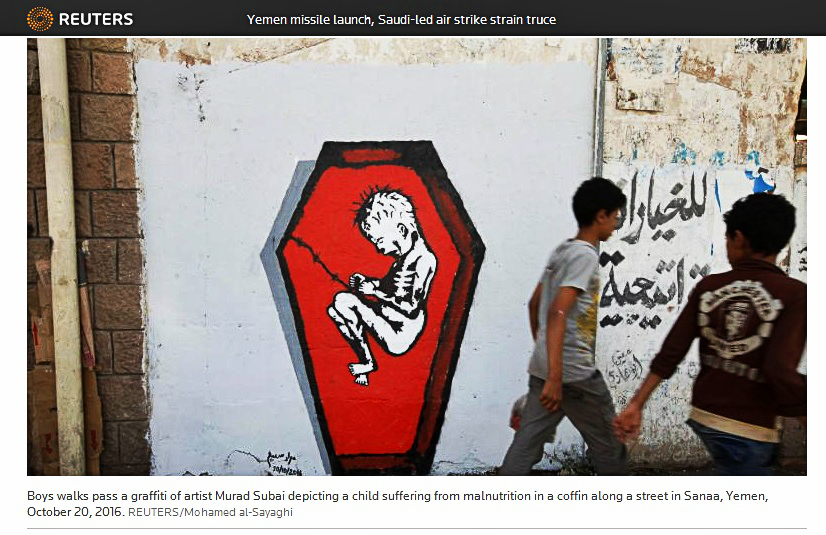
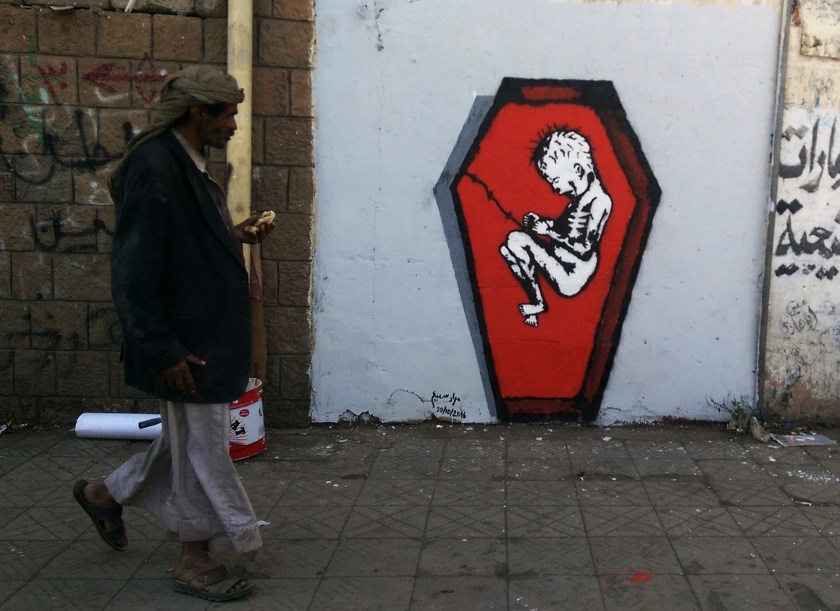
The graffiti, including a malnourished child locked in a blood-red coffin, is turning heads in a country where more than two thirds of the population are in need of some form of humanitarian aid, according to the United Nations.
“We came up with this campaign because of the internal and external wars in Yemen, the economic crisis, all of these factors led to famine and poverty in Yemen,” said participating artist, Thou Yazan Al Alawi.
More than 10,000 people have been killed, thousands more wounded and the healthcare and education systems have crumbled in Yemen‘s 19-month civil war.
A Saudi-led coalition launched an offensive last March aimed at restoring exiled Yemeni president Abd-Rabbu Mansour Hadi to power and ousting the Iran-allied Houthi movement from their strongholds.
“The war has made this country sick, people are dying of hunger,” said one passer-by, Yousef Abdelqawi.




Yemeni street artists are daubing the capital’s walls with haunting images of war and starving children in an effort to highlight the impact conflict is having on the country’s population.
The graffiti, including a malnourished child locked in a blood-red coffin, is turning heads in a country where more than two thirds of the population are in need of some form of humanitarian aid, according to the United Nations.
“We came up with this campaign because of the internal and external wars in Yemen, the economic crisis, all of these factors led to famine and poverty in Yemen,” said participating artist, Thou Yazan Al Alawi.
More than 10,000 people have been killed, thousands more wounded and the healthcare and education systems have crumbled in Yemen’s 19-month civil war.
A Saudi-led coalition launched an offensive last March aimed at restoring exiled Yemeni president Abd-Rabbu Mansour Hadi to power and ousting the Iran-allied Houthi movement from their strongholds.
“The war has made this country sick, people are dying of hunger,” said one passer-by, Yousef Abdelqawi.
(Reporting by Reuters Television; Writing by Adela Suliman; Editing by Patrick Johnston and Alison Williams)

Boys walks pass a graffiti of artist Murad Subai depicting a child suffering from malnutrition in a coffin along a street in Sanaa, Yemen, October 20, 2016. REUTERS/Mohamed al-Sayaghi


جدارية “تجنيد الأطفال”، ضمن حملة “12 ساعة” غلاف لمجلة ” معهد فينا للحوار والتعاون الدولي الإلكترونية (في أي دي سي)”، في عددها الفصلي الـ 38.
Children Recruitment mural, “12 Hours” Campaign, a cover of the magazine of “Vienna Institute for International Dialogue and Cooperation (VIDC)” in its quarterly publication 38.


葉門首都沙那老城區於1986年列入聯合國教科文組織世界遺產名錄,被譽為是「會呼吸的歷史城市」。不過由於葉門政治動盪不安,當地居民說:「我們在長期戰區生活。」
★觀賞老城區 必訪「總統清真寺」
2008年完工薩里赫清真寺(Al Saleh Mosque)是葉門最大的建築物,也是最具特色的伊斯蘭建築。由前總統沙雷(Ali Abdullah Saleh)建造,也以他的名字命名,所以又稱為「總統清真寺」。屋頂設計六座喚拜塔,光是正廳面積就達1萬3500平方米,可容納超過4萬4000人, 這裡也是觀賞老城區的最佳地點。
★塗鴉悼死者 讓倖存者看見希望
由於葉門戰火不斷,因此人民格外渴望和平的到來。葉門街頭塗鴉藝術家Murad Subay便找了朋友與當地孩子一起在街頭塗鴉,傳達人民對於和平的訴求。每當戰火將城市變成斷壁殘垣,他們就在街頭畫上美麗的圖樣,且廣邀其他民眾一起 加入。Subay希望藉由這些畫作紀念死去的百姓,也讓倖存者能看見希望。2014年他獲得義大利Veronese頒發的藝術和平獎。
★赴傳統市場 吃全沙那最棒早餐
進入沙那舊城的Souq al-Melh市集便能發現這個城市獨特的魅力,小街道上保留了許多傳統特色,有各式各樣具民族風味的手工藝品和飾品以及傳統小吃,這裡還有全沙那最棒的早餐。
★10歲嫁13歲 童婚惹議震驚國際
2010年3月沙那因幾樁童婚案招致爭議,其中包括10歲的Sally Al-Sabahi被迫嫁給13歲的Ilham,並遭到丈夫強暴及毆打,內出血4天後傷重不治。這則新聞引起國際震驚,聯合國及婦權組織「立即平等」 (Equality Now)皆嚴厲譴責,在強大的壓力下,葉門政府似乎有終結童婚傳統的趨勢。
★人民的願望 「和平…還在路上」
2011年起許多年輕的社會活動家和大學生由於不滿失業和貪汙等現象,聚集在沙那街頭展開反政府示威,期間發生暴力衝突,也遭到政府武力鎮壓,最後成功讓前總統沙雷下台。雖然如此,和平的願望卻還是沒有實現,2015年葉門爆發內戰,使人民繼續生活在動盪之中。




 Murad Subay