News

اليمن: “أطفال المقابر”/جريدة “السفير”

  • اليمن: “أطفال المقابر”

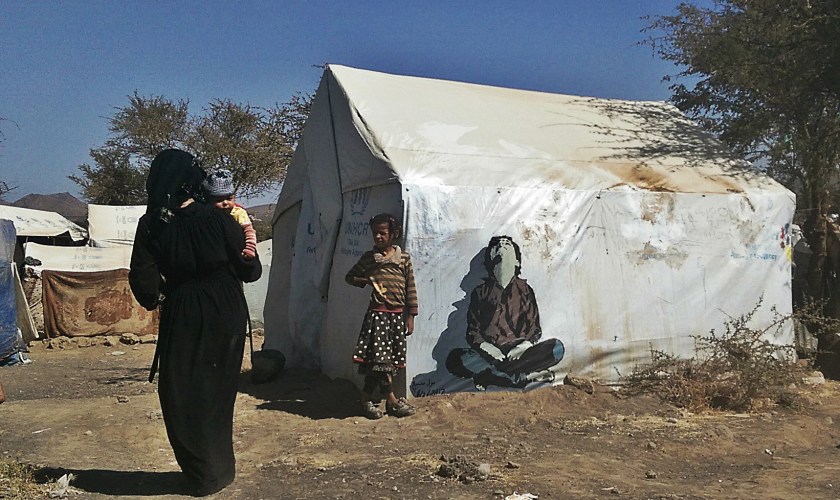
غرافيتي للفنان مراد سبيع (مخيم ضروان – اليمن)

10-02-2017

على الجهة اليسرى من الطريق الممتدة المتجهة لمحافظة “عمران”، تضطجع مئات من مخيمات النازحين الذين أجبرتهم الحرب على النزوح أو دمرت منازلهم.
عندما وصلنا أنا والأصدقاء إلى مخيم “ضروان”، استقبلنا النازحون هناك بلطف تام ومطلب هو الأهم، ألا وهو مدرسة لتعليم أطفالهم الذين منعوا من التعلم في المدارس الموجودة في المنطقة لعدم توفر مقاعد دراسية لهم، بحسب قولهم.
الأطفال وأهاليهم من النازحين يعانون الأمرين في مخيمات مُهمَلة لا توفر أبسط الخدمات مثل الحمامات. من المؤسف أنّ هذا ما يعاني منه جميع النازحين في جميع المخيمات التي صنعتها وما زالت تصنعها الحرب الدائرة في اليمن.
جداريتي، ضمن #حملة_حطام، عن النازحين، في مخيم ضروان للنازحين، 6 فبراير 2017.

من صفحة رسام الغرافيتي اليمني مراد سبيع – Murad Subay (عن فايسبوك)

رابط المقال>>

Continue reading “اليمن: “أطفال المقابر”/جريدة “السفير””

“Selling Misery” mural by: Rhman Qaid, in “Ruins campaign”. Feb.6,2017.


“المعاناة تُباع“

لأن المنظمات خذلت النازحين، وأصبحت تتاجر بمعاناتهم, قمت برسم هذه الجدارية، وأنا كلي أمل أن تصل الرسالة للمنظمات، وتقوم بمهامها وواجباتها الإنسانية تجاه المخيمات المنسية على أكمل وجه، لا أن يتم تحويل قضية النازحين إلى سلعة يتاجر بها.
جدارية الفنان: Rhman Qaid، ضمن #حملة_حطام، عن “النازحين”، في مخيم ضروان للنازحين، 6 فبراير 2017.

____________
“Selling Misery”

Because of the great suffering due to war and in addition, they have been let down by the inefficient work by organizations and government toward them, I painted this moral to send a message of their suffering to whome it might concerns.
Mural by: Rhman Qaid, about “Displaced people” in #Ruins_campaign, in Dharawan’s displaced camp, February 6, 2017.

 "Selling Misery"
“Selling Misery”

“Yemenis dream” mural by: Thiyazen Alalawi, in “Ruins Campaign”. Feb.6,2017.


“الحلم اليمني “
المنزل هو سقف الأسرة ,وسقف استقرار المجتمع والحرب في اليمن نتائجها عديدة منها أنها طردت الناس إلى العراء .
العودة إلى المنزل والعودة للسلام هو حلم كل يمني.

جدارية الفنان: ذي يزن العلوي، ضمن #حملة_حطام، عن “النازحين”، في مخيم ضروان للنازحين، 6 فبراير 2017.

_______________

“Yemenis dream”


The house is the cover of the family ,and the cover of the society’s stability.
Ejecting the people outdoors is one of many results of the war .
Regained the houses and the peace are dreams of all Yemenis.

Mural by: Thiyazen Alalawi, about “Displaced people” in #Ruins_campaign, in Dharawan’s displaced camp, February 6, 2017.

Yemenis Dream1
Yemenis Dream1

“Barbed camps” mural by: Rsheed Qaid, in Ruins Campaign. Feb.6,2017.


“مخيمات شائكة”

النازحين في المخيمات هم أكثر من يعاني من الحرب ,لأنهم تعرضوا للطرد من بيوتهم ومناطقهم, وهم ايضا يعانون داخل المخيمات المحصورة فهم غير قادرين علئ الخروج بسبب الحالة المادية السيئة كما أنه لاتتوفر لديهم ابسط الامكانيات الأولية للعيش بكرامة .

جدارية الفنان: Rsheed Qaid ، ضمن #حملة_حطام، عن “النازحين”، في مخيم ضروان للنازحين، 6 فبراير 2017.

_____________

“Barbed camps”

The displaced people are the most affected by war . They have been forced to leave their homes and areas .They are expose to persecution inside the camps due to the absence of the most basic necessities of life.
Mural by: Rsheed Qaid, about “Displaced people” in #Ruins_campaign, in Dharawan’s displaced camp, February 6, 2017.

Barbed Camps 1
Barbed Camps 1

“Children of Graves” my mural in “Ruins Campaign”, Feb.6,2017.


“أطفال المقابر”

على الجهة اليسرى على الطريق الممتده من الطريق المتجهة لمحافظة “عمران” تضطجع مئات من مخيمات النازحين الذين أجبترهم أو دمرت منازلهم الحرب.
عندما وصلنا أنا والأصدقاء إلى مخيم “ضروان”، إستقبلنا النازحين هناك بلطف تام ومطلب هو الأهم، ألا وهو مدرسة لتعليم أطفالهم الذين منعوا من تدريس اطفالهم في المدارس الموجوده في المنطقة لعدم توفر مقاعد دراسية لهم، بحسب قولهم.
الأطفال وأهاليهم النازحين يعانوا الأمرين في مخيمات مهملة ن توفر أبسط الخدمات مثل “الحمامات”. من المؤسف ان هذا ما يعاني منه جميع النازحين في جميع المخيمات التي صنعتها ومازالت تصنعها الحرب الدائرة في اليمن.
جداريتي، ضمن #حملة_حطام، عن “النازحين”، في مخيم ضروان للنازحين، 6 فبراير 2017.

_________________________________

“Children of Graves”


On the left side of the road leading to Amran governorate lays hundreds of “Displacement Camps”, in which people have been forced to leave their houses and lands and move to live in camps due to the war.
When I arrived with my friends to “Dharawan’s displacementl camp”, we were welcomed warmly by the residents of the camp. Afterwards, they had only one simple and basic request, and that is a school for their children to learn. They told me they couldn’t register the children in the schools in the surrounding areas because there isn’t any space for them.
The displaced people and their children lack access to the most basic services like “bathrooms” and clean water. It saddens me to see people living under these harsh conditions for an indefinite time. This is only a small taste of what the displaces endure today in the camps that were and are still being made by this war.
My mural about “Displaced people” in #Ruins_campaign, in Dharawan’s 
displacement camp,February 6, 2017.

16463771_10212134051173078_5256887587311060357_o.jpg
Children of Graves
Children of Graves1
Children of Graves1

Murad Subay: Yemen’s war makes a month feel like a year\ By: KIERAN ETORIA-KING

index_logo_2col

Murad Subay: Yemen’s war makes a month feel like a year

The Index award winner talks about his fears of a possible escalation of the conflict in Yemen
03 Feb 2017
BY KIERAN ETORIA-KING

US president Donald Trump’s executive order banning citizens of seven predominantly Muslim countries from travelling to the USA for has had devastating consequences for thousands of people. Among them is Index on Censorship Award winner Murad Subay. The Yemeni street artist is now unable to visit his wife, who is currently studying in the USA.

“It’s really frustrating to even start thinking that I won’t be able to see her for that long,” he told Index. “She was supposed to visit during summer break, however, it seems that she can’t do that now.”


With uncertainty surrounding how the Trump administration’s policy towards Yemen will play out, the couple are now facing the very real prospect of not seeing each other until she finishes her studies four years from now.

“It’s been a really difficult time for both of us because it’s the first time we’ve been away from each other for more than a month,” Subay said. “I can’t say that this doesn’t have its negative effects on my work, for it surely does.”

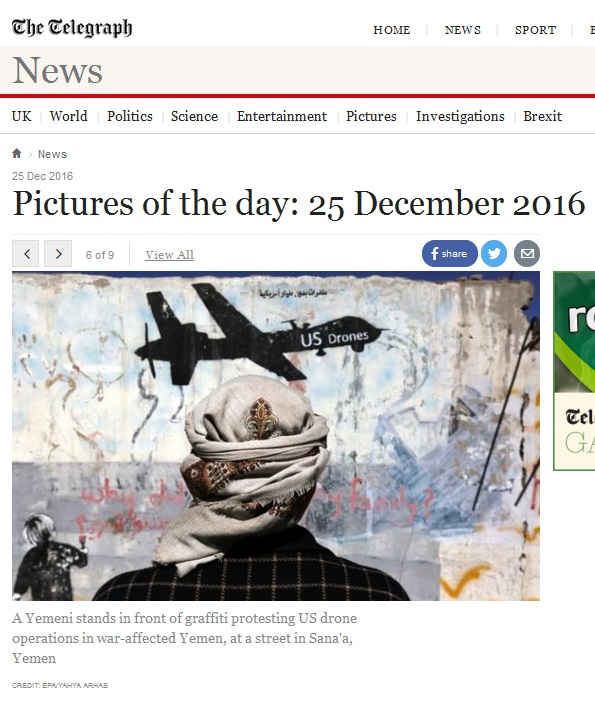
At home, the worries that have plagued Subay throughout the Obama administration remain, particularly Trump’s continuation – and possible escalation – of his predecessor’s drone strikes in Yemen, which by February 2016 had killed up to 729 Yemenis including 100 civilians. One rural counter-terrorism raid authorised by Trump has already left at least 10 women and children dead, according to Al-Jazeera.


2016 Freedom of Expression Fellow Murad Subay

Murad Subay is the 2016 Index on Censorship Freedom of Expression Arts Award-winner and fellow. His practice involves Yemenis in creating murals that protest the country’s civil war. Read more about Subay’s work.


“Trump has no right to make things even worse for Yemenis. Yemen is already suffering from US arms deals with Saudi Arabia that helped fuel this war. Barring Yemenis from entering the USA under his administration only adds to these troubles.”

The war has been hitting close to home for Subay in recent months. Two of his cousins were recruited by warring parties and killed on the battlefield. – Fuad Subay, aged 26, was a soldier killed in Albuka’a, and Yaser Subay, just 14, was recruited by Houthis and killed in Isilan.

On top of this, a close friend of his, the respected investigative journalist Mohammed Alabsi, was killed in an apparent assassination. According to the Yemen Times, Alabsi had gone out for dinner in Sana’a with a cousin on 20 December. A little while later both men were rushed to hospital, where Alabsi died.

“I was told that blood came out of his ears and eyes,” Subay said. “Mohammed was investigating the black markets trading in oil that were associated with high-ranking politicians. I do not know the exact details of this, but what I do know is that Yemen has lost one of its most important and noblest investigative journalists, and that I lost a dear friend.”

An investigation into Alabsi’s death is underway.

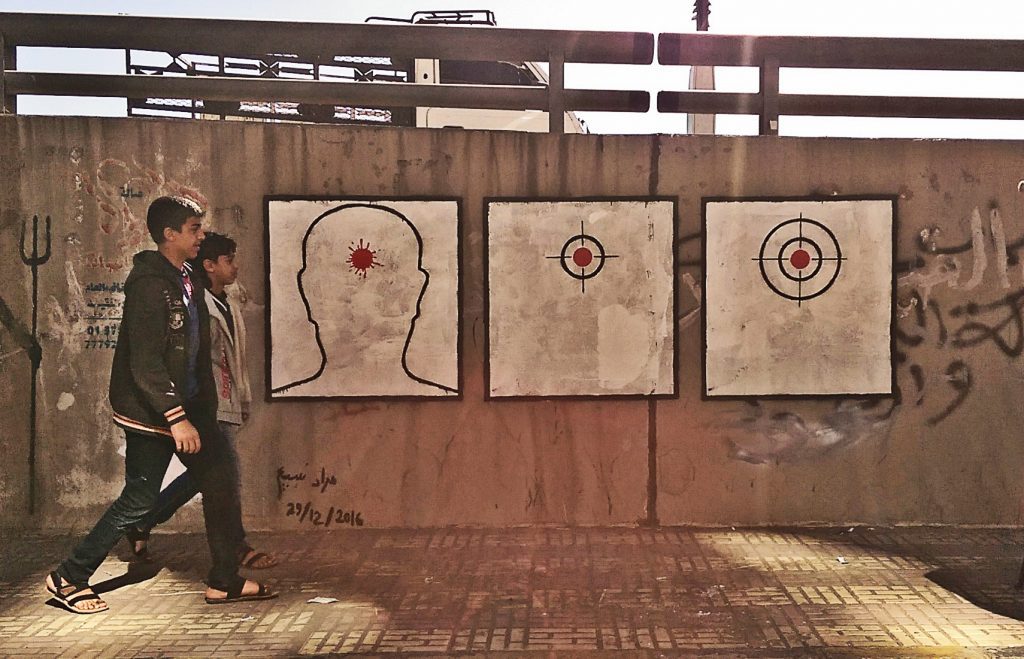
Subay addressed a recent wave of violence against civilians, including journalists and public figures, in a mural entitled Assassination’s Eye, painted on the Mathbah Bridge in Sana’a in late December. Part of the Ruins Campaign, the minimalist painting depicts a sniper’s crosshairs training in on a human target.

“It conveys the assassin’s point of view, where it first feels like it is only a part of training on how to hit a target, but then in the final square the bullet ends up in the head of a real person rather than a target board,” Subay explained. “These assassinations have spread vastly since 2012, where they were mostly carried out among the military ranks and politicians. Lately, however, these operations have been targeting civilians too. I was planning to address this issue some time ago after hearing about the assassinations of innocent civilians in different places of the country, and that was just two weeks before I was shocked by the death of my friend.”

Elsewhere, Subay has been asked to serve as a judge for the Italian arts award, Fax for Peace, which invites students and artists from around the world to send pictures, videos or animations on the themes of peace, tolerance, human rights and the fight against all forms of racism. He said of the role: “It is a great pleasure to be selected as a judge in this contest and it is a big responsibility, which I hope to be able to carry out effectively.”

However, with Yemen’s economic circumstances ever worsening, and many working people now into their fourth month without receiving salaries, he sees difficult times ahead.

“It’s very harsh to see people every day looking for anything to eat from garbage, waiting along with children in rows to get water from the public containers in the streets, or the ever increasing number of beggars in the streets. They are exhausted, as if it’s not enough that they had to go through all of the ugliness brought upon them by the war.”

Referring to the deaths of his cousins and his close friend, he added: “No one can live in this country and not be affected by the war. This all happened in the last three or four months. These events make a month in Yemen feel like a year.”

Continue reading “Murad Subay: Yemen’s war makes a month feel like a year\ By: KIERAN ETORIA-KING”

Ripped apart: Yemeni couple fearful after Muslim ban\ On “Aljazeera English”


Ripped apart: Yemeni couple fearful after Muslim ban

A young Yemeni artist shares his experience of being banned from visiting his wife, who studies in the US.
Murad Subay says the US Muslim ban is unjustified and feels certain the world will not be silent towards it [Courtesy of Murad Subay]
By: &

Prior to US President Donald Trump’s recent Muslim ban, Murad Subay, a Yemeni artist, never had to worry about being able to see his wife, Hadil, who studies in the US on a scholarship.

Following the recent executive order, which placed a travel ban on seven Muslim-majority countries including Yemen, seeing his wife again has become a distant dream.

Subay cannot travel to visit her and fears that if Hadil returns home, she will not be allowed back in the US. What was once a valuable opportunity for Hadil to study political science at Stanford University in California has now turned into a nightmare.

Subay is stuck in a war-ravaged country while his wife lives in a place where foreign Muslims are eyed with suspicion.

Here is Subay’s account of how the Muslim ban changed his life for ever.

READ MORE: Trump’s Muslim ban – This could never happen in America

My wife scored 94.5 percent in her high school final examination. Last year, she went to the US to complete her bachelors and masters.

I am astonished at how a country known for defending democracy is implementing such orders.

Today, she cannot return to her country whenever she likes so long as this decision stays in effect. This will negatively affect her studies and our life.

This ban is absolutely upsetting.

Hadil and I were planning to meet every summer. She can either come to Yemen or I can travel to see her in the US.

That was our plan.

However, with Trump’s Muslim ban in place, entering the US is impossible. Even if she decides to come to Yemen, she may not be able to return to the States.

This is a racist and unreasonable decision.

Now our families are worried about our future. We do not know what lies in store for us. We do not know if this ban will persist or be repealed.

Whatever the difficulties will be, Hadil is going to pursue her studies until 2020 as long as she is permitted to continue. However, the worrying matter is that she must leave America every year to another country where she can renew her visa in any American embassy. She cannot renew the visa in America.

READ MORE: Trump’s Muslim ban ‘will rip our family apart’

We will do our best to support her to complete her studies in America or elsewhere. In Yemen, the education system is weak and it is unfortunately being destroyed.

Hadil is ambitious and hardworking, and I will not let her down.

She got a scholarship to the US last year, and I was happy that she would be able to receive quality education there. We did not know time would change in America.

There is no justification for banning Muslims from entering the US. All those refugees or immigrants belonging to the seven banned countries including Yemen have not committed any terrorist acts. This is a politically motivated decision, and it intends to show off power and strictness.

Americans themselves will resist this racist decision. It is unreasonable for this unfair decision to succeed.

The majority of the countries targeted by this order are fragile. This is a big problem. We are living in the 21st century. I am astonished at how a country known for defending democracy is implementing such orders. This is an individual deed.

The protests against this decision are ongoing. I hope they will continue.

It would be impossible that the beacon of democracy and freedom blocks people from travelling on racist and religious grounds. Millions of people should not pay the price for terrorist acts carried out by some individuals.

This decision dishonours America.

The consequences of this decision are grave, and I do not think the world will let it pass unopposed. I believe the principles of democracy in America will not be easily abandoned.

As told to Khalid Al-Karimi and Mohammed Al-Sameai. 

Source: Al Jazeera News

Article link>>

ட்ரம்பின் தடை தொடர்பில் யேமனியர்கள் அதிருப்தி\ On “Athavan News”

ட்ரம்பின் தடை தொடர்பில் யேமனியர்கள் அதிருப்தி

athavan-news

குறித்த தடை தொடர்பில் கருத்து தெரிவித்த யேமனின் புகழ்பெற்ற ஓவியர் முராட் சப்பே (Murad Subay), “இந்த தடை காரணமாக அமெரிக்காவில் உள்ள எனது மனைவியை சந்திக்க இயலாத நிலைமை தோன்றியுள்ளது. எனது மனைவி தற்போது அமெரிக்காவில் கல்வி கற்று வருகின்றார். குறித்த தடை அகற்றப்படும் வரை என்னால் அவரை சந்திக்க இயலாது. இந்த தடைக்கு அமெரிக்கர்கள் எதிர்ப்பு தெரிவிக்க வேண்டும்” என தெரிவித்தார்.

Video Link>>

Yemenis condemn Trump visa restrictions STORY\ On “Reuters”

reuters

Yemenis condemn Trump visa restrictions STORY:

U.S. President Donald Trump’s temporary ban on Yemeni citizens travelling to the United States sparked panic and anger among Yemenis, with some describing the move as “racist” and “unjust”. The war-damaged and impoverished country in the south of the Arabian Peninsula is one of seven majority-Muslim countries whose citizens face a 90-day ban on entering the United States. Trump, a businessman who successfully tapped into American fears about terror attacks during campaigning for November’s presidential election, has also put a four-month hold on allowing refugees into the United States.

   Speaking from the capital Sanaa, internationally renowned Yemeni street artist Murad Subay said the visa ban has effectively prevented him from seeing his wife, who is currently studying in the United States. “Unfortunately this is a decision that is going to affect millions of citizens in these countries. For me personally, my wife is a student at university in America. This is a totally racist decision,” said Subay. “We (my wife and I) can no longer meet after this decision. I, along with any nationals of these countries, will be completely prohibited from entering (the US). And if these people left the United States, they will be prevented from re-entering. This decision must be revised and Americans should oppose it,” Subay continued.

   The Houthi-led government in Sanaa also denounced the decision describing it as “illegal and illegitimate”.The Houthi-controlled news agency SABA quoted a foreign ministry source as saying the ministry was aware that such an action is the sovereign right of the U.S. government.

   But “the source said emphatically that any attempt to classify Yemen or its citizens as a possible source of terrorism and extremism was illegal and illegitimate”. Yemeni Human rights activist Radiyye al-Mutawakal said her office has received numerous calls from Yemenis tied to the United States asking questions about how the visa restrictions may apply to them.

   “This decision…affects many in Yemen, for example like those that reside in the United States but are currently visiting relatives (in Yemen) and they are wondering and concerned that they may not be able to return to America and to their lives there. This decision impacts many different segments and it is unjust,” she said. The Yemeni embassy in Washington issued an advisory on Sunday (January 29) for Yemenis already inside the United States not to leave the country until details of the visa ban and its ramifications are clarified.

Video Linke>>

visa-ban-murad-subay