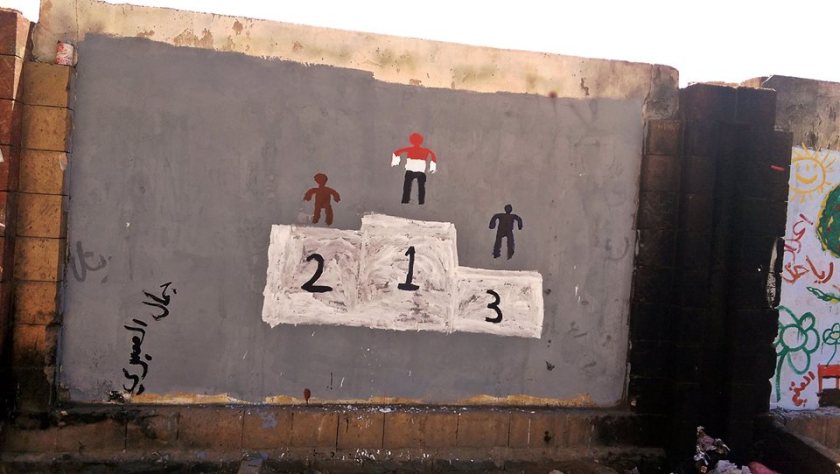
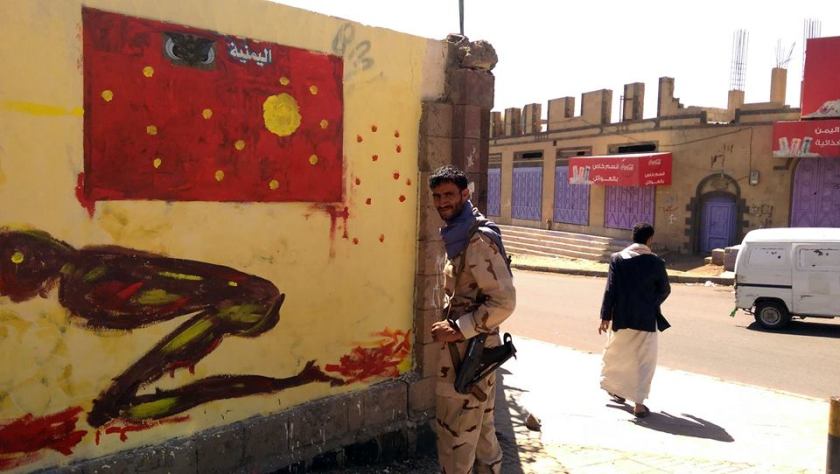
عانى اليمنيون الأمرين خلال هذه الحرب، الدمار والقهر والجوع والعطش، وفوق ذلك، يعانون الآن من دمار شبه كلي لإقتصادهم.
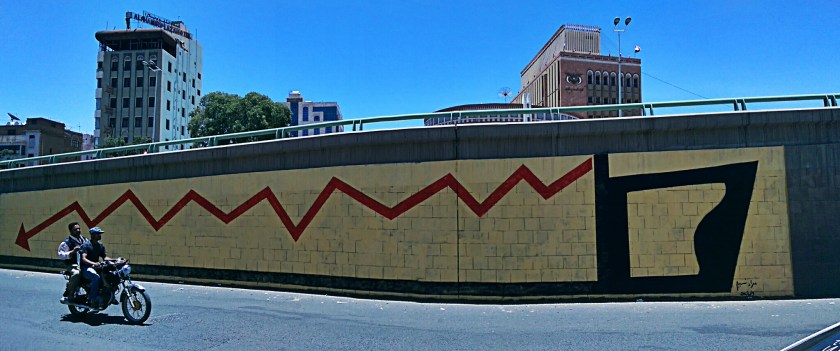
جداريتي الثامنة “المنشار”، ضمن حملة “حُطام” في النشاط الثامن بعنوان “تدهور الإقتصاد”، على جدار جسر الصداقة، شارع التحرير، صنعاء بتاريخ 9 يونيو 2016. يظهر في الصورة “البنك المركزي اليمني”.
Yemenis have suffered both, destruction, oppression, hunger and thirst, and above it all, they are now going through even harder times with the almost economy collapse.
My mural “The Saw”, in the eighth activity of “Ruins” campaign around “The Economy Collapse”. It was painted on Al-sadaqah bridge, Tahrir street, Sana’a, on June 9, 2016. The “Central Bank of Yemen” appears in the picture.
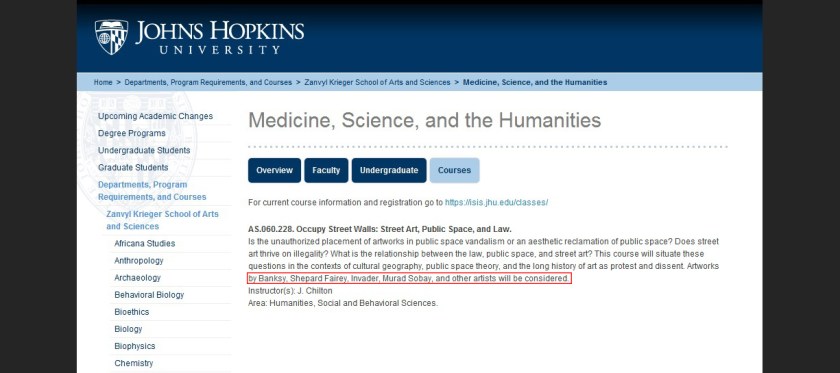
I passed by an information a time ago, and was so happy to know that my artworks, along with the artworks of the international artists “Banksy, Shepard Fairey, Invader and other artists, are being taught in “John Hopkins University” under the course “Occupy Street Walls: Street Art, Public Space, and Law”. I’m so pleased to know that the humble campaigns I launched are getting this kind of attention.
مررت قبل فترة على هذه المعلومة وسعدت جدا بأن جامعة جون هوبكنز الأمريكية، والتي تعتبر من أهم وأعرق الجامعات في العالم، تقوم بتدريس أعمالي إلى جوار كل من أعمال الفنانين العالميين مثل “بانكسي، شيبيرد فيري، إنفيدر، وفنانين أخرين” ضمن مادة “شَغل جدران الشوارع: فن الشارع، المساحات العامة، والقانون”. من الجميل ان يكون للحملات المتواضعة التي اطلقتها مثل هذا الإهتمام.
“Elites and Politicians did not represent Yemenis well and they let them down, but there is no doubt that things will change. It won’t last forever. People will get to the stage where they demand a state, a just state – free of corruption. They will definitely pursue that.”
“Yemenis love beauty by nature, and for four years now, the murals in the streets haven’t been touched or destroyed by the Yemeni citizens.”
خُذل اليمنيون من قبل ساستهم ونخبهم، لكن بلا شك الزمن يتغير وسيصل اليمنيون الى فكرة حاجتهم إلى الدولة، وسيخرجو لأجل الدولة، دولة مدنية، دولة عادلة ودولة خالية من الفساد. لا بد أن يخرجو”
“اليمنيون بطبعهم يحبون الجمال، ولأكثر من أربعة أعوام، لم تتعرض الجداريات للطمس من قبل المواطن اليمني.”
من فيلم قصير بعنوان “مراد”
للعبقري: عبدالرحمن حسين
People pass by Murad Subay’s mural “Flowers Bouquet” in Sanaa in May 2015. The Yemeni street artist has spent five years making the case for peace through street art projects.
On the first day of Saudi Arabia’s intervention into Yemen’s civil war in March of last year, warplanes bombed a residential compound on the outskirts of the capital Sanaa, killing dozens of people inside.
A Yemeni human rights organization said a coalition led by Saudi Arabia killed 27 civilians, including 15 children, in the strikes on the Bani Hawat neighborhood on March 26, 2015.
Yemeni artist Murad Subay headed to the compound with a group of friends a few weeks later, and together with local kids painted 27 flowers on its walls, 15 of them with just one leaf to symbolize the children whose lives were lost.
It was the beginning of the 28-year-old’s latest street art campaign, “Ruins.”
SHARF ALHUTHY
Murad Subay is a 28-year-old artist who grew up in the Yemeni capital Sanaa.
At least 6,200 people have been killed since last march in the latest round of conflict, in which Saudi Arabia’s military coalition and its Yemeni ally President Abd-Rabbu Mansour Hadi are battling Yemen’s Houthi rebels and supporters of ex-president Ali Abdullah Saleh.
“They have destroyed everything,” Subay told The WorldPost of the warring parties. “So, what can we do? Just this: Not remain silent, commemorate the innocent people who have been killed, and highlight the cost of this war.”
Over the past year, Subay and fellow artist Thi Yazen have gone to areas where the war has destroyed homes or killed civilians, and covered them in murals.
What can we do? Just this: Not remain silent, commemorate the innocent people who have been killed, and highlight the cost of this war.”
U.N.-sponsored peace talks between the government and rebels began on Thursday, 10 days into a shaky truce. Government representatives said their expectations of the talks were low, while Yemenis on social media urged the leaders: “Don’t come back without peace.”
“I hope this is an opportunity, and it’s not just me,” Subay said. “There are millions of Yemenis who want peace… who need peace.”
MOHAMMED HAMOUD /ANADOLU AGENCY/GETTY IMAGES
Subay tries to get the community involved in his street art projects. “Art humanizes us,” he says.
Subay has been making his case for peace in Yemen through street art projects for the past five years.
The Arab Spring uprisings of 2011 were a rude political awakening for the young artist. He joined thousands of Yemenis protesting then-president Saleh’s three-decade grip on power. He and his friends helped form a security cordon around Sanaa’s “Change Square” to prevent people bringing in weapons into peaceful sit-in.
But in the end, Yemeni activists weren’t able to stop the pro-democracy uprising from being hijacked by the political forces tussling over power in Yemen. The protests became street battles, and Saleh cut a deal to leave office in exchange for legal immunity, allowing him lurk around Sanaa trying to undermine the new government led by Hadi.
Subay was disgusted by the way politicians exploited the revolution. “It turned out that there was a game inside the revolution,” he said. “I was so frustrated by what happened, and that the country was heading into turmoil, and all I wanted to do was paint.”
MOHAMED AL-SAYAGHI / REUTERS
Last month, he and his friends held a three-day public street art campaign in the capital, where they invited passers-by to help paint.
In March 2012, he launched his first street art campaign, “Color the walls of your street.” He and his friends headed into battle-scarred neighborhoods where different factions were fighting for control, and covered them in colorful murals.
On social media, Subay invited people to come help them paint, and after a week, dozens of people started to show up, bringing their kids and their own paints. Similar murals began to appear on the walls of other cities.
“It’s like protesting by colors,” Subay said. “We painted to paint on the ugliness of war, and say there are options instead of going to war and using weapons.”
“To use colors — it is better than to use bullets.”
MOHAMED AL-SAYAGHI / REUTERS
His first campaign was “Color the walls of your street” in March 2012. “We painted to paint on the ugliness of war,” he says.
One of Subay’s next street art campaigns brought him into more direct confrontation with authorities. Inspired by the investigations of his friend, Yemeni journalist Sami Ghalib, into enforced disappearances in Yemen, Subay launched “The walls remember their faces” in September 2012. Over the next seven months, he and his collaborators painted portraits of over 100 Yemenis thought to have been secretly kidnapped or killed by authorities since the 1960s.
“It was very simple — just faces and names — but they are not remembered,” Subay said. “The people responsible for these crimes have silenced every voice who wanted to say something about this.”
HANI MOHAMMED/ASSOCIATED PRESS
His street art campaign, “The walls remember their faces,” commemorated over 100 Yemenis who were forcibly disappeared since the 1960s.
Subay found his murals kept getting erased, but his team would just go back and repaint them, and add more portraits of the disappeared.
They also took the campaign right to the heart of the regime — painting faces of the disappeared on the walls of the intelligence agency, and outside the offices of powerful general Ali Mohsen al-Ahmar and ex-president Saleh. This drew the ire of Yemeni security forces, but Subay says the families of the disappeared and media who accompanied the painters prevented their arrest.
KHALED ABDULLAH ALI AL MAHDI / REUTERS
The campaign drew the attention of the authorities. Above, a soldier tries to stop Subay painting a portrait of one of the disappeared in September 2012.
Saleh eventually allied with the Houthi rebel movement (which as president, he had repeatedly tried to crush), enabling their takeover of the Yemeni capital in September 2014.
As the Houthis continued to advance through the country, and Hadi fled for his life, Saudi Arabia formed a military coalition to oust the rebels, citing concerns that they were supported by the kingdom’s regional rival Iran.
The impact of the ensuing war has been devastating to Yemen, already the poorest country in the region. Some 35,000 people have been wounded, over 2.5 million people displaced, and 14 million people don’t have enough food. The United Nations and human rights groups say the coalition has bombed weddings, markets, schools, hospitals and homes around Yemen.
“Things people built over decades, they lost in one moment,” Subay said.
The war has made him constantly anxious — about making ends meet or getting hold of basic supplies — but he emphasizes that his family in Sanaa has had it much better than the millions who don’t have food, water or shelter because of the war. His older brother, a poet and journalist, was shot by unknown gunmen in the capital earlier this year, but he is recovering overseas.
MOHAMED AL-SAYAGHI / REUTERS
Subay’s latest campaign, titled “Ruins,” places murals in the areas damaged or destroyed by war, and highlights its terrible toll on the people of Yemen.
Subay went to the U.K. last week to collect a “Freedom of Expression” award from the campaign group Index on Censorship. He dedicated his award to all “the unknown people who struggle to survive” in Yemen, while berating the “the world’s presidents, kings and leaders who misused their power,” and the international community and media for turning a blind eye.
While in London, he collaborated with British street artists to paint his first mural outside Yemen, slamming international involvement in the war and indifference to the civilian toll.
“Sometimes it feels like nobody knows what’s happening in Yemen,” Subay said.
He warned of the dangers of neglecting the fallout of Yemen’s war, which is exacerbating divisions and grievances in a country with weak institutions and awash with weapons. “You see what happened in Libya with nobody in government … some even say it could be worse than Syria because there is so much anger in Yemen,” he said.
MURAD SUBAY
Subay collected a freedom of expression award in London last week, and took the opportunity to paint his first mural outside of Yemen, which he called “Dirty Legacy.”
Yet Subay is a determined optimist. He is encouraged that some Yemenis have replicated his street art campaigns and others have begged him for art classes.
In a country where people are fighting for survival and art galleries are a distant luxury for many, he stresses the importance of bringing art to people where they already are — “in front of their houses, the places they pass by on the way to work.”
Last month, he organized a three-day public art event in the capital, inviting passers-by, including some members of the security forces, to help cover the walls of the university in murals.
MURAD SUBAY
In a country where many are struggling to survive, Subay says it’s important to bring art to the places where people already are.
He hopes Yemenis will get both joy and insights out of participating in his art projects.
“War is not an option. There is a lot of beauty to see in this world,” he said. “If they take just this idea from the art, it would be enough.”
“Art humanizes us,” he said.
More images of the “Ruins” campaign with descriptions from Subay:
MURAD SUBAY
“We painted this on a big container in Taiz. The most common weapon used in that area at the time was mortars, and they were destroying many areas. I took a photo of a friend’s daughter holding a watering can, and painted her watering a flower that is growing out of a mortar. We have to believe and we have to hope… our life will not stop with this war. It will not prevent us from dreaming.”
MURAD SUBAY
“We left Taiz after we were stopped and questioned by gunmen. It was also for our safety as there was shelling in the area. So we painted this in north Sanaa. It’s very simple. The black crow has kicked the family photo out of balance. It’s like our country has lost its balance because of this war. A family was living in this house, and the only survivors were the father and the 1-year-old daughter.”
MURAD SUBAY
“Before the war there was 26 weekly or daily newspapers published in Yemen. Now, there are maybe only five and they all have one voice. The parties to this war have closed their websites. So I painted this mural on the Yemeni journalists’ syndicate to protest that there is no freedom anymore.”
MOHAMMED HUWAIS VIA GETTY IMAGES
“I painted this in the middle of the city of Sanaa, to say the whole of Yemen is under blockade — both from internal and external parties. The blockade is turning the whole country to ruins. I used barbed wire to convey the reality of how hard life is here.”
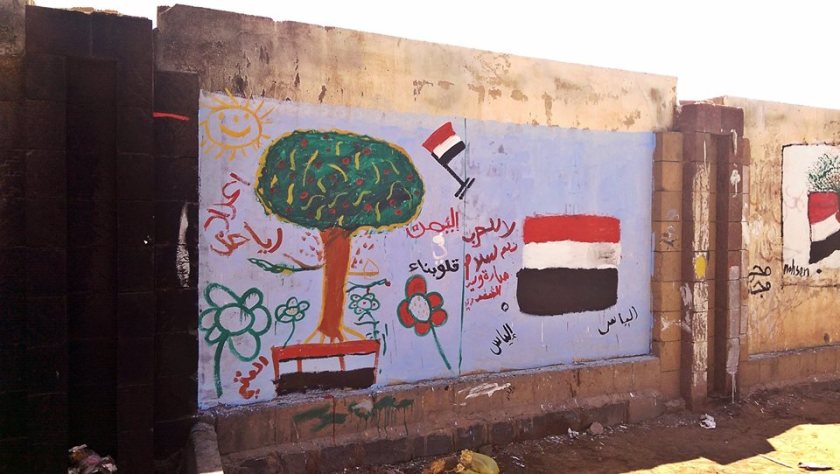
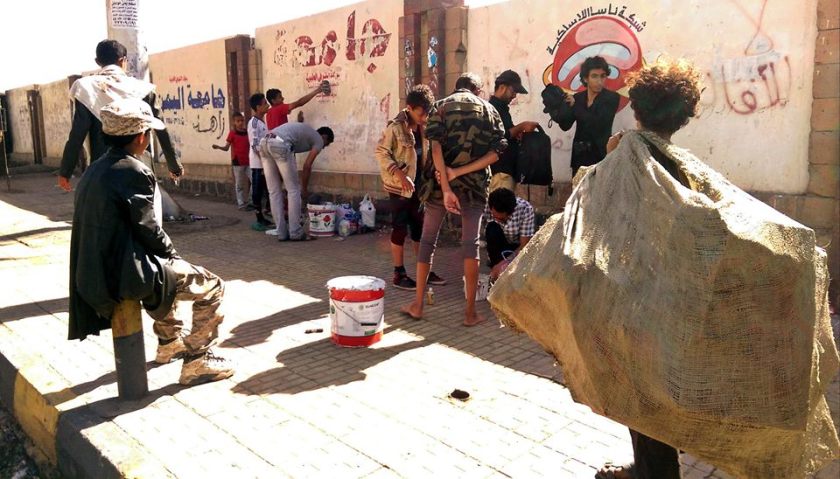
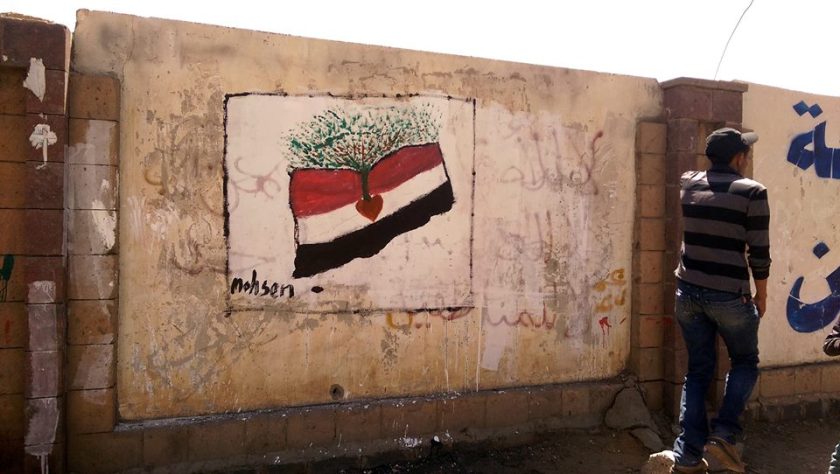
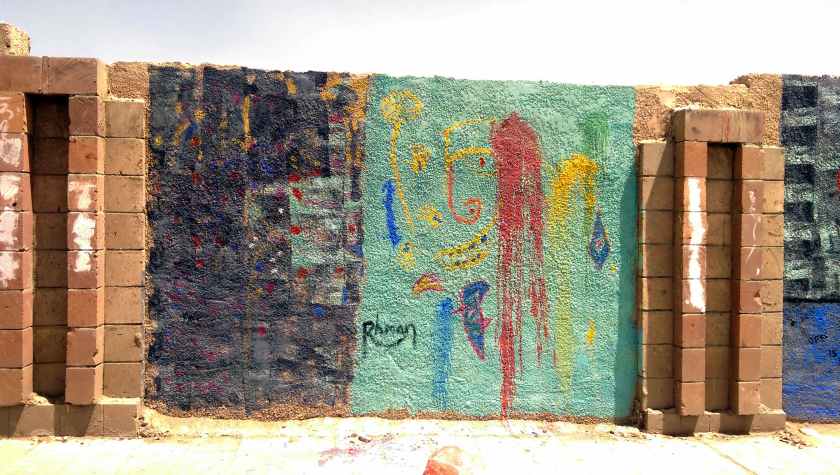
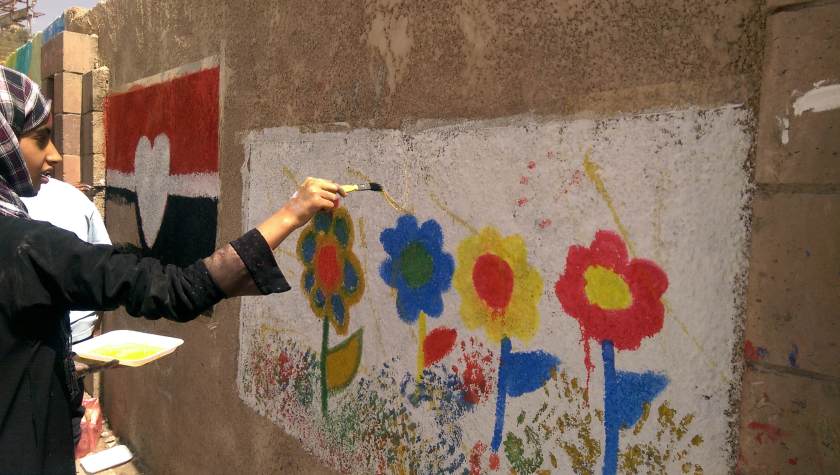
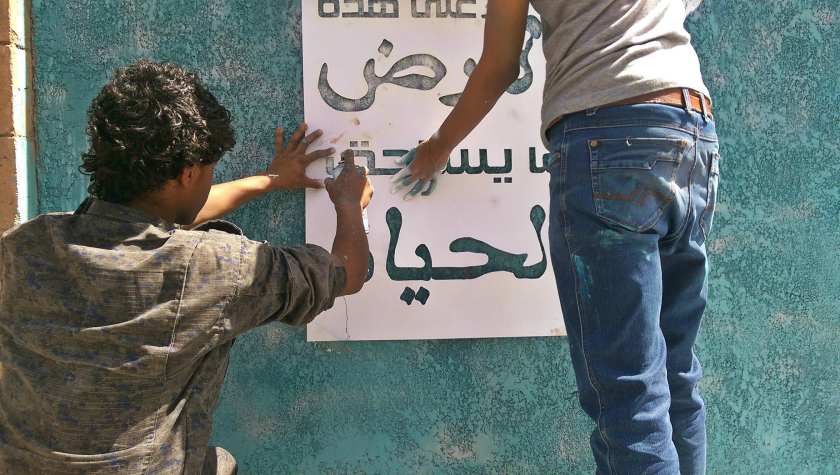
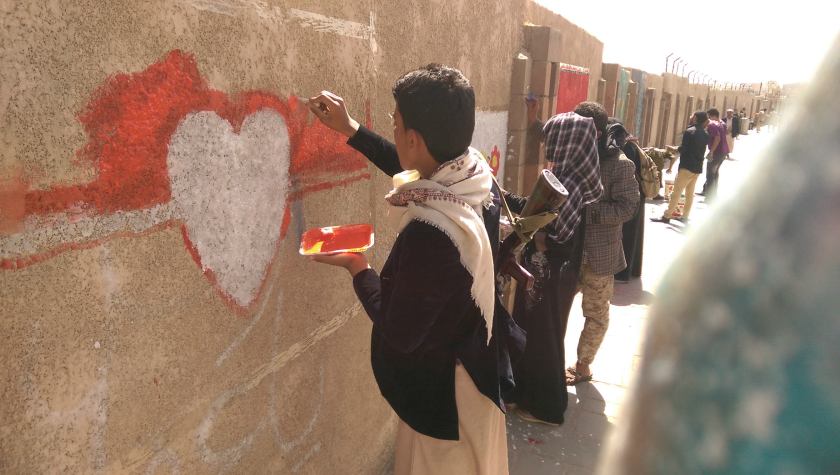
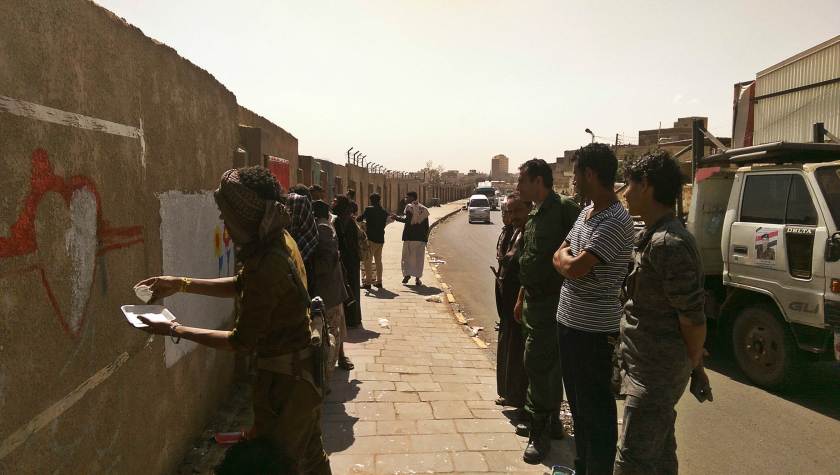
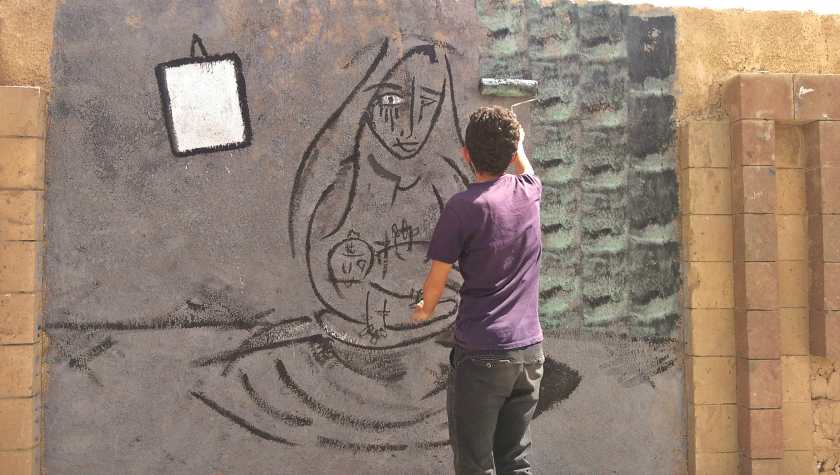
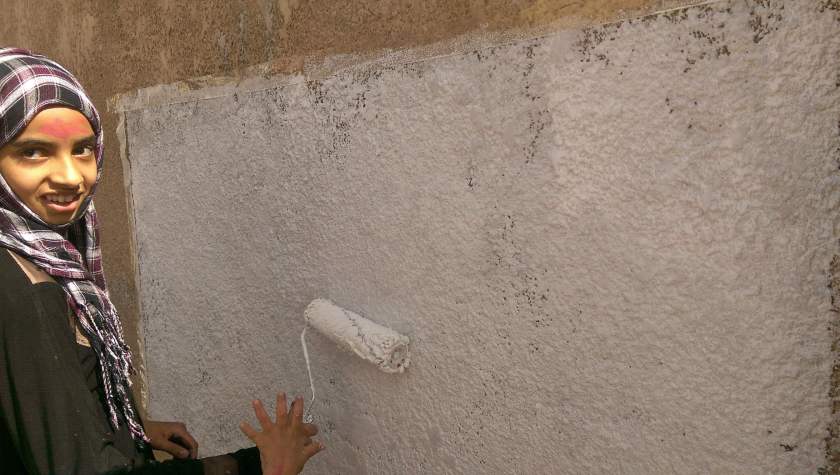
اختتمنا اليوم فعالية الرسم المفتوح على جدران الشارع بعد أن رسمنا لمدة ثلاثة أيام (15 مارس – 17 مارس 2016) على جدران الجامعة الجديدة في شارع الرباط، أمام قسم شرطة 14 أكتوبر، صنعاء.
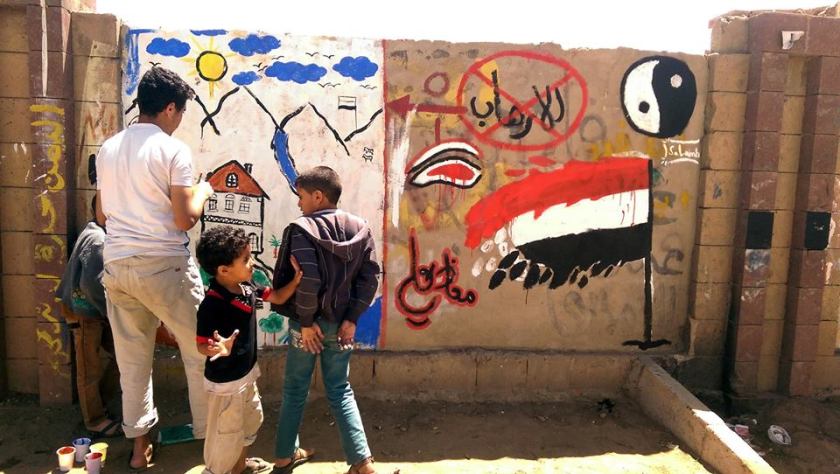
لقد كانت ثلاثة أيام مميزة بحق، ومليئة بالألوان والحياة. رسم فيها على الجدران الأطفال، والكبار، والمارة، وحتى الجنود. رسموا هؤلاء الأشخاص، بتقنياتهم البسيطة أو العظيمة، آمالهم وأحلامهم الجميلة على الجدران.
من أهم أسباب نجاح هذه الفعالية هي مشاركة الناس، والذين لطالما مثلوا روح هذه الحملات الفنية التي أطلقت في اليمن، ويالها من روح بديعة التي تشكلت خلال هذه الأيام الثلاثة.
شكراً جزيلاً لجميع من شارك بالرسم معنا، ولمن ألقى الملاحظات، وشجع، وأسقى عطشنا بالماء والعصير، سواء كانوا من الأصدقاء، وأبناء المنطقة، والجنود، والمارة، وكل من تفاعل مع الدعوة للمشاركة في هذه الفعالية. وأخص بالشكر أصدقائي الفنانين الذين لم يدخروا اي جهد لإنجاح هذه الفعالية المتواضعة.
مرة أخرى، نشكركم جميعاً لتفاعلكم مع هذا الحدث، ونتمنى، أنا والأصدقاء، رؤية المزيد من الفعاليات الثقافية والفنية التي تدعو إلى السلام في اليمن.
Today was the third and last day in the event “Open Days for Art” where we painted on the walls of the new university, in Ribat Street, In front of October 14 police station, Sana’a, from March 15 – March 17, 2016.
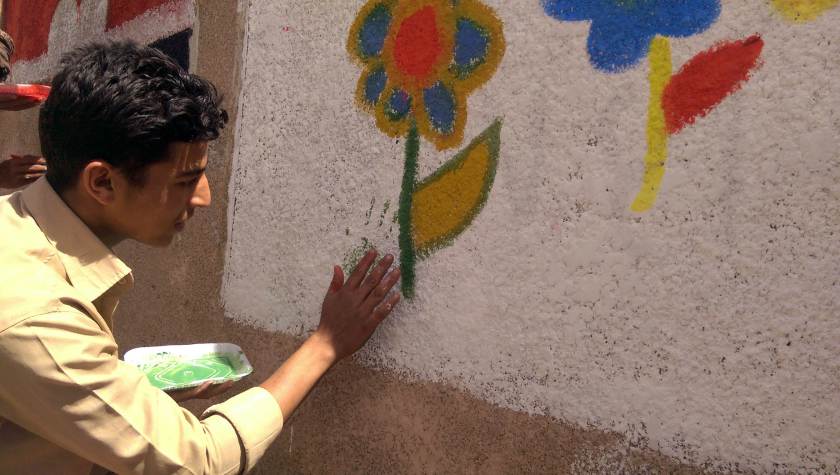
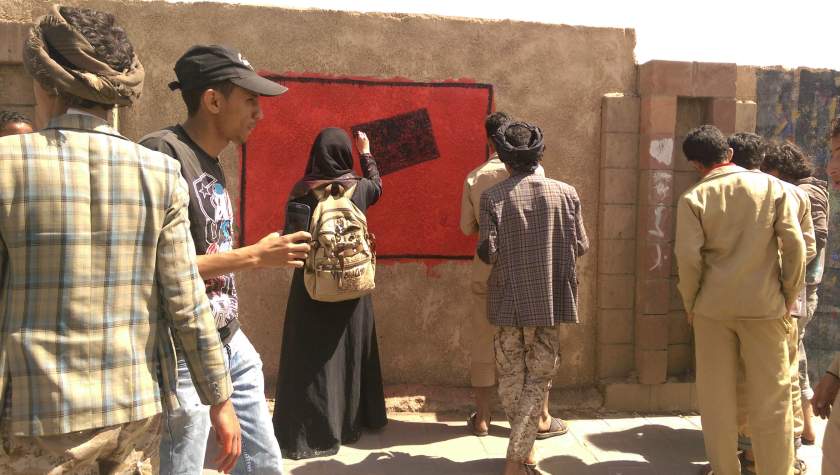
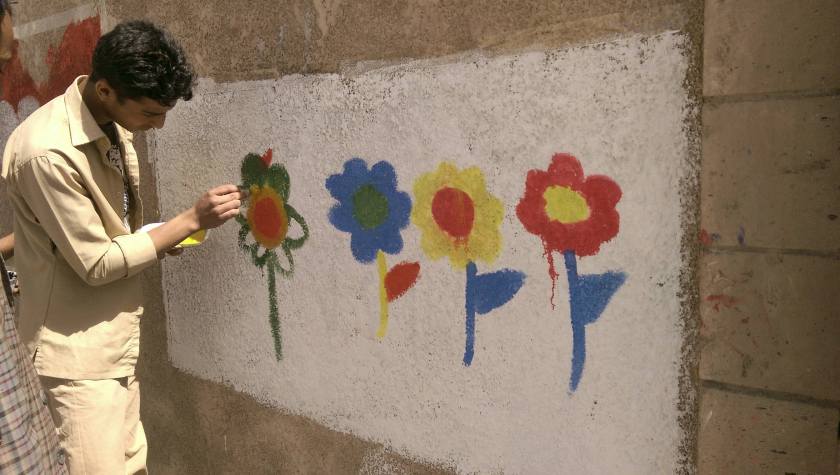
These three days have been distinctive, and filled with so much colors and life. Children, adults, pedestrians, and even soldiers painted during these three days. These people, whether with simple or great techniques, have painted their beautiful hopes and dreams on the walls.
One of the most important reasons for the success of this event is the participation of people, who have always represented the spirit of these artistic campaigns launched in Yemen. And what an exquisite spirit that has formed during these three days.
Many Thanks to all who have participated in painting, making remarks, encouraging and watering our thirst by providing us with water and juice, whether they were friends, neighborhood residents, soldiers, pedestrians, and everyone else who interacted with the invitation to join us in painting. I especially thank my friends who had spared no effort to ensure the success of this modest event.
Once again, thank you all for your interaction with this event. My friends and I wish to see more cultural and artistic events that call for peace in Yemen.
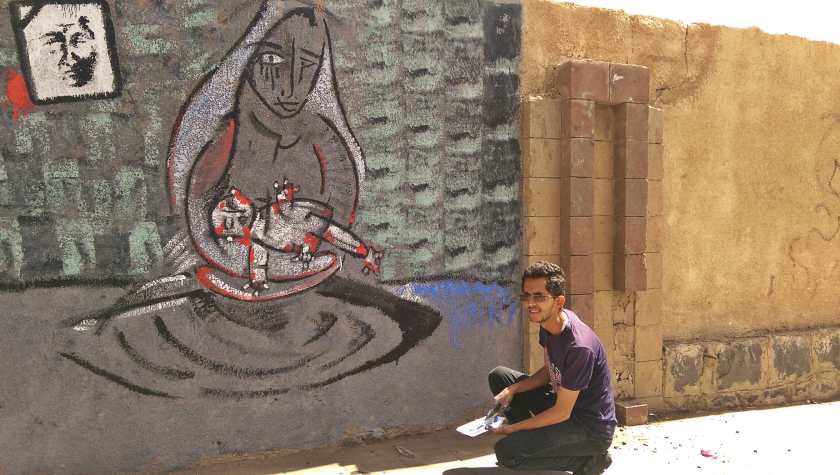
صور من فعالية اليوم للرسم المفتوح على جدران الشارع، 15 مارس 2016، أمام قسم شرطة 14 اكتوبر، شارع الرباط، صنعاء.
للراغبين بالإنضمام إلى الفعالية، سنستمر بالرسم ليومي 16 و17 مارس 2016 في نفس المنطقة. يبدأ الرسم من الساعة التاسعة صباحاً.
شكر خاص لجميع من جعل هذا اليوم جميلاً ومليئاً بالألوان والإبتسامات.
تصوير: هديل الموفق
These pictures were taken from today’s event “Open Days for Art”, March 15 2016, where people painted on the walls of the street, in front of 14 October police station, Ribat Street, Sana’a.
For those who wish to join us in painting, the event will go on for another two days, 16 and 17 of March 2016, in the same area. We’ll begin painting at 9:00 AM.
Special thanks to everyone who made this day a beautiful one and full of colors and smiles.
يعيش اليمنيون كافة أوضاع كارثيه في ظل الحرب وصراعات الداخل والخارج. الشعب اليمني اليوم يتضور جوعا وعطشا ويفتقد لأبسط الأدويه بسبب الحرب وحصارها. بحسب الإحصائات فإن 21 مليون يمني يحتاجوا إلى المساعدة اليوم، منهم أكثر من 7 مليون يمني بحاجة للمساعدات الإنسانية الأساسيه الطارئه.
جدارية “النبض الأخير”
للفنان/ ذي يزن العلوي، ضمن حملة “حُطام” في نشاطها السادس حول “الحصار”، على الجدار المقابل لوزارة الشباب والرياضه، شارع الزبيري، في اليوم الأخير للعام 2015.
Due to the internal and external conflicts in Yemen, Yemenis live under catastrophic conditions. Today, Yemeni people struggle with the lack of food, water and medications because of war and its siege. According to recent statistics, 21 million Yemeni need assistance, of whom more than 7 million Yemenis need urgent and basic humanitarian assistance.
“The Last Impulse” mural
By the artist Thi Yazan Al-Alawai, under “Ruins” campaign in its sixth activity around “Blockade”, on the opposite walls of the Youth & Sports Ministry, Alzubairi Street, in the last day of the year 2015, December 31.
My mural about “Treason” in “12 Hours” campaign is republished by “FOREIGN AFFAIRS” Magazine along with other artistic murals from countries sinking in conflicts entitled “War Painting”.
“In Sana’a, Artist and activist Murad Subai puts final touches on his graffiti depicting Saudi, U.S., and Iranian currency banknotes on a wall. His work is part of a graffiti campaign against foreign interference in the internal affairs of Yemen, May 15, 2014.”
ما أشبه اليوم بالأمس حيث تزدهر الخيانة الوطنية أكثر ويتباهى الخونة بخيانتهم، كالطواويس.جداريتي عن “الخيانه الوطنيه” في حملة “12 ساعه” اعادت نشرها مجلة “FOREIGN AFFAIRS” الأمريكيه مع مجموعة من الجداريات الفنيه من بلدان تلتهما الصراعات تحت عنوان “جداريات الحرب”
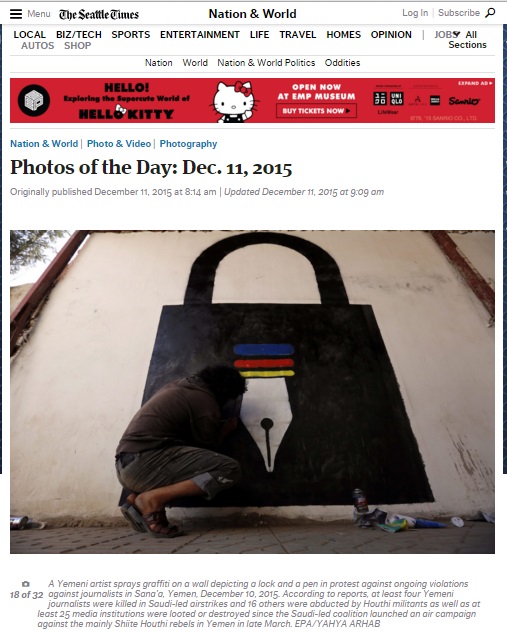
On the American website “The Seattle Times”: Photos of the day.
During painting my fifth mural in “Ruins” campaign, on the wall of the Yemeni journalist Syndicate, Dec.10, 2015
من “صور اليوم من حول العالم” على الموقع الأمريكي “The Seattle Times”
الصوره أثناء عملي على جداريتي الخامسه ضمن حملة “حُطام” التي عنت بالحريات، على جدار نقابة الصحفيين اليمنيين، 10 ديسمبر 2015.
تصوير: Yahya Arhab “EPA”



























 Murad Subay