
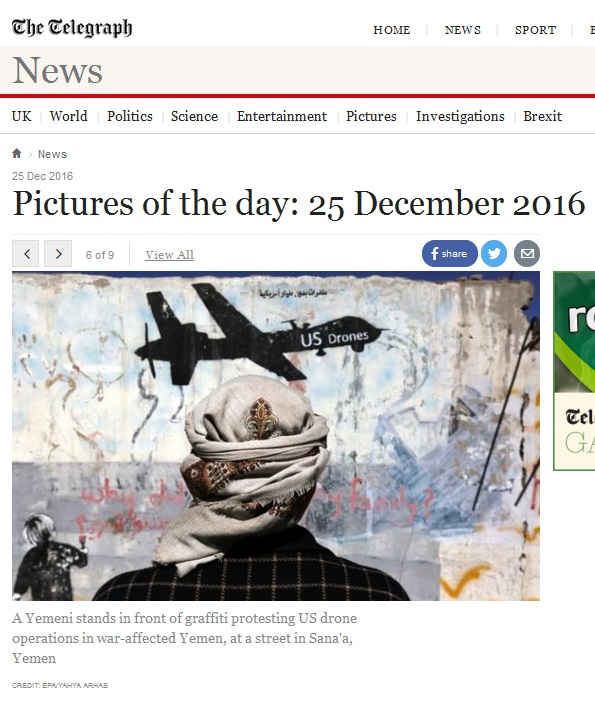


Atrocities are being committed against an innocent Yemeni population on a scale as serious as Syria and Iraq. But why doesn’t this story get as much media attention as those conflicts? Gouri Sharma reports.

When the UN children’s rights organization UNICEF recently released a report stating that at least one child dies every 10 minutes in Yemen, the expectation was that the news would be picked up by international news outlets. But barring a few exceptions, including Al Jazeera and DW, the news was not carried by much of the global media prominently, and some not at all.
In its report, the humanitarian organization estimated that more than 400,000 Yemeni children are at risk of starvation, and a further 2.2 million are in need of urgent care. How could it be that statistics this alarming, the result of a war involving regional superpowers with the backing of the US and UK, does not make headline news?
But people close to the story say this example is just a reflection of how the war in Yemen is covered by the global media.
Yemen and the western media
It’s not that the conflict isn’t covered, but when it is, news outlets tend to focus on the ‘Sunni-majority Saudi Arabia versus the Shia Iran proxy war’ narrative which overlooks the country’s deepening humanitarian crisis.
Yemen, a country of 24 million people, has endured political strife for decades, but the situation worsened in March 2015 when a Saudi-led coalition began airstrikes with the aim of reinstating President Abdrabbuh Mansour Hadi, who had been ousted by the Houthi rebel group. The Houthis are said to be backed by Saudi Arabia’s regional political foe, Iran.
Since the bombing began, the UN estimates that more than 10,000 innocent people have been killed, 69 percent of the country is in need of humanitarian assistance, and three million people have been forced to flee their homes.
 Although atrocities are committed on a daily basis, the conflict in Yemen seems to have dropped off the radar
It’s a complex political situation and those closest to it – the local journalists – have been forced to stop telling the story because of the dangers they’ve been facing. The Committee to Protect Journalists, a New York-based press freedom watchdog, has recorded the deaths of at least six journalists caught in the crossfire since the start of the Saudi campaign. In its latest report, the Yemeni Journalist Syndicate said that more than 100 press violations were committed in the first six months of 2016, including 10 cases of attempted murder, 24 abductions and disappearances, and 12 cases of assaults on journalists and their offices. The situation for foreign journalists isn’t any better, amid reports that those who get access can be subject to harassment and kidnappings.
Afrah Nasser, an independent Yemeni journalist who is based in Sweden, told DW: “When western news outlets cover Yemen it’s often ‘parachute journalism.’ This is mainly because it’s been hard to access Yemen and if you want to get in you have to get permission from the Saudis and the Houthis. For foreign journalists, it’s become hell to enter or leave the country and a trip that used to take a few hours might now take days or even weeks.”
But Iraq and Syria, which has ranked as the world’s most dangerous place for journalists for at least two years in a row, are considered more difficult for journalists to report from than Yemen, yet both countries receive much more media coverage.
Syria, Iraq more ‘newsworthy’
Yemeni activists and journalists point to one other major factor as to why the country is kept lower down on news agendas. Many of the people attempting to get to Europe are from Syria and Iraq so western news audiences are more affected by the what’s happening in those countries than what’s happening in Yemen – news editors may not deem the war newsworthy enough for their audiences.
“There isn’t a direct or immediate threat coming to western countries from Yemen,” Baraa Shiban, a London-based Yemeni human rights activist, tells DW. “There are no ‘waves’ of Yemeni refugees crossing the Mediterranean because it’s too far and if there are refugees they remain few in numbers. This is also related to the threat western countries feel they are facing. Dealing with the ‘Islamic State’ (IS) tops the list for western politicians. IS has claimed attacks inside Europe and such attacks could happen again. Al-Qaeda in the Arabian Peninsula has been busy hitting inside Yemen – recently killing soldiers in Aden – but it’s limited in its ability to hit in Europe or the US.”
Coverage could also be affected by who is involved in Yemen – and who isn’t. “Any journalist or researcher who tries to dig deeper into the situation will see it’s a local conflict, especially when we talk about specific places like Taiz, a city in the south which has been living under siege for the past year and a half by forces loyal to the former president, along with the Houthi rebels who come from the north. If you compare that with the situation in Aleppo, you have Russia, Iran and Hezbollah. That’s a more interesting story with international and regional powers,” says Shiban.
The biggest known player involved in Yemen is Saudi Arabia, who has been carrying out its military campaign with arms brought from the US and Britain. In December, the US announced it would be halting an arms deal worth $350 million to the Kingdom amid concerns of the coalition’s indiscriminate bombing inside the country. But up until that point, President Obama had reportedly sold arms to the tune of $115 billion (107 billion euros) to Riyadh during his eight years in office – more than any US administration in history.
 Many local observers accuse western media and western governments of double standards when it comes to Yemen
Double standards
The UK, meanwhile, approved 3.3 billion pounds (3.7 billion euros) worth of arms to the Kingdom in the first 12 months of its bombardment of Yemen. So it may not make for good business sense for the corporate media in the US and the British mainstream media to cover a war and the negative impact it’s having on civilian life when their governments are making huge profits from it.
“If there is one country in the world that has the most gross double-standards, it’s the UK. As long as the Saudis are their ally, they can overlook any of atrocities committed by their friend. Yemenis’ blood means nothing when Saudi’s cash is on the table and if you’re a foreign journalist, some big media outlets won’t buy your story because they don’t want to annoy the Saudis,” says Nasser.
But amidst all the reasoning, the facts remain. Atrocities are still being committed against innocent people on a daily basis and a humanitarian crisis is worsening as millions of people lack basic food and water supplies.
Murad Subay, an internationally renowned Yemeni street artist who has been using his art to call for peace, says that the situation in Syria should serve as a warning. “What happened in Syria is an example of where the world ignored the crisis until it turned into catastrophic war. We as citizens of the world have a responsibility to pressure countries to stop engaging in Yemen’s war and to stop selling the arms that fuel it. People suffering in faraway places doesn’t make the rest of the world immune from it. People everywhere should care because it is the right thing to do, because what’s happening is wrong and inhumane.”
Continue reading “Yemen conflict all but ignored by the West\ On “DW””


Als je op straat loopt in Sanaa, de hoofdstad van Jemen, kun je niet om de kunstwerken van de ‘Banksy van Jemen’ heen. De gebouwen zijn misschien kapot door alle bombardementen, maar ze zijn niet lelijk: op de gevels staan nog de graffitikunstwerken van Murad Subay.
“Toen in 2011 de oorlog begon, brak dat vele harten”, vertelt Murad aan de NOS. “Maar niet alleen harten gingen kapot, ook huizen en straten. Op dat moment besloot ik de straat op te gaan en graffitikunst te gaan maken. Ik wilde het lelijke van de oorlog verdoezelen. De kogelgaten in de muur laten verdwijnen. Dat lukte me door de graffiti.”
In Jemen woedt al jaren een burgeroorlog. De NOS heeft contact met inwoners van het land, om een beeld te krijgen van de situatie in het land. Zij vertellen hun verhaal via WhatsApp, e-mail en Skype. Deze week spreken we met Murad Subay. Eerdere verhalen kwamen van Abdullah uit al-Mukalla, Fadia uit Taiz en Layla uit Sanaa.

Sommige werken van Murad zijn puur artistiek, andere hebben een politieke lading. De artiest nodigt inwoners van Sanaa ook uit om te helpen bij de kunstwerken. “Zo kunnen de mensen hun stem laten horen en hun mening geven over de oorlog. Kunst is niet alleen entertainment, het kan voor zoveel meer dingen worden gebruikt. Kunst geeft een stem en zorgt voor communicatie, zeker als het zo duidelijk op straat te zien is.”
De 29-jarige Murad woont met zijn ouders, drie zussen en vier broers in een huis in Sanaa. Hij heeft Engels gestudeerd en haalde in 2012 zijn diploma.
“Ik begon met tekenen toen ik 13 was. Mijn ouders moedigden me aan en daardoor kon ik mezelf veel dingen leren. In 2012 maakte ik mijn eerste graffitiwerk en dat resulteerde in een campagne waardoor ik werken in heel Sanaa mocht maken.”
De oorlog heeft veel veranderd, gaat hij verder. “Dat heeft zoveel effect op me. Op iedereen.” Murad noemt het tekort aan basisbenodigdheden als elektriciteit en water, en de economische gevolgen van de oorlog.
“Deze dingen hebben veel effect op mij persoonlijk, maar ook op mijn werk. Het is niet meer mogelijk om vrij te reizen in Jemen. Het is soms ook veel te gevaarlijk op straat om de werken te maken.”
De laatste tijd wordt het steeds moeilijker om onze mening te mogen uiten door middel van kunst.
Murad Subay
Murad zorgt altijd dat hij goedkeuring krijgt van de autoriteiten om graffiti te spuiten, maar ook dat gaat nu lastig. “De laatste tijd wordt het steeds moeilijker om onze mening te uiten door middel van kunst. Ook al heb ik toestemming, vrij graffiti spuiten wordt nauwelijks nog toegelaten.”
Murad heeft inmiddels zoveel roem in Jemen verworven, dat hij ook wel de ‘Banksy van Jemen’ wordt genoemd. “Banksy is een grote artiest, een genie. Mijn werk lijkt op dat van hem omdat we dezelfde techniek gebruiken. Maar de manier waarop we werken, is anders”, legt Murad uit.
“Ik wil zoveel mogelijk mensen betrekken bij mijn kunst. Als ik een kunstwerk maak en er lopen mensen langs, dan nodig ik ze altijd uit om me te helpen en hun mening te geven. Zo kunnen we een politieke discussie op gang brengen, op een niet-gewelddadige manier.”
Ik hoop dat het nieuwe jaar echt een nieuw jaar wordt. Het afgelopen jaar was zo vermoeiend.
Murad Subay
Na vijf jaar als graffiti-kunstenaar wacht Murad nog steeds op het hoogtepunt. “Ik hoop ook dat ik nog niet mijn mooiste werk heb gemaakt. Ik ben pas op het begin van mijn reis.”
Voor 2017 heeft hij maar één wens: “dat het écht een nieuw jaar wordt.” “Het afgelopen jaar heeft de wereld enorm vermoeid. We zijn er allemaal klaar mee.”

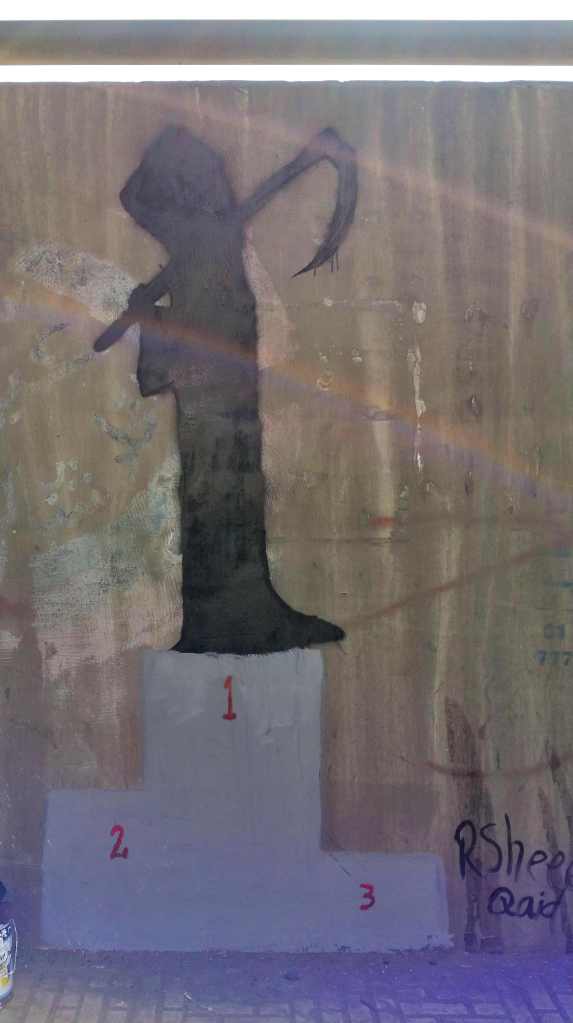
العالم يتسابق للصدارة في الجمال ويتسابقوا هنا في صدارة القبح.
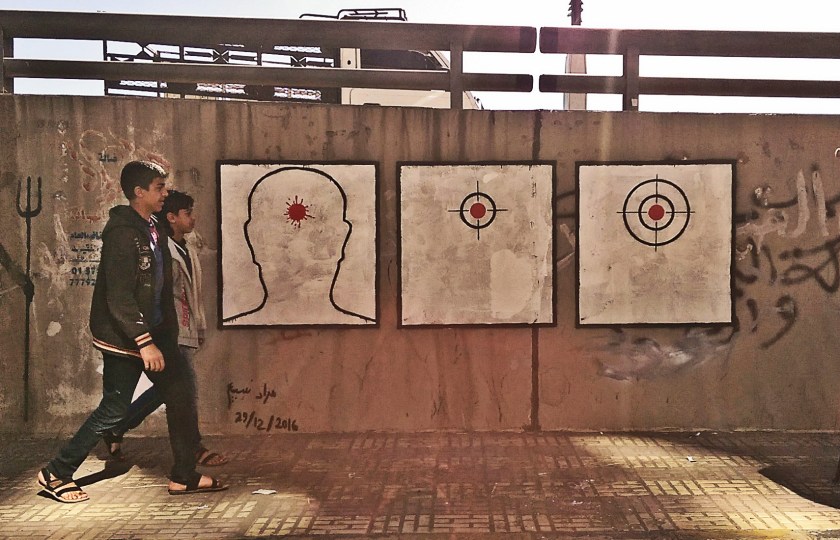
“الاول” جدارية الفنان: رشيد قائد، ضمن #حملة_حطام، في نشاطها الحادي عشر حول قضية “الإغتيالات”، على جدار جسر مذبح، 29 ديسمبر 2016.
World racing to the forefront of the beauty and here they are racing for the top of ugliness.
“The first” mural by the artist: Rsheed Qaid, #Ruins_Campaign, in its 11th activity about “Assassinations”. On Mathbah bridge’s wall, Dec.29,2016.

القتلة يدونوا التاريخ بالدم.
“ذكريات حمراء”، عنوان جدارية الفنان: ذي يزن العلوي، ضمن #حملة_حطام” في نشاطها الحادي عشر، عن قضية “الإغتيالات”. على جدار جسر مذبح، 29 ديسمبر 2016.
Criminals do write the Yemeni history with blood.
“Red Memories”, a mural by the artist: ذي يزن العلوي, #Ruins_Campaign, in its 11th activity about “Assassinations”. On Mathbah bridge wall, Dec.29, 2016


ما زالت الكوارث تتوالى على هذا البلد وشعبه، حروب انتجت الموت والجوع والخوف، وكأن البلد لم تكتفي من هذا بل وجاءت كارثة اخرى إلى هذه الكومة المفجعة وهي عمليات “الإغتيالات” والتصفيات.
منذ اعوام وعمليات التصفيات والإغتيالات السياسية تمشي على قدم وساق في جميع مناطق اليمن، بدأت التصفيات في صفوف الجيش منتقلة لصفوف السياسيين ومؤخرا انتقلت إلى صفوف المواطنين والمدنيين. إستمرار هذا الوضع وهذه العمليات، يجعل اليمن بلد خالي من الحياه ومن التنوع، ويبعدنا تماما عن سلام قريب.
الشعب اليمني منهك من هذا الوضع المستمر بالتدهور الهائل، على جميع الأصعدة. لن يُحكم هذا البلد بالحديد والنار ولا بالخوف والجوع والموت وعلى اصحاب القرار ان يصلوا بهذا البلد بأسرع ما يمكن إلى وقف لهذا التدهور الذي سيطالهم عاجلا أم اجلا ان استمر.
جداريتي “عين الإغتيال” ضمن حملة “حُطام” على جدار جسر مذبح المقابل لمستشفى العلوم والتكنولوجيا، 29 ديسمبر 2016.
Disasters are still coming down on this country and its people, where war is leaving behind death, hunger and fear. Now another disaster is on the rise, “assassinations, adding to the misery of this country as if the tragedy happening in Yemen is not enough. Political assassinations and the extrajudicial killings have been thriving in many regions in Yemen. These operations began among military ranks, and then moved to target politicians, until recently it shifted into targeting civilians. The continuation of this situation and these operations turns Yemen into a lifeless country and deny it its diversity and peace. Yemenis are exhausted from this rapidly deteriorating situation. There must be another way out, for no country in the world should be governed by iron, fire, fear, hunger and death. Decision-makers must end this situation as soon as possible or it will eventually reach them.
My mural “Assassination’s Eye” #Ruins_Campaign, on Mathbah bridge wall, December 29, 2016.


“صوت من صنعاء”
حديثي مع راديو “ان بي او” الهولندي، حول الوضع في اليمن.


เยเมนเป็นอีกประเทศหนึ่งในตะวันออกกลางที่ประสบปัญหาความขัดแย้งทางการเมือง เนื่องจากกระแสการต่อต้านของประชาชนที่มีต่อรัฐบาลเป็นไปอย่างเข้มข้นและยาวนานมาจนถึงจุดแตกหัก ทำให้การเมืองเมืองของเยเมนขาดเสถียรภาพและประสบกับความปั่นป่วนอย่างหนัก ล่าสุดจากผลการสำรวจของฟอร์บส์ นิตยสารการเงินชื่อดังของสหรัฐฯ รายงานว่าประเทศที่มีเศรษฐกิจย่ำแย่เลวร้ายที่สุดของโลกคือ เยเมน ดินแดนที่เคยมั่งคั่งไปด้วยน้ำมันและก๊าซธรรมชาติ แต่กลับถูกรุมเร้าด้วยปัญหาความไม่สงบจากชนเผ่าภายในประเทศ รวมถึงภัยคุกคามจากเครือข่ายก่อการร้ายอัลกออิดะห์นานต่อเนื่องหลายปี ในขณะที่ Sana เมืองหลวงของประเทศยังได้รับการโหวตให้เป็น 10 อันดับเมืองที่ไม่น่าอยู่ที่สุดในโลกอีกด้วย
อย่างไรก็ตาม เยเมนไม่ได้แร้นแค้นศิลปินไปด้วย ประเด็นปัญหาที่ฝังรากลึกมานานจึงถูกถ่ายทอดออกมาตามแนวกำแพงในเมืองหลวง โดยมี Murad Sobay ศิลปินแนว street art เป็นตัวตั้งตัวตีในการทำแคมเปญสุดครีเอท ‘12th Hour’ เพื่อต่อต้านรัฐบาล โดยได้ชักชวนบรรดาเหล่าศิลปิน รวมทั้งคนทั่วไปผ่านทาง social network ซึ่งได้รับการตอบรับเป็นอย่างดี ยิ่งในปัจจุบันกระแสกราฟฟิตี้ (graffiti) หรือภาพวาดล้อเลียนตามฝาผนังหรือกำแพง ไม่ได้เป็นเพียงพื้นที่ระบายอารมณ์ของพวกมือบอนเท่านั้น แต่ได้กลายมาเครื่องมือเพื่อสื่อ ‘สาร’ ของเหล่าศิลปินอิสระทั้งหลาย ซึ่งดึงดูดความสนใจของคนหมู่มากได้เป็นอย่างดี ทั้งในแง่ของการเข้าถึงได้ง่าย การได้มีส่วนร่วมของคนหมู่มาก บวกกับธรรมชาติของกราฟฟิตี้ ที่มักจะมีความน่ารักเจืออารมณ์ขันร้ายๆ ไว้เสมอ กับข้อความโดนๆ ที่สามารถสามารถเชื่อมโยงกับผู้คนได้ทุกชนชั้น ดังนั้นกราฟฟิตี้จึงสามารถสร้างแรงขับเคลื่อนและเปลี่ยนแปลงได้อย่างน่าสนใจ
ในชั่วโมงแรกของของเเคมเปญ Sobay ได้นำเสนอเรื่องความรุนแรงกับอาวุธปืน กับข้อมูลอันน่าตกใจที่ว่าประเทศเล็กๆ ของเขามีผู้ถือครองอาวุธปืนมากที่สุดเป็นอันดับ 2 ของโลก ทั้งกองทัพที่มีประสิทธิภาพสูงพร้อมปฎิบัติการทันที รวมถึงปัญหาความหลากหลายของเชื้อชาติซึ่งเป็นปัญหาระดับประเทศ ชั่วโมงที่ 2 เป็นเรื่องของความขัดแย้งรุนแรงของชาวมุสลิมระหว่างนิกายชีอะห์และสุหนี่ ทำให้เกิดความแตกแยกภายในประเทศ ชั่วโมงถัดมาเป็นเรื่องของสิทธิมนุษยชน ที่ประชาชนจำนวนมากถูกจับและหายตัวไปอย่างลึกลับ ‘The Walls Remember’ ที่เปิดพื้นที่ให้คนในครอบครัวหรือคนรู้จักมาวาดรูปใบหน้ารูปสเก็ตช์ หรือภาพ print และวันที่ของบุคคลที่หายไป ซึ่งแต่ละซีรี่ย์นั้นมีพลังเฉพาะตัวเพราะเกิดจากความรู้สึกส่วนลึกของคนในประเทศที่ได้รับผลกระทบ ที่มากไปกว่านั้นมันแสดงให้เราเห็นว่า ‘ศิลปะ’ สามารถเปลี่ยนแปลงโลกได้จริงๆ


อ้างอิง : Designboom


Graffiti murals have propped up across walls destroyed by the two-year conflict [Muradsubay.com]
Date of publication: 11 November, 2016
While the death toll stands at more than 10,000, a further 3 million have been flung to all corners of the nation and beyond, and more than half of the 22 million population are barely surviving the war.
Like Pandora’s Box, the conflict has unleashed even more fiends to concern Yemen’s otherwise peaceful and care-free civilians.
Hunger, poverty, kidnapping, airstrikes, drone strikes, sectarianism, civil war, recruitment of child soldiers, regional-meddling and government corruption are among the many crises to hit the country once described as ‘Arabia Felix’ – Happy Arabia – but one man has marched towards the frontlines of these battles, armed with nothing but a paintbrush and a graffiti can.
“I believe that art can have important messages,” Murad Subay told The New Arab. “It reaches more people – especially graffiti murals which are seen by hundreds of thousands of people walking by it every day.”
The 29-year-old has used his talents to paint the town red, white and black, since the extraordinary days of the 2011 Arab Spring.
| What do child-soldiers dream of? |
But among the flags and the patriotic symbols, Subay, along with his other peers, have imprinted his visions of both despair and hope along Yemen’s iconic, old-brick walls.
“People who pass by while we’re painting praise us, pray for us and sometimes even join us in painting,” he said, noting that men, women, children the elderly “and even soldiers” have stopped to contribute to the colours seen on the walls of the city.
“They feel like we’re highlighting their concerns and issues by discussing them on the streets.”
The Sanaa-based artist himself has felt the blow of the conflict.
“My brother, a journalist and writer was shot in both legs twice for his satirical pieces against the warring parties,” he said.
“Two of my relatives were killed during the war and my 14-year old cousin was also killed,” he added, noting that he was recruited as a child soldier by one of the armed groups involved in the conflict.
Despite this, Subay remains hopeful and believes his efforts of the past five years have had an impact on society.
| Ying and yang |
“Even if art is not going to feed the poor or stop the killings, I still feel like its presence in these times is crucial. It is our way of saying we want peace. It is our way of saying there are other alternatives to violence.”
Several attempts have been made to arrive at a peaceful political settlement aimed at ending the conflict since it began in September 2014 and escalated with the Saudi-led coalition intervention in March the following year.
However, the peace talks – though backed by numerous global powers – have failed Yemen’s population time and time again, causing many to lose hope amid the ongoing suffering.
“Hope is all that is left for us now, the war has taken away everything else,” Subay suggests.
“If we to give up on hope, then the whole place will turn into a big grave of people who chose to let go.
“If the political parties fail to see a chance of cooperation and peace, then we’ll keep reminding them. It’s the only way out.”

This was how Peter Maurer, the president of the International Committee of the Red Cross, saw the country in August 2014: “Yemen after five months looks like Syria after five years.” As ever, civilians are bearing the brunt of the violence. In fact, Yemen has been in turmoil for far longer, with a split between the north and south areas, and between Shia and Sunni. Internal conflict became even more serious war with the intervention in 2015 of Sunni Saudi-backed coalition forces.
Artists have come to the fore, using a variety of media to contemplate and bring the Yemenis’ situation to the world’s notice. It strikes me that Yemeni art and culture is inherently poetic, how else could they make films such as The Melody of our Alienation?

Just as lyrical is The Color of Injustice.

However, here I am concentrating on the activities of Murad Subay, an artist outraged at the ravages wrought in Yemen, who started a series of Campaigns in March, 2012. He made street art, and encouraged other artists and the ordinary Yemenis to join in, which they have done with enthusiasm. This is despite the obvious dangers of pointing to the corruption, gun violence, enforced disappearances or state kidnappings, the effect of US drones, to mention but a few of the ills that beset the Yemenis.
His Campaigns are carefully orchestrated and I have, where possible, obtained images that relate to each of them. Each Campaign or activity within a Campaign produced many images, I have only room for an example from each. His first Campaign was called Color the Walls of your Streets, in March 2015. It started in Sana’a and later was launched in other cities.

The second Campaign, called The Walls Remember their Faces, in September 2012, referred to the oppression that Yemenis were suffering, particularly the enforced disappearances, or state kidnappings, of numerous individuals. Subay and his friends painted the pictures of 102 forcibly disappeared victims in many areas in the cities Sana’a, Taiz, Alhudayda and Ibb.

On July 4, 2013, Subay launched his third and most forceful and ambitious Campaign, 12 Hours. For a whole year, Subay and fellow artists painted murals about a certain subject each month in the streets of Sana’a city. Each subject was a pressing political or social issue affecting Yemeni society. The twelve months equated to twelve hours and a clock face normally appeared on the murals, indicating their place in the sequence.
The first topic was the spread of weapons leading to gun violence. “The war-torn Arab country [Yemen] is second only to the U.S. in gun ownership — and second to none in weapons culture.”

Fellow artists started to join him during the second activity of the campaign which was about sectarianism.

In the third ‘hour’ Subay revisited the enforced disappearances or state kidnapping of hundreds of individuals, in Huthi-controlled areas.

The fourth hour dealt with the splits within Yemen. North and South Yemen had been warring for some time, but had been united, supposedly, in 1990. Conflicts have repeatedly broken out since.

The dreaded US drones, stealthily backing up the regime’s forces, and killing civilians, are the subject of the fifth Hour.

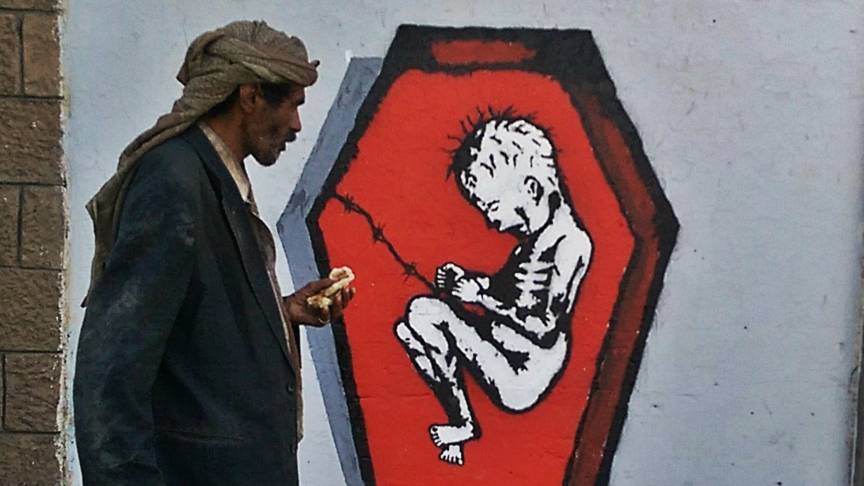
Yemen is one of the driest, poorest and least developed countries in the world. Its conflicts have brought even worse conditions for ordinary Yemenis. Poverty is Subay’s subject for the sixth Hour.

For the seventh Hour, Subay reverted to the key problem for Yemenis—the civil war. Subay sees Yemen’s self-inflicted wounds, and exhorts the country and its people to unite against the real enemies.

I could not find an image from the eighth Hour, terrorism. Of course, not everybody liked or approved of Subay’s Camapigns. As might be expected, activists on both, or all, sides have attempted to obliterate the various images that have appeared on the streets. Perhaps that has happened to the terrorist ones.
The ninth Hour was devoted to the tragic cases of child recruitment into the fighting factions.

The tenth Campaign deals with ‘treason’.

This mural shows Saudi, USA and Iranian currency banknotes being worshipped by treasonable Yemenis who are taking advantage of US drones strikes, Saudi Arabia’s encouragement of tribal insurgents, and Iranian money and weapons going to Shiite Houthi rebels in the north. Saudi Arabia has now, of course, interfered with a vengeance, with full scale bombing.
Unsurprisingly, many of the tenth and eleventh hour images were vandalised or covered with white paint. Fortunately some were recorded before this happened.

“Corruption is the root cause of Yemen’s stagnant growth, which threatens the country’s future and wastes vital resources, time, and human capabilities on a national level. ” We see corrpt antagonistic parties tearing the Yemeni flag to pieces as they are manipulated by third parties.
The final, twelfth Hour, was open to all to add their images.

Wonderfully, they declare, “We won’t be silenced”. They resist still.
Subay’s fourth Campaign was to consist of sculptures, hence its title Dawn Sculptures. However, power outages and lack of funding forced him to postpone the activity. Only one sculpture was made, the Elmuqah, an ancient Yemeni symbol. Its importance for Subay is that it represents the unity of Yemenis and their state 3000 years ago, that he yearns to re-establish.

Recent interpretations of the symbol of the god Elmuqah, or Almaqah, are that it depicts bull’s horns cradling a solar disc. The writing on the first line of the tablet is in the ancient Sabatean script.
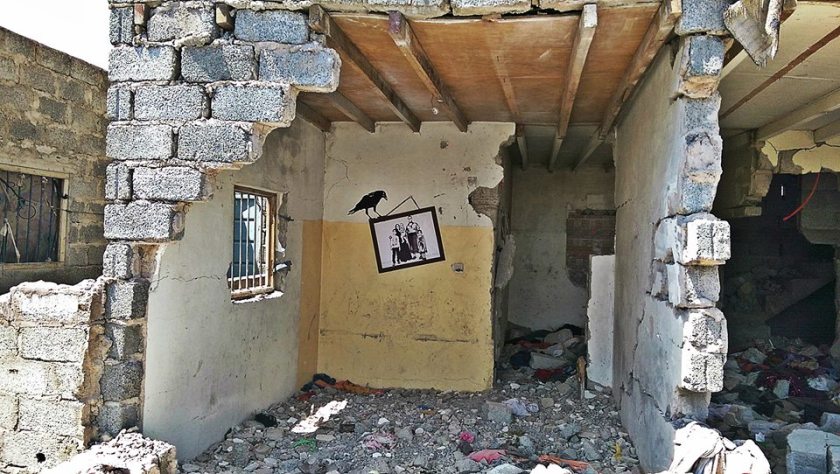
Subay’s fifth Campaign, in 2015, was carried out during the actual war in Yemen, once the Saudis and their allies started bombing and destroying the country physically. Hence the campaign’s title, Ruins, to commemorate the victims of the conflicts and to highlight the catastrophic situation of the country. He often paints in the destroyed areas.

Inside a destroyed house

Throughout, other artists have joined in, and this is a particularly striking, bitter and clever image by Thi Yazan Al-Alawai, for the Ruins campaign. Yemen’s heartbeat is failing.

There were many more images produced during the Ruins campaign, not included here.
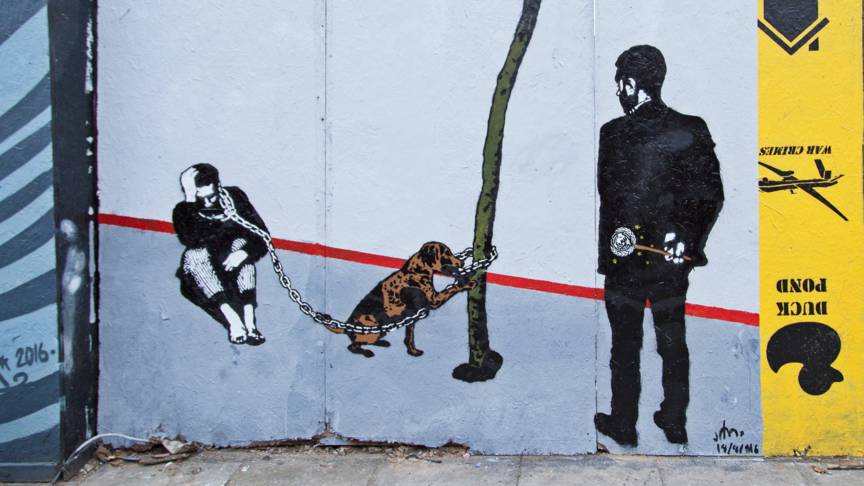
A sort of respite was granted to Subay, when in April 2016 he went to London, to receive the Freedom of Expression Award 2016 from the campaign group Index on Censorship. This did not, of course stop him from expressing his passionate concerns about his country on a wall in London, in collaboration with other artists, as part of the Ruins campaign.

His acceptance speech is powerful and moving. He dedicates his award to the suffering and struggling people of Yemen, and says to “the world’s presidents, kings and leaders who misused their power… you should know that you are leaving behind a dirty legacy…” You can see from the mural that he includes the UN in this, as well he might.
There is ‘Compelling evidence’ that UK weapons used on Yemen civilians‘. But the chink of Saudi money is all that the UK government hears. The Yemenis wait in vain for help.


 Murad Subay