“Sounds of Peace” mural by the artist “Hakim Alrudaini”, in “Ruins” campaign, May 14, 2017.


“صوت السلام”

“أن نكون في سلام مع أنفسنا، يجب ان نكون في سلام مع الأخرين اولاً.”
يقول الفنان: حكيم الرديني
جدارية الفنان #صوت_السلام، على جدار في تقاطع على شارع هايل مع الزبيري، #حملة_حطام, الأحد 14 مايو 2017

“Sound of Peace”

“To have peace with ourselves, we should have peace with others first.”
“Hakim Al-Rudaini” Said the artist.
The artist mural #Sound_of_Peace, on the wall at the intersection of Hail street and al-Zubairi street. #Ruins_Campaign Sunday May 14, 2017.

Mural by “Al-Alawi, “Ruins” Campaign, May 14, 2017.

 
“السلام اصبح ضرب من المستحيل بالنسبة للمجتمع اليمني , من رحم الحرب خرجت الامراض والمجاعة وعوامل اخرى تهدد وجود المجتمع .
هناك تجاهل من المجتمع العالمي للأزمة اليمنية ,اليمنيين لا يردون الألتفاف إلى ازمتهم بل يريدون حلول واقعية لينالون السلام ويعيشون بوئام .كل أطراف الحرب لا يهمهم معاناة المجتمع اليمني ,المجتمع اليمني يرى كل اطراف الحرب مجرد تجار بأسم السلام .”
يقول الفنان: ذي يزن العلوي
 
جدارية الفنان، على جدار في تقاطع على شارع هايل مع الزبيري، #حملة_حطام, الأحد 14 مايو 2017
 
 
Peace has become an impossible for Yemeni society, the war threaten the existence of the society due to the spreading of famine and diseases.
 
The international community did not give an enough attention to the Yemeni crisis. Yemenis wants more than attention at this moment, they want a real moves to push toward the peace, so they can have some peace. All the sides of this war did not care about the people of Yemen. Yemenis see the sides of the war as traders in the name of peace.
“Thiyazen Al-Alawi” said the artist.
 
The artist mural, on the wall at the intersection of Hail street and al-Zubairi street. #Ruins_Campaign Sunday May 14, 2017.

“War Brand” my mural in “Ruins” Campaign, May 14, 2017.


“ماركة حرب”

لمست اليوم أثناء الرسم في الشارع النقمة في عيون الناس ضد هذا الصراع الكارثي وأطرافه والمشجعين لإستمراره.
تظهر هذه الحرب كم ان الشعب اليمني وبلدهم مكشوفي الظهر، فلا سياسيين ولا جماعات أو نخب فاعلة من طرفا الصراع قد تكترث لما يجري لهم من قتل وتدمير وجوع ومرض. أطراف الصراع لا يكترثوا إلا لمصالحهم.
لم يعد لدى المواطن اليمني أدنى قدرة تحمل، في حين يتم تسليع السلام الوهمي في الداخل والخارج والتسويف في إيجاد الحلول من جميع أطراف الصراع.
يجب تقديم التنازلات من الجميع والوصول لحلول عاجلة لأجل الشعب اليمني المخنوق والذي يحتضر الملايين منه.
جداريتي بعنوان #ماركة_حرب والتي استخدمت في وضعها على الجدار تقنية الويت بيست. الجدارية على جدار في تقاطع لشارع هايل مع الزبيري، ضمن #حملة_حطام، الأحد 14 مايو 2017.

“War Brand”

Today, while drawing in the street, I saw the resentment in people’s eyes against this catastrophic war, its parties and its supporters.
This war shows that the backs of Yemenis are exposed; No politicians, groups or elites of the war parties may care about the killing, destruction, starvation or epidemics spread in this country. The war parties care only about themselves.
The Yemeni citizen no longer has the slightest capacity to carry on, while delusory peace is being commodified in the inside and outside by all war parties.
Everyone must make concessions and come up with urgent solutions for the sake of the suffocated Yemeni people, millions of whom are dying.
My latest mural entitled #War_Brand in which I used wheatpaste technique to place it on one of the walls at the intersection of Hail street and al-Zubairi street. #Ruins_Campaign Sunday May 14, 2017.

My mural “War Brand”

“Death by Hunger and disease”, Murals on “Ruins” campaign\ Showcase on “TRT world”


Street artists in Sanaa are painting the city’s walls with images of starving children. They want to highlight the hunger and poverty faced by millions of Yemenis during the country’s civil war.

Yemen: Art, love, bombs and bans\By Dorian Geiger

Aljazeera

Yemen: Art, love, bombs and bans

Yemen’s most prolific street artist copes with Donald Trump’s immigration ban.

Subay’s artistic campaigns invite everyday Yemenis to pick up a paint brush or can of spray paint and participate in his art [Al Jazeera]

by

Dorian Geiger is a Canadian journalist, award-winning filmmaker, and a social video producer at Al Jazeera English.

They call him the Banksy of Yemen. ButMurad Subay, a 29-year-old street artist based in the capital Sanaa, shrugs off such comparisons.

Subay has transformed the streets of an active war zone into his own vibrant gallery. His canvases are often the ruins of war – crumbling, abandoned houses with gaping holes caused by mortar explosions.

“It is three letters only: W-A-R,” said Subay of his work, which continually shines a light on Yemen’s horrific humanitarian situation.

“It’s just to show the ugliness of war – this is what happens by war. This is my way to to protest against the injustice of this war and for peace.”

Subay’s work also focuses on Yemen’s dire economic situation, political corruption, disappeared persons, and US drone strikes.

‘It’s just to show the ugliness of war – this is what happens by war. This is my way to to protest against the injustice of this war and for peace’ [Photo courtesy of Murad Subay]

Yemen’s revolution, which unfolded on streets across the country on the heels of the Arab Spring just over six years ago, largely inspired his brand of artistic activism. Subay was there with the people, protesting in the streets of Sanaa. Those blissful but fleeting moments were short-lived, as the revolution would soon turn into a full-blown civil war.

“Yemenis were united in every part of Yemen,” said Subay. “It was a great moment. We loved it. When the revolution came, it never stops and it will continue.”

Unlike many street artists, who often work in the shadows, Subay’s work is a collaborative effort. Subay’s artistic campaigns invite everyday Yemenis to pick up a paintbrush or a can of spray paint and participate in his art. It’s an artistic approach he says is for the people, by the people.

“It’s a voice of [the people],” he described. “I’m a Yemeni. When I discuss something, I first [ask] what people should care about, what they are afraid of, and what [are] the issues that concern them? People are longing to end this war.”

His open-sourced style of art is what led him to his wife Hadil Almowafak. Almowafak, then in high school, had learned of one of Subay’s campaigns on social media. It was 2012, shortly after Yemen’s revolution and the ousting of former president Ali Abdullah Saleh.

She was mixing colours when Subay first approached her.

The happy couple are now separated and do not know when they will see each other again [Photo courtesy of Murad Subay]

“When we arrived we saw people painting on the walls,” she recalled. “Everyone was there. That was something new. People in the streets were standing by watching or [were] taking the brush and started painting. He wants to make the whole society part of his work.”

From then on, Almowafak was hooked – on both Subay and his art.

“Even if I had school, many times I would skip school just to go paint with them,” she added.

Three years later, in October 2015, the pair celebrated their wedding. By that time, civil war had broken out in Yemen.

Today, Houthi rebels and loyalists to former president Saleh are still engaged in a bloody battle against the current government of Abd-Rabbu Mansour Hadi. A Saudi Arabian-led coalition – aligned with Hadi, and supported by the US – bombs the country routinely. It’s a fertile breeding ground for al-Qaeda, which the US frequently targets with drone strikes, and there’s an ISIL presence, too. But more often than not it seems, it is everyday Yemenis who pay the cost, often with their lives.

Just last week, a botched Navy Seals raid targeting al-Qaeda killed roughly 30 people, many of them civilians and some of them children, in President Donald Trump’s first attempt at military intervention in the country.

Subay’s work also focuses on Yemen’s dire economic situation, political corruption, disappeared people and US drone strikes [Photo courtesy of Murad Subay]

Tens of thousands have died in the fighting, many of them regular citizens. Hospitals and schools and have been bombed to bits, starvation is rampant and UNICEF has reported that a child dies every 10 minutes.

“Every day you hear of civilians being killed,” said Almowafak, now 21.

“When you hear air strikes, especially if it’s nearby, the whole house will be shaking. At night, you don’t know where they’re going to hit, especially [if] you’ve been hearing they’re targeting civilians. You’re always in this uncertainty. You don’t know if you’re going to be next, if your neighbour’s going to be next. It was insane. They will be firing at each other. The shelling, you’ve got mortars, you’ve got snipers killing people. It’s just crazy.”

Then, last year, the couple received life-changing news: Almowafak had been accepted to Stanford University in California, where she is currently studying. Conditions in Yemen had deteriorated at such a swift and deadly pace that it was impossible for Almowafak to pursue a serious education at home.

The acceptance offer from such a prominent US university was a life-preserver amid a sea of death and destruction. It was a way out and a bridge to achieving her dreams. Almowafak had dreamed of coming to America since she was a child.

But under Trump’s immigration banthat prohibits citizens of seven Muslim-majority countries, including Yemen, from entering the US for 90 days, Almowafak’s academic future has been cast into doubt.

Subay has transformed the streets of an active warzone into his own vibrant gallery [Photo courtesy of Murad Subay]

“It’s really unfair,” said Almowafak, who wants to be a human rights lawyer.

Although a federal judge in Seattle has temporarily blocked the ban, it is unclear if this will stick.

“I am disappointed to see America take this road. I do feel like I’m trapped, like when I was in Yemen and the airport was closed and people wouldn’t be able to travel. I felt trapped there, as well, but at least there was war. The war was unfair to us. But here in US, in the land of freedom, and this happens, I just couldn’t believe it.”

The US only granted her a 12-month visa for her studies, as opposed to a four-year permit, which Almowafak would need to continue studying. If the block on Trump’s ban doesn’t hold, Almowafak will probably be forced to abandon her studies and return to Yemen indefinitely.

“You’re at Stanford, that’s a good place to be trapped in,” said Almowafak. “It’s like it’s a golden cage. I can’t visit my husband. He cannot come here, as well. I cannot visit my family. I can’t study abroad. I came here to study and I cannot do that and in a year I won’t be able to if the ban continues. I’m holding on to hope because I don’t want to think about what’s going to happen next.”

Almowafak had planned to return to Yemen this summer to be with Subay, but now those plans are in jeopardy.

“The first time [I heard about the ban], I thought it was a joke actually,” said Subay. “[The US] is the country of opportunities, the country of democracy and in the 21st century, you ban people according to their race, their religion for their nationality? This is stupidity. This law is racist. It’s unbelievable. [It’s] like putting honest, innocent people in a prison.”

Though the odds are stacked against them, Subay refuses to believe that his wife must give up on her dreams.

“She’s been following this chance to have a scholarship for two years. I know, I was there every step,” he said.

“Our country is what they call the third world. Our chances [are] not a lot. It sometimes comes once. So such a chance, to prove yourself in such a respectable university, it is really important and [precious] so she must and she will stay there to continue her studies. She is very brilliant.”

Article link>>

Continue reading “Yemen: Art, love, bombs and bans\By Dorian Geiger”

اليمن: “أطفال المقابر”/جريدة “السفير”

  • اليمن: “أطفال المقابر”

غرافيتي للفنان مراد سبيع (مخيم ضروان – اليمن)

10-02-2017

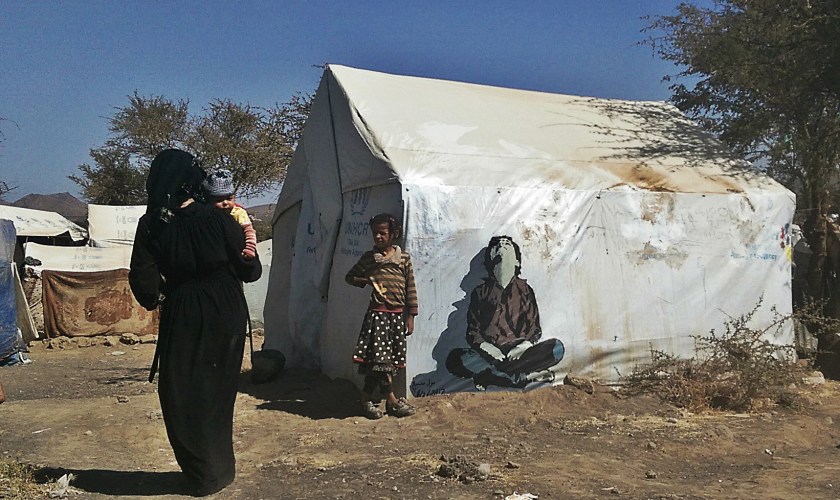
على الجهة اليسرى من الطريق الممتدة المتجهة لمحافظة “عمران”، تضطجع مئات من مخيمات النازحين الذين أجبرتهم الحرب على النزوح أو دمرت منازلهم.
عندما وصلنا أنا والأصدقاء إلى مخيم “ضروان”، استقبلنا النازحون هناك بلطف تام ومطلب هو الأهم، ألا وهو مدرسة لتعليم أطفالهم الذين منعوا من التعلم في المدارس الموجودة في المنطقة لعدم توفر مقاعد دراسية لهم، بحسب قولهم.
الأطفال وأهاليهم من النازحين يعانون الأمرين في مخيمات مُهمَلة لا توفر أبسط الخدمات مثل الحمامات. من المؤسف أنّ هذا ما يعاني منه جميع النازحين في جميع المخيمات التي صنعتها وما زالت تصنعها الحرب الدائرة في اليمن.
جداريتي، ضمن #حملة_حطام، عن النازحين، في مخيم ضروان للنازحين، 6 فبراير 2017.

من صفحة رسام الغرافيتي اليمني مراد سبيع – Murad Subay (عن فايسبوك)

رابط المقال>>

Continue reading “اليمن: “أطفال المقابر”/جريدة “السفير””

“Selling Misery” mural by: Rhman Qaid, in “Ruins campaign”. Feb.6,2017.


“المعاناة تُباع“

لأن المنظمات خذلت النازحين، وأصبحت تتاجر بمعاناتهم, قمت برسم هذه الجدارية، وأنا كلي أمل أن تصل الرسالة للمنظمات، وتقوم بمهامها وواجباتها الإنسانية تجاه المخيمات المنسية على أكمل وجه، لا أن يتم تحويل قضية النازحين إلى سلعة يتاجر بها.
جدارية الفنان: Rhman Qaid، ضمن #حملة_حطام، عن “النازحين”، في مخيم ضروان للنازحين، 6 فبراير 2017.

____________
“Selling Misery”

Because of the great suffering due to war and in addition, they have been let down by the inefficient work by organizations and government toward them, I painted this moral to send a message of their suffering to whome it might concerns.
Mural by: Rhman Qaid, about “Displaced people” in #Ruins_campaign, in Dharawan’s displaced camp, February 6, 2017.

 "Selling Misery"
“Selling Misery”

“Yemenis dream” mural by: Thiyazen Alalawi, in “Ruins Campaign”. Feb.6,2017.


“الحلم اليمني “
المنزل هو سقف الأسرة ,وسقف استقرار المجتمع والحرب في اليمن نتائجها عديدة منها أنها طردت الناس إلى العراء .
العودة إلى المنزل والعودة للسلام هو حلم كل يمني.

جدارية الفنان: ذي يزن العلوي، ضمن #حملة_حطام، عن “النازحين”، في مخيم ضروان للنازحين، 6 فبراير 2017.

_______________

“Yemenis dream”


The house is the cover of the family ,and the cover of the society’s stability.
Ejecting the people outdoors is one of many results of the war .
Regained the houses and the peace are dreams of all Yemenis.

Mural by: Thiyazen Alalawi, about “Displaced people” in #Ruins_campaign, in Dharawan’s displaced camp, February 6, 2017.

Yemenis Dream1
Yemenis Dream1

“Barbed camps” mural by: Rsheed Qaid, in Ruins Campaign. Feb.6,2017.


“مخيمات شائكة”

النازحين في المخيمات هم أكثر من يعاني من الحرب ,لأنهم تعرضوا للطرد من بيوتهم ومناطقهم, وهم ايضا يعانون داخل المخيمات المحصورة فهم غير قادرين علئ الخروج بسبب الحالة المادية السيئة كما أنه لاتتوفر لديهم ابسط الامكانيات الأولية للعيش بكرامة .

جدارية الفنان: Rsheed Qaid ، ضمن #حملة_حطام، عن “النازحين”، في مخيم ضروان للنازحين، 6 فبراير 2017.

_____________

“Barbed camps”

The displaced people are the most affected by war . They have been forced to leave their homes and areas .They are expose to persecution inside the camps due to the absence of the most basic necessities of life.
Mural by: Rsheed Qaid, about “Displaced people” in #Ruins_campaign, in Dharawan’s displaced camp, February 6, 2017.

Barbed Camps 1
Barbed Camps 1

“Children of Graves” my mural in “Ruins Campaign”, Feb.6,2017.


“أطفال المقابر”

على الجهة اليسرى على الطريق الممتده من الطريق المتجهة لمحافظة “عمران” تضطجع مئات من مخيمات النازحين الذين أجبترهم أو دمرت منازلهم الحرب.
عندما وصلنا أنا والأصدقاء إلى مخيم “ضروان”، إستقبلنا النازحين هناك بلطف تام ومطلب هو الأهم، ألا وهو مدرسة لتعليم أطفالهم الذين منعوا من تدريس اطفالهم في المدارس الموجوده في المنطقة لعدم توفر مقاعد دراسية لهم، بحسب قولهم.
الأطفال وأهاليهم النازحين يعانوا الأمرين في مخيمات مهملة ن توفر أبسط الخدمات مثل “الحمامات”. من المؤسف ان هذا ما يعاني منه جميع النازحين في جميع المخيمات التي صنعتها ومازالت تصنعها الحرب الدائرة في اليمن.
جداريتي، ضمن #حملة_حطام، عن “النازحين”، في مخيم ضروان للنازحين، 6 فبراير 2017.

_________________________________

“Children of Graves”


On the left side of the road leading to Amran governorate lays hundreds of “Displacement Camps”, in which people have been forced to leave their houses and lands and move to live in camps due to the war.
When I arrived with my friends to “Dharawan’s displacementl camp”, we were welcomed warmly by the residents of the camp. Afterwards, they had only one simple and basic request, and that is a school for their children to learn. They told me they couldn’t register the children in the schools in the surrounding areas because there isn’t any space for them.
The displaced people and their children lack access to the most basic services like “bathrooms” and clean water. It saddens me to see people living under these harsh conditions for an indefinite time. This is only a small taste of what the displaces endure today in the camps that were and are still being made by this war.
My mural about “Displaced people” in #Ruins_campaign, in Dharawan’s 
displacement camp,February 6, 2017.

16463771_10212134051173078_5256887587311060357_o.jpg
Children of Graves
Children of Graves1
Children of Graves1