“Children of Rubble” Cover photo of the German Magazine “IZ3W”


صورة جداريتي “أطفال الركام” والتي رسمتها ضمن مجموعة “وجوه الحرب”, غلاف لمجلة “اي زد ثري دبليو” الألمانية. والتي ستنشر غدا في ألمانيا.

My mural “Children of Rubble”, “Faces of War” street art collection, as a cover photo of the German Magazine “iz3w”. It will be available tomorrow in German.

Link>>

The Art of War: Using Art to Promote Peace in Yemen\ On “Inside Arabia”

The Art of War: Using Art to Promote Peace in Yemen

As combative as it is dangerous, painter Murad Subay weaponizes his art to quell tensions in the ever-escalating war in Yemen.

Photo courtesy: Murad Subay

As combative as it is dangerous, painter Murad Subay weaponizes his art to quell tensions in the ever-escalating war in Yemen.

In Yemen, the post-Arab Spring transition that started in 2012 has been accompanied by political failure and violence. Artists have taken to the streets of Yemen’s capital, Sanaa, and numerous other Yemeni provinces in an effort to disseminate messages of peace through outdoor exhibitions of their works.


Yemeni artist Murad Subay’s artwork combats attempts to undermine the freedom of the Yemeni people, eliminate their civilization, and threaten their political and human rights. Since 2012, Subay has launched numerous political art campaigns, including  “Color the Wall of Your Street,” a protest of the ongoing civil war. Subay recounted how he was inspired to paint bullet holes as an “indirect call for peace.” These vibrant bursts of color serve as messages of hope, life, and tolerance.

Similarly, Subay worked on the “The Walls Remember Their Faces” campaign, to remember the victims of enforced disappearance. The memorial, which was on display from September 8, 2012, to April 4, 2013, featured 102 photos of the victims, along with their names, the date of disappearance, and the last place that they were seen written in both Arabic and English.

Of his activism, Subay has said that participating in the 2011 revolution against Saleh encouraged him to become more politically aware and “to do something against political crime.”

In a recorded interview, Subay discussed twelve major political challenges facing Yemen: “sectarianism, employment, poverty, kidnapping, destruction, civil wars, terrorism, corruption, child recruitment, arms proliferation, and the American drones strikes in Yemen.” His “12-hour” campaign ran from July 4, 2013, to June 24, 2014, and featured 38 murals depicting these topics dispersed throughout Sanaa. Interestingly, the exhibition coincided with the National Dialogue Conference, from March 18, 2013, to January 24, 2014. While there was no comment from conference attendees, the Yemeni people have responded positively. Subay believes that the public’s response to the campaigns “is a sign of people’s longing for peace and life.”

On March 26, 2015, the first day of the Saudi-Emirati coalition’s military intervention in Yemen, the coalition targeted a residential neighborhood in Bani Hawat, destroying 14 houses, killing 25 civilians, including 6 children, and injuring 40 others, according to Amnesty International. This was the first attack targeting the capital Sanaa.

The site of this crime was the starting point for Subay’s third campaign, entitled “Ruins,” which began on May 18, 2015. The campaign focused on the areas destroyed by the warring parties by “drawing on walls of residential neighborhoods, houses, schools, tents of displaced people, living rooms, [and] drawing in cities and rural areas,” he explained.

Subay humanizes the victims of the war through his murals. In “Family,” he documented a war crime on the remnants of a bedroom wall at the site where a whole family was killed; the father and one of his children were the only survivors. On July 12, 2015, a coalition aircraft targeted a marginalized neighborhood in Sanaa, killing 23 civilians from one family, including women and 14 children under the age of 16, Human Rights Watch reported.

Subay offers “life testimonies in a country long ravaged by civil wars.” Although he has faced dangerous situations such as being arrested by the Houthis during his campaigns, he commented: “I was ignoring this in order to continue because reporting these violations may further strengthen the restrictions imposed by the conflicting parties, but what I hope for is the continuation of work and [art] campaigns.”

War has exacerbated the tragedy of Hodeidah, a city engulfed in the hardships of war, hunger, and disease. Here, Subay launched a campaign entitled “The Faces of War” on November 21, 2017. He said, “[T]he aim of this campaign is to draw the local and international communities’ attention  to this stricken city, where war has multiplied the suffering of its forgotten population.”

Subay has a strong belief that “the continuation of art and painting in Yemen is evidence of the people’s attachment to life, as well as an important outlet for freedoms, including freedom of opinion and expression.” He added, “The artworks carried out in Yemen during this stage included clear criticism of the political process of all parties and warnings from young people who are not affiliated with any party or political or ideological group.”

The  Umberto Veronesi Foundation awarded Subay the Art for Peace Award during the Sixth International Peace Conference in Milan on November 14, 2014.

Many artists, such as Thou Yazan Al Alawi, Saba Jallas, and Haifa Subay (Murad’s sister) have responded to Subay’s calls to action.

Haifa Subay worked on two separate campaigns. The first one on August 17, 2017, entitled “#Silent_Victims”, focused mainly on women and children as a strong representation of civilians. The second one, a call for peace, entitled “#Dove_Campaign,” began on August 9, 2018. Both campaigns are ongoing.

In the “Silent Victims” murals, Haifa wanted to share Yemen’s tragedies with the world. “I loved to show the world something that we miss and demand,” she said, referring to the suffering civilians as “silent victims of the war,” without means of expression, or political or religious power.

In her new campaign, “The Peace Dove,” Haifa endeavored to be simpler, clearer and more direct in her call for peace. “Participation in the campaign does not require drawing on the street, but using the hashtag, taking a picture with the drawing, and publishing it on social media.” It is also straightforward and easy to understand, taking into account the educational level of all social classes. The social media campaign is “not restricted by political orientation; its goal is purely humanitarian,” Haifa confirmed to Inside Arabia.

Haifa will launch another peaceful social media campaign as a continuation of The Peace Dove on September 20, 2018. It was originally supposed to be launched on the International Day of Peace on September 21, but that day “marks the Houthis’ entry to Sanaa and the crimes they committed there — that’s why it was moved ahead by one day,” said Haifa.

When Jallas, an artist living in Saudi Arabia at the time a coalition airstrike targeted Razzaq al-Sannani School, saw pictures of the aftermath, she found that they reminded her of the “scenes of Israeli shelling and destruction on the Gaza Strip.” She told Inside Arabia that the scenes of devastation that were broadcast throughout the country affected her so profoundly that she lost her zeal for life and felt frustrated and desperate for change.

Jallas started drawing as a form of therapy, and one of her most well-known works depicts a mother holding her child and wearing the Yemeni flag as a scarf. The mother is smiling to the world while the flag burns.

She worked on 40 images in the “Smoke” group over the span of three years. In 2017, she returned to Yemen and became involved with humanitarian work. Today, she sells her artwork and uses the proceeds to support the most impoverished populations in Yemen. “My goal is to restore hope and promote tolerance and love because [the poor]  were targeted by the war, and people are very desperate,” she said.

Continue reading “The Art of War: Using Art to Promote Peace in Yemen\ On “Inside Arabia””

Get to know Yemeni Street Artist Murad Subay\ Interview with “Doug Gillen” On FifthWallTV


Get to know Yemeni Street Artist Murad Subay


September 3, 2018
Fifth Wall create and enhance projects based around art, culture and social movements.

Murad Subay isn’t your average street artist. For the last seven years, he’s been changing the facade of war torn buildings in the heart of Yemen.

Today, regular air strikes attack markets, funerals and school buses, lack of access to clean drinking water has caused the world’s biggest outbreak of cholera and blocked access to vital food supplies have caused nationwide famine. Despite this, Murad Subay creates his artwork with a smile on his face and resillience in his demeanor.

In this week’s video, I’m in conversation with Murad discussing how art empowers communities, what it’s like making street art surrounded by armed militias and the what like is like in the heart of a revolution.

– Doug

Link>>

The politcs of street art in Yemen (2012-2017)\ An academic article by researcher: Anahi Alviso Marino

This abstract is taken from the research ..


“Abstract

In 2012, as a continuation of street politics developed in places like the antigovernment sit-in in Change Square in Yemen’s capital Sana’a, a small number of visual artists incorporated dissent, transgression, and civil disobedience into their artistic practices. Such is the case of Murad Subay, the painter who initiated the series of street art campaigns analyzed in this article. This case allows us to study the intersections of space, contentious politics, and artistic practices, interrogating how visual expressions located in the streets reflect a vivid political public sphere, understood as a site of critical debate and interaction. Furthermore, it introduces a series of dynamics that make of these campaigns something more than a site for production and circulation of discourses critical of the state. Street art campaigns in Yemen are thus explored sensitizing devices for political awareness. ”

PDF: CAP-the politics of street art in Yemen (2012-2017) 2 copie

Link: http://journals.sagepub.com/doi/abs/10.1177/2057047317718204

Les “visages de la guerre”, le projet qui dit “merde” à la guerre au Yémen

Les “visages de la guerre”, le projet qui dit “merde” à la guerre au Yémen

Crimes de guerre, disparitions forcées, épidémies : le Yémen vit depuis 5 ans dans le chaos. Un artiste-peintre de la capitale, Murad Subay, dénonce l’horreur du conflit en décorant les murs du pays avec des graffitis. Son projet s’appelle « les visages de la guerre ».

A Yemeni artist fights the war his way, by using colours\ On “The Arab Weekly”

A Yemeni artist fights the war his way, by using colours

Through murals and graffiti, Subay has dealt with many important issues facing Yemen, especially sectarianism.
Sunday 29/07/2018
Fighting with a brush. A Murad Subay mural in Yemen.        (Al Arab)
Fighting with a brush. A Murad Subay mural in Yemen. (Al Arab)

SANA’A – A few years ago, street artist Murad Subay emerged as one of the best in his field in Yemen. Subay uses graffiti to reflect on the tragedy in Yemen and, since the beginning of the war three years ago, the 31-year-old artist has organised street art campaigns to express to the world his country’s pain.

The various parties in the Yemeni conflict have tried to silence opposing voices in Yemen. Subay, however, could not quiet the artist inside him. He explained that he “uses graffiti to express the artist’s opinion about Yemeni affairs, especially during these tough times of war.”


“We try, through art, to depict our conditions during the war and at the same time give a concrete form to the role of art in the current conflict,” he said.

“If art cannot be present to speak for the people during war conditions, when should it appear then?”

“The symbolic significance of having art present during the current conditions, especially graffiti, lies in its being very close to people. They can actually touch it and they can see it on their way to work or to school and during their other errands,” he said.

Through murals and graffiti, Subay has dealt with many important issues facing Yemen, especially sectarianism. In May 2015, he began his fifth art campaign, which he called “Ruins.” People and other artists were invited to take part in the campaigns. Most of the street art campaigns started by Subay, either inside or outside Yemen, focused on peace for Yemen.

Subay has expanded his artistic activities and campaigns to other cities in Yemen. The artist and his friends are active in Sana’a, Aden, Taiz, Ma’rib, Ibb and Hodeidah. Artist friends of Subay’s in Seoul, Paris and Madagascar have taken part in the campaigns.

Subay said that, last November, he initiated a murals campaign in Hodeidah that he called “Faces of the War” because, as he put it, “the city was systematically being left neglected and its inhabitants left in hunger, poverty and disease.”

Subay completed other murals in Sana’a this year. They address the effects of war on people’s lives. Subay insisted that his main message through his art is that warfare is not just machine guns and explosives. It touches people in many other ways.

“I wanted to depict war in the way it affects people,” Subay explained. The horror of war is apparent in his murals through the subjects’ hollow eyes or bones showing through their skin or their emaciated faces.

Subay said he is deeply saddened whenever the subject of the effects of the war on his life and that of the Yemenis is brought up. “The war makes us lose our dreams, our hopes, our life and our soul as well,” he said.

Subay decried the absence of tolerance for the differences of opinion and lack of freedom of expression. “I practise my art in a context full of fear. Each party dominating a region in Yemen believes only in its voice,” Subay explained.

He said he plans to continue depicting people’s concerns and hopes through art campaigns across Yemen. He said he was happy to see that “young people have started to come out of their homes and paint about their concerns.”

“People have started using peaceful and artistic means to talk about their problems and this is great. It is a sign that the Yemenis are indeed people with deep civilisational roots,” Subay said.

Continue reading “A Yemeni artist fights the war his way, by using colours\ On “The Arab Weekly””

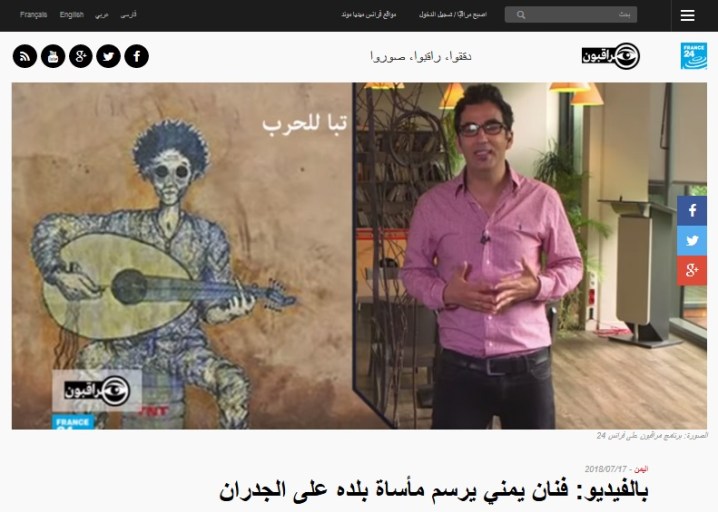
The murals denouncing the horrors of war in Yemen\ Video Report on “France 24”


“Faces of war” on The Obsdervers at “France 24”.

Video Link>>

بالفيديو: فنان يمني يرسم مأساة بلده على الجدران/على قناة “فرانسا 24”

بالفيديو: فنان يمني يرسم مأساة بلده على الجدران

قتلى وجرحى واختفاءات قسرية ومجاعة وأوبئة…الفنان التشكيلي اليمني مراد سبيع رسم جداريات في عدة مدن يمنية يروي من خلالها قصص معاناة اليمنيين في زمن الحرب. شاهدوا!

رابط الفيديوا..

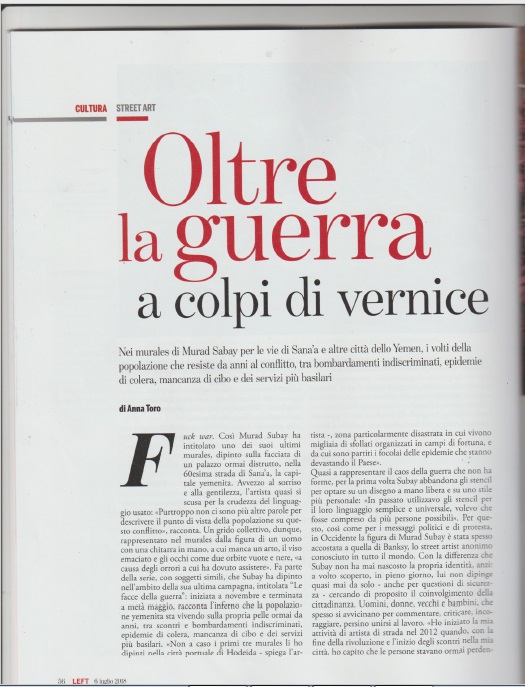
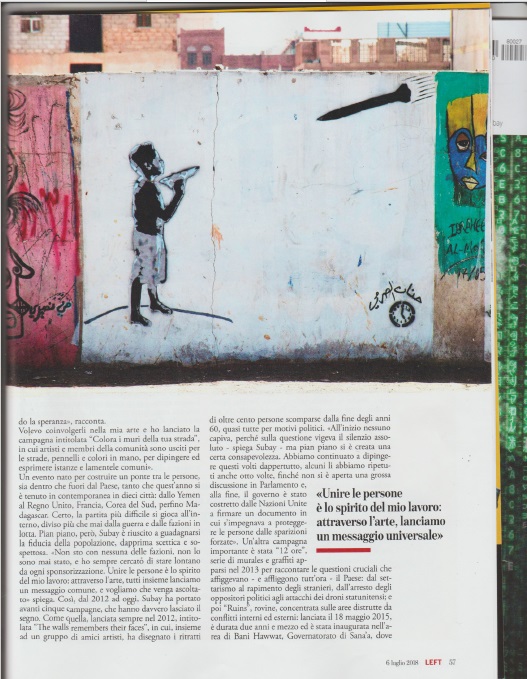
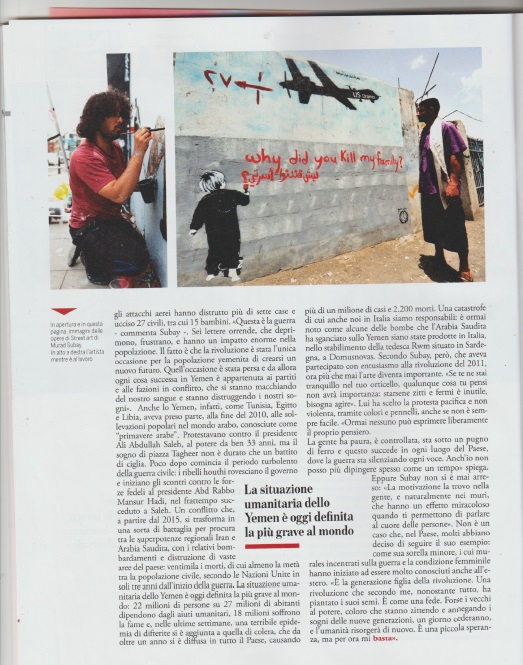
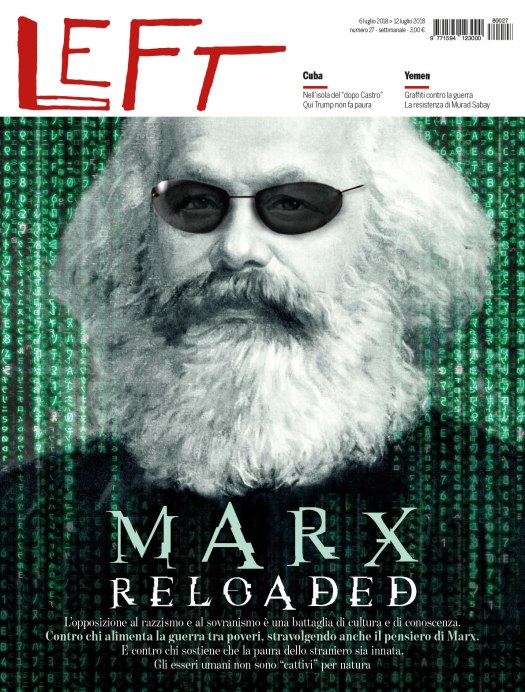
Oltre la guerra a colpi di vernice | By: Anna Toro, On “Left” Magazine

Oltre la guerra a colpi di vernice

By: Anna Toro, On “Left” Magazine

Article Link..


“Merde à la guerre” : un artiste yéménite rassemble les civils autour du graffiti\ On “FRANCE 24”


“Fuck war” (“merde à la guerre”), une des œuvres de Murad Subay qui a fait le plus réagir.

Un artiste yéménite peint depuis le début du conflit au Yémen les murs de la capitale Sanaa pour dénoncer les crimes de guerre, les disparitions forcées, la pauvreté et les épidémies. Surnommé le “Banksy arabe “par les médias occidentaux, il adopte un mode de travail singulier : le graffiti collaboratif, c’est-à-dire que les habitants d’un quartier réquisitionnent leurs murs pour s’y exprimer librement.

Murad Subay a 30 ans. Artiste-peintre, il vit à Sanaa dont il décore les murs de graffitis aux résonnances politiques depuis le début du conflit, en 2014, entre séparatistes houtistes et forces pro-gouvernementales. Engagé dans les révoltes anti-gouvernementales de 2011, il s’efforce depuis de dénoncer les horreurs de la guerre.

Il a récemment peint une œuvre intitulée “Fuck war “[merde à la guerre, en français], qui a eu beaucoup de succès sur les réseaux sociaux.

L’artiste peint régulièrement les immeubles et maisons en ruines, détruits par les bombardements de la coalition menée par l’Arabie saoudite, qui soutient les forces pro-gouvernementales.

Il s’attarde aussi sur les conséquences sanitaires du conflit pour la population.

Cette fresque dénonce l’épidémie de choléra qui touche le pays. Plus de 300 000 Yéménites auraient contracté cette maladie depuis juin 2017, selon l’OMS.

>> LIRE SUR LES OBSERVATEURS : Eau croupie, choléra et malnutrition : cocktail mortel pour les enfants yéménites

Cette autre fresque symbolise les “trois maux du Yémen” : la guerre, la faim et la maladie.

Cette œuvre dénonce l’utilisation d’équipements militaires américains par la coalition dirigée par l’Arabie saoudite, qui bombarde les régions tenues par les houthis, soutenus par l’Iran.

Continue reading ““Merde à la guerre” : un artiste yéménite rassemble les civils autour du graffiti\ On “FRANCE 24””